Preview
 Send
Send Share
Share
 Details
 Guide
Guide

 Download
 Similars
 X-Ray
X-Ray Diaporama
 Q&A
Q&A Stats
StatsEaster Monday


 Read More
The artwork displayed on this page is protected by copyright law, which means we cannot legally create or sell an identical reproduction. This protection is enforced under international agreements such as the Berne Convention and by national laws, including those outlined by the U.S. Copyright Law - Title 17.
This method fully complies with copyright regulations because it does not involve copying or duplicating the protected artwork. Instead, it is a creative reinterpretation - a new painting that is influenced by the original but not identical to it.
Giclée / Art Print
Museum-quality giclée or canvas print with fast production and flexible finish options. ( Buy Hand Made Painting Switch to Digital Image)




P118B $10

P118H $10

P118W $10

P438Z $10

P508JH $12

P508YH $12

P805H $10

P805Z $10

P919BZ $10

P919G $10

P919XJ $10

P959ZH $10

P968JZ $12

W106C $8

W218G $10

W218JH $8

W218Y $10

W307PJ $10

W316G $10

W316PJ $8

W316Y $10

W398PJ $8

W4111J $10

W500HY $15

W500JH $15

W692G $12

W849H $8

W940BG $15

W953PJ $8




Pick from our preset sizes that match the artwork's original proportions.

Type the width and the height you need, to fit your frame or your wall. A print can only be cut, never made bigger than the picture, so a size with a different shape loses a part of the image. We send you a digital mockup to approve before we print anything. The picture shown on this page does not show the real cut — only the mockup does.
Worldwide Delivery () in 2 weeks instead of standard 4/5 weeks. (10 November)

Free Worldwide Express Shipping

High-Quality Linen Canvas

Full Shipping Insurance

Customs Tax Refund Guarantee

True Color Matching Guarantee

100-Day Return Policy (Defects Only)

100% Money-Back Guarantee

Bulk Discount Offer
 Glass option is only available in size under 110 CM

Easter Monday
Giclée / Art Print
Reproduction Size
-


Total Price
$ 63
A Study in Contrast: De Kooning’s ‘Easter Monday’
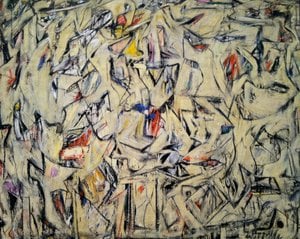
Willem de Kooning's 1956 painting, “Easter Monday,” is not merely a depiction of faces; it’s an intensely psychological exploration rendered with the artist’s signature blend of aggression and vulnerability. The work immediately confronts the viewer with two figures, dramatically differentiated in scale and presence. One face, boldly positioned and adorned with a white hat, dominates the canvas, its gaze direct and seemingly challenging. This figure embodies a forceful assertion, a deliberate engagement that draws us into the painting’s turbulent emotional landscape. The other face, partially obscured and wearing spectacles, offers a quieter, more contemplative response – a subtle acknowledgement of the dominant presence. This juxtaposition immediately establishes a dynamic tension, reflecting perhaps the complexities of human interaction and the struggle for self-expression.
De Kooning's Abstract Expressionist Technique
Executed in oil on canvas, “Easter Monday” exemplifies de Kooning’s mastery of Abstract Expressionism. His technique is characterized by broad, gestural brushstrokes – thick impasto applied with a raw energy that suggests both control and unrestrained emotion. The painting isn't about precise representation; instead, it utilizes fragmented forms and distorted perspectives to convey feeling rather than objective reality. Notice the layering of paint, particularly around the prominent face, creating a sense of depth and texture that adds to the work’s visceral impact. De Kooning’s use of color is equally significant – muted tones punctuated by flashes of white and darker shades contribute to the painting's overall mood of unease and intensity. The horse heads, seemingly placed almost arbitrarily, further disrupt any potential for serene observation, adding another layer of unsettling symbolism.
Symbolism and Context within De Kooning’s Oeuvre
Created during a pivotal period in de Kooning’s career, “Easter Monday” reflects his ongoing exploration of the human figure – often rendered with a deliberately confrontational style. The painting's title, ‘Easter Monday,’ while seemingly straightforward, adds another layer of complexity. Easter, traditionally associated with rebirth and renewal, is juxtaposed with the raw emotional intensity of the scene. This tension speaks to de Kooning’s broader concerns about identity, alienation, and the anxieties of modern life. His work during this period was heavily influenced by Surrealism, particularly its exploration of the subconscious and dreamlike imagery, though he rejected the movement's emphasis on automatic drawing.
A Legacy of Emotional Intensity
“Easter Monday” stands as a powerful example of de Kooning’s ability to translate personal turmoil into universally resonant art. Its enduring appeal lies in its unflinching portrayal of human vulnerability and conflict. The bicycle, a symbol of freedom and movement, adds an element of irony to the composition, suggesting perhaps a futile attempt to escape internal struggles. This painting is more than just a reproduction; it’s a window into the mind of one of America's most influential artists – a testament to his relentless pursuit of emotional truth through bold, expressive brushwork. A hand-painted reproduction offers an unparalleled opportunity to experience the full force of de Kooning’s vision.
Questions & Answers
What is the creation date of "Easter Monday" by Willem de Kooning?
"Easter Monday" by Willem de Kooning was created in 1956.
What is the art-historical place of "Easter Monday" by Willem de Kooning?
"Easter Monday" by Willem de Kooning belongs to the Abstract Expressionism movement, within the Modern period. Together they give the work its place in art history.
How strong is the contrast in "Easter Monday" by Willem de Kooning?
The light-dark contrast of "Easter Monday" is recorded as statement. Contrast describes how strongly light and dark areas differ.
Related Artworks


Artist Biography
The Life of Willem de Kooning
Rotterdam, 1904. The air in the Netherlands carries the weight of a family in transition. Willem de Kooning enters the world on April 24, born to Leendert de Kooning and Cornelia Nobel. His early years are defined by a familial split, a divorce that leaves a sense of restless searching in its wake. This internal displacement follows him across the Atlantic. In 1926, he arrives in America not as a traveler, but as a stowaway on a British freighter, landing at Newport News, Virginia. He is an outsider looking for a foothold in a new landscape.
The grit of New York City becomes his reality. He navigates the urban sprawl through manual labor, working as a house painter and a carpenter to sustain his vision. This period of survival is not a detour; it is the foundation. He absorbs the pulse of the city, moving from the physical toil of construction to the intense, gestural demands of the canvas. His existence becomes a continuous negotiation between the structured world of his training and the chaotic energy of the New York School.
He remains a central figure in the Abstract Expressionist movement, a presence that persists through decades of stylistic evolution. He moves from the depiction of urban scenes toward a more visceral, fragmented language of form. This trajectory continues until his death on March 19, 1997, at the age of 92. He leaves behind a body of work that reflects a lifelong struggle to articulate the human psyche through paint.
Early Life and Artistic Training
Rotterdam, 1916. The classroom is abandoned. At twelve years old, Willem de Kooning leaves formal schooling behind to enter the world of commercial art. He begins an apprenticeship with a firm of commercial artists, learning the technical mechanics of the trade. The focus is on precision and the practical application of pigment. It is a period of disciplined labor, building a foundation of craftsmanship that remains present even as his later work moves toward abstraction.
The evenings belong to the Academie van Beeldende Kunsten en Technische Wetenschappen. From his teenage years until 1924, he attends these classes in Rotterdam, balancing the demands of work with the study of formal art. He is honing his ability to see, to map form, and to understand the structure of the visual world. By the time he leaves the academy, he is no longer just an apprentice. He is a portrait painter, capturing the likenesses of his subjects with a growing sense of technical command. This period of focused training provides the essential tools for the radical shifts that await him across the Atlantic.
Arrival and Life in New York
The Atlantic crossing is a gamble of shadows. In 1926, de Kooning arrives in the United States not as a passenger, but as a stowaway on the British freighter Shelley. The ship docks at Newport News, Virginia, on August 15, 1926. From there, the momentum shifts toward the grit of New York City. The city provides a landscape of labor and survival. He navigates the urban environment by working as a house painter, a carpenter, and a commercial artist. These manual trades keep him tethered to the physical reality of the city while he pursues his vision.
By 1934, the struggle for recognition takes a more organized form. He joins the Artists Union, a move that places him within the collective energy of the New York art scene. The work is demanding. He moves between the precision of commercial art and the heavy, physical labor of his various jobs. This period is defined by a relentless, daily grind in the city that will eventually become his home. He is an outsider working from within the machinery of New York life.
Key Works and Major Series
The early years of the 1930s find him working through the tension between representation and the emerging abstract impulse. Around 1938, he produces Two Standing Men, a work that captures a sense of the figure before the total dismantling of form takes hold. This period of experimentation leads toward a radical shift in the early 1950s. Between 1950 and 1953, he produces the Woman series, a sequence of paintings that confront the viewer with fragmented, visceral depictions of the female form. These works do not seek to idealize; instead, they use aggressive brushwork to explore the complexities of human emotion and sexuality.
Within this intense period, Woman I emerges, created between 1950 and 1952. The canvas is a site of struggle, where the figure is caught in a web of thick impasto and jarring color. This focus on the human figure eventually gives way to a different kind of spatial tension. By 1955, he completes Interchange. This work marks a departure from the figurative intensity of the previous years, moving toward an expansive, abstract urban landscape. The transition is visible in the way he handles space and color, shifting from the carnal focus of the Woman series to the more architectonic, gestural compositions of the mid-century.
- Two Standing Men (about 1938)
- Woman I (1950–1952)
- Woman series (1950–1953)
- Interchange (1955)
Technique and Artistic Style
The canvas becomes an arena of physical struggle. De Kooning attacks the surface with aggressive brushwork, building up layers of thick impasto that create a heavy, tactile topography. He does not merely apply paint; he manipulates it, often employing a wet-on-wet technique aided by the addition of salad oil to the pigment. This method allows for a fluid, unpredictable interaction between colors, where edges blur and new textures emerge from the constant movement of the brush. His marks are rarely controlled or static. Instead, they are gestural, leaving behind calligraphic black images that slash through the composition with sudden, decisive energy.
He refuses the comfort of a single category. While many of his contemporaries move toward pure abstraction, de Kooning maintains a restless tension between the recognizable and the chaotic. He frequently merges abstraction and figuration, pulling elements of the human form into a fractured, non-linear space. A face might emerge from a tangle of strokes only to be dismantled by the next layer of paint. This refusal to settle on a definitive shape creates a sense of constant becoming. The work exists in a state of perpetual revision, where the act of painting is as much about the struggle to find a form as it is about the form itself.
- Woman I (1950–1952)
- Excavation (1950)
- Interchange (1955)
Influences and Artistic Circles
The shift from representation toward abstraction happens in the company of others. In New York, de Kooning finds a mentor in Arshile Gorky. The relationship is profound; Gorky is the master who pushes him toward experimentation and the dismantling of traditional forms. This connection provides the bridge between de Kooning's early urban landscapes and the visceral abstraction that defines his later years. He moves through a landscape of ideas, absorbing the influence of Stuart Davis and John Graham, whose presence helps steer his vocabulary away from literal depiction.
The visual language he develops is a collision of disparate forces. He draws from the structural lessons of Cubism and the psychological depth of Surrealism. The influence of Picasso is felt in his approach to form, while the work of Franz Kline introduces a new dimension to his practice. From Kline, he adopts a more calligraphic approach, utilizing black and white enamel compositions and gestural marks that replace violent brushstrokes. This evolution marks a departure from his earlier, more heavy-handed methods.
He becomes a central figure within the New York School. This group of artists, including figures like Jackson Pollock and Lee Krasner, redefines the creative epicenter of the art world. They reject the sterile formalism of previous movements, opting instead for a space where the canvas becomes an arena for spontaneous, emotional truth. Within this circle, de Kooning’s work oscillates between the figurative and the abstract, never fully settling into one or the other.
Marriage and Personal Life
The year 1943 marks a shift in the domestic landscape of his life when he marries Elaine Fried. Their union is a complex entanglement of mutual artistic support and personal struggle. They share studio spaces, navigating the high-pressure environment of the New York art scene together. The marriage is characterized by an open relationship and a shared commitment to their respective careers, yet it is also shadowed by the heavy presence of alcoholism. This tension defines their years together, a period of intense creative output and private instability.
In 1956, the family structure expands with the birth of his daughter, Lisa de Kooning. However, the internal fractures in the marriage deepen. By 1957, the couple is separated. The distance between them persists for nearly two decades, a long hiatus in their shared history. The separation remains a constant, even as their professional lives continue to intersect within the same artistic circles. The rift eventually closes in 1976 when he and Elaine reunite.
Legacy and Global Impact
The shift in the center of the art world moves from the traditional salons of Paris to the experimental frontiers of America. De Kooning is at the heart of this transition. As a central figure in the Abstract Expressionist movement, he helps establish New York City as a global center for art. His presence in the New York School helps redefine the visual language of the mid-20th century, moving away from the sterile formalism of previous decades toward a more visceral, gestural approach to the canvas.
His influence reaches far beyond the immediate post-war era. He is considered one of the most important American artists of the 20th century, a status cemented by his ability to bridge the gap between abstraction and figuration. His work continues to provoke debate and inspire awe through its refusal to conform to established norms. The tension between chaos and order remains present in his canvases, challenging viewers to confront the raw, untamed essence of his subjects.
- Woman I (1950–1952)
- Interchange (1955)
- Excavation (1950)
- Untitled XII (1983)

Willem de Kooning
1904 - 1997 , Netherlands
Quick Facts
- Artistic Movement Or Style: Abstract Expressionism
- Artists Or Movements Influenced By This Artist: ['New York School']
- Artists Who Influenced This Artist:
- Arshile Gorky
- Stuart Davis
- John Graham
- Picasso
- Franz Kline
- Full Name: Willem de Kooning
- Nationality: Dutch-American
- Notable Artworks:
- Woman I
- Excavation
- Interchange
- The Glazier
- Place Of Birth: Rotterdam, Netherlands
- Date Of Birth: 1904
- Date Of Death: 1997
Related Articles

Abstract Expressionism's 10 Defining Masterpieces |
Explore 10 defining Abstract Expressionism masterpieces by Pollock, Rothko & de Kooning. Discover the stories behind these iconic paintings and find museum-quality art reproductions to elevate your home decor on .

Willem de Kooning: Abstraction, Gesture & the Evolution of Post-War American Painting
Explore the evolution of Willem de Kooning's iconic Abstract Expressionist paintings. Discover his signature style, key themes & investment potential with expert insights for discerning art collectors.

Mastering Abstraction: The 25 Most Iconic Works by Wassily Kandinsky
Explore 25 iconic Kandinsky masterpieces and the birth of abstraction. Discover the full collection online at ArtsDot.com.

Mastering Shadows: The 25 Most Powerful Artworks by Francisco Goya
Explore Goya's haunting masterpieces from courtly portraits to Black Paintings. Discover the full collection on ArtsDot.com.

Beyond Representation: Exploring the Emotional Landscape of Abstract Expressionism
Explore the profound emotional world of Abstract Expressionism with ArtsDot. Discover key artists like Pollock & Rothko, learn about collecting, and find museum-quality reproductions to inspire your space.