Preview
 Send
Send Share
Share
 Details
 Guide
Guide

 Download
 Similars
 X-Ray
X-Ray Diaporama
 Stats
StatsSleep


 Read More
Hand Made Oil Reproduction
Hand-painted oil on canvas in your size and frame, made to order by our artists. ( Switch to Print Switch to Digital Image)




P118B $10

P118H $10

P118W $10

P438Z $10

P508JH $12

P508YH $12

P805H $10

P805Z $10

P919BZ $10

P919G $10

P919XJ $10

P959ZH $10

P968JZ $12

W106C $8

W218G $10

W218JH $8

W218Y $10

W307PJ $10

W316G $10

W316PJ $8

W316Y $10

W398PJ $8

W4111J $10

W500HY $15

W500JH $15

W692G $12

W849H $8

W940BG $15

W953PJ $8




Pick from our preset sizes that match the artwork's original proportions.

You may enter your own dimensions to fit a specific frame or space. If your selected size does not match the original image's proportions, we will either crop the artwork or extend the painting with additional hand-painted elements. A digital mockup will be sent for your approval before production begins.
Please note that the on-screen preview does not reflect the actual cropping or extension. Only the mockup will accurately show the final composition.
While custom sizes are available, we recommend selecting a dimension from the predefined list to preserve the original proportions.
After order, ArtsDot.com team will email client for instructions and provide a mockup preview
Worldwide Delivery () in 3/4 weeks instead of standard 5 weeks. (13 October). No compromise on quality.

Free Worldwide Express Shipping

High-Quality Linen Canvas

Full Shipping Insurance

Customs Tax Refund Guarantee

True Color Matching Guarantee

100-Day Return Policy (Defects Only)

100% Money-Back Guarantee

Bulk Discount Offer
 Glass option is only available in size under 110 CM

Sleep
Reproduction Medium
Reproduction Size
-


Total Price
$ 313
The Weight of Tradition: An Encounter with Walter Ufer’s “Sleep”
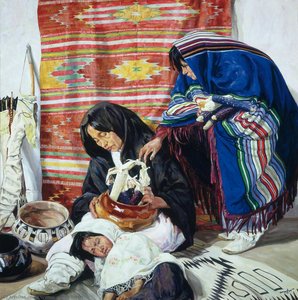
Walter Ufer's "Sleep," painted in 1923, isn’t merely a depiction of three Native American women; it’s an immersion into a world steeped in ritual and profound reverence. The painting immediately draws the viewer in with its rich tapestry of color – predominantly warm reds, oranges, and browns that evoke the earth itself, grounded by cooler blues and greens woven through the textiles and pottery. This palette isn't simply decorative; it speaks to the cultural heritage of the subjects, hinting at a deep connection to the land and ancestral traditions. The composition is carefully orchestrated, centering on the kneeling woman as a focal point, yet subtly inviting us into the periphery of the scene, suggesting an active participation in this sacred space.
Ufer’s masterful technique reveals layers of painstaking detail. He employs a layered oil painting approach, building up texture with deliberate brushstrokes that create a palpable sense of roughness on the clothing – perhaps representing the wear and tear of daily life intertwined with ceremonial garb – while simultaneously rendering the pottery with smooth, almost polished surfaces. This juxtaposition speaks to the duality inherent in Native American culture: the balance between practicality and spirituality, the tangible and the intangible. The lighting, soft and diffused, isn’t dramatic; it's deliberately muted, casting subtle shadows that lend a sense of solemnity and depth to the figures and objects, as if illuminating a secret whispered within a sacred space.
A Window into Taos: Contextualizing Ufer’s Vision
To fully appreciate “Sleep,” it's crucial to understand its historical context. Painted in 1923, during his time in Taos Pueblo, New Mexico, the artwork represents a pivotal moment in Walter Ufer’s career and his deep engagement with Native American culture. He was part of the "Taos Ten," a group of artists who sought to document and celebrate the lives and traditions of the region's indigenous communities. This wasn’t simply an act of observation; it was a deliberate attempt at understanding and portraying these cultures with respect and authenticity, a rare undertaking for American art at the time.
Ufer’s background as a German-born artist profoundly shaped his approach. His training in Europe instilled a meticulous attention to detail and a sophisticated understanding of composition – elements he skillfully translated into his depictions of Native American life. However, it was his immersion within the Taos community that truly informed his work, allowing him to capture not just appearances but also the spirit and essence of these traditions. The painting’s realism is tempered by an underlying sense of mystery, inviting viewers to contemplate the deeper meanings embedded within the scene.
Symbolism Woven into the Fabric
The details within “Sleep” are laden with symbolic significance. The intricately patterned rug serves as a visual anchor, framing the central figures and providing a rich backdrop that speaks to the importance of storytelling and communal life within Native American culture. The pottery, often adorned with geometric designs and natural motifs, represents both artistic skill and spiritual connection – a tangible link to ancestors and the earth. The women themselves, engaged in what appears to be a ritualistic activity, are not simply subjects; they embody generations of tradition, wisdom, and connection to the divine.
The act depicted—kneeling in reverence—suggests healing or a profound spiritual ceremony. The quiet dignity of the figures, coupled with the muted colors and soft lighting, evokes a sense of solemnity and timelessness. It’s an image that transcends mere representation, offering a glimpse into a world governed by ancient beliefs and deeply rooted traditions.
A Legacy of Authenticity: Reproductions and Beyond
Walter Ufer's "Sleep" remains a powerful testament to the beauty and complexity of Native American culture. ArtsDot offers high-quality, hand-painted reproductions that faithfully capture the painting’s rich detail and evocative atmosphere. These reproductions are more than just images; they are windows into another world—a world of sacred rituals, profound traditions, and enduring wisdom. Investing in a reproduction is an investment in preserving this important piece of American art history and honoring the legacy of Walter Ufer's insightful portrayal.
Questions & Answers
Where can I find a guide to "Sleep"?
The guide to "Sleep" is the artwork's Guide page - a printable factsheet showing the artwork with its caption, credit line and identity table (artist, dates, medium, original size, collection).
What color harmony does "Sleep" by Walter Ufer display?
The color harmony of "Sleep" is recorded as discordant palette.
Did "Sleep" stay in its artist's homeland?
No - the artwork is kept abroad. Walter Ufer was born in Germany, and the original "Sleep" is held in a museum in Соединенные Штаты.
Where can I find statistics about "Sleep" by Walter Ufer?
Statistics about "Sleep" by Walter Ufer are on the artwork's Stats page: monthly visits of the artwork, visits of the artist's works, and country and language breakdowns of recent visitors.
Which museum holds the original "Sleep"?
The original "Sleep" by Walter Ufer is held at the National Cowboy - Western Heritage Museum, Оклахома-Сити, Соединенные Штаты. A reproduction allows the work to be displayed at home.
Where does "Sleep" stand among Walter Ufer's recurring subjects?
Among Walter Ufer's recorded themes - taos ten influence, native american realism, spiritual ceremony focus, cultural preservation theme, westward expansion reflection, ufer's ethnographic interest, documenting indigenous life, key work in artist corpus - "Sleep" brings its own focus on native american culture, ritual ceremony, indigenous art, textile patterns, cultural heritage, portraiture, depth of field, warm color palette.
How do I discover artworks close to "Sleep" by Walter Ufer?
The Similars page of "Sleep" by Walter Ufer presents related artworks.
What mood would "Sleep" bring to a space?
The calm atmosphere of "Sleep" by Walter Ufer matches its recommended space: a living room.
Related Artworks


Artist Biography
The Soul of the Southwest: The Life and Legacy of Walter Ufer
Walter Ufer stands as a pivotal figure in American Impressionism, a painter whose brushstrokes did more than merely capture light; they captured the very heartbeat of a culture. Born in 1876 in Hückeswagen, Germany, Ufer’s journey to the high deserts of New Mexico was paved with rigorous European training and a deep-seated curiosity about the human condition. His early years were shaped by the German-American diaspora in Louisville, Kentucky, where he first began to absorb the rich textures of his heritage. This foundational period, marked by studies in lithography and printmaking, gifted him with a technical precision that would later allow him to navigate the complexities of light and shadow with unparalleled mastery.
His pursuit of artistic excellence led him on a transformative odyssey across Europe. As a traveling journeyman, Ufer immersed himself in the diverse artistic traditions of the continent, refining his technique at the prestigious academies of Hamburg and Dresden. This period of intense intellectual and creative expansion culminated in his time in Munich, where he dedicated himself to an intensive studio practice. When he finally returned to the United and States in 1911, he carried with him a sophisticated European sensibility that was poised for a profound encounter with the rugged, sun-drenched landscapes of the American West.
A Visionary of the Taos Ten
The year 1914 marked a definitive turning point in Ufer’s life and the trajectory of American art. Upon venturing into Taos Pueblo, New Mexico, he found himself part of an extraordinary artistic revolution. Joining the influential group known as the "Taos Ten," Ufer became a central figure in a collective that sought to move beyond mere landscape painting toward a more authentic, visceral portrayal of Native American life. Unlike many of his contemporaries who viewed the Southwest through a romanticized or colonial lens, Ufer approached his subjects with a profound respect and an eye for the dignity of daily existence.
His work became a bridge between European Impressionist techniques and the raw, spiritual energy of the Pueblo people. He was not merely an observer but a chronicler of rituals, landscapes, and the quiet rhythms of community life. Central to this creative evolution was his relationship with Jim Mirabal, a Taos Indian who served as both Ufer’s muse and collaborator. Through this connection, Ufer gained an intimate understanding of the cultural nuances that define the region, allowing him to infuse his canvases with a sense of lived truth that resonated far beyond the borders of New Mexico.
Technique, Symbolism, and Historical Significance
Ufer’s oeuvre is characterized by a masterful command of color and a bold, expressive application of paint. His style, while rooted in the principles of American Impressionism, often leaned toward a more robust and textured approach that captured the heat of the desert sun and the weight of the earth. He utilized light not just to illuminate form, but to evoke emotion—creating scenes where the atmosphere feels heavy with history and tradition.
The historical significance of Walter Ufer lies in his ability to elevate genre painting into a profound social and cultural statement. His achievements include:
- Authentic Representation: Breaking away from the "picturesque" stereotypes of Native American life to present a more nuanced and humanized portrait of the Taos people.
- Artistic Synthesis: Successfully merging the formal academic training of Germany with the vibrant, unbridled spirit of the American Southwest.
- Legacy of the Taos Ten: Playing a crucial role in establishing Taos as a premier destination for American modernism and a vital center for indigenous-focused art.
Today, Ufer’s paintings remain enduring testaments to a period of intense cultural intersection. His ability to weave together the technical rigor of his European education with the spiritual depth of the Pueblo culture ensures that his work continues to captivate, inviting modern viewers to witness the timeless spirit of the Taos Valley through his evocative and masterful eyes.

Walter Ufer
1876 - 1936 , Germany
Quick Facts
- Full Name: Walter Ufer
- Nationality: German-American
- Date Of Birth: 1876
- Date Of Death: 1936
- Place Of Birth: Hückeswagen, Germany
- Notable Artworks:
- Her Daughter
- Builders Of The Desert
- After Them
- Artistic Movement Or Style: Taos Impressionism
Related Articles

The Enduring Legacy of Oil on Canvas: Technique, History & Aesthetic Impact
Explore the rich history & techniques of oil painting – from Renaissance masters to Impressionism. Discover pigments, layering methods, and why this timeless medium endures. Expert insights for artists & art enthusiasts.

Grant Wood & American Regionalism: Identity, Myth & the Rural Landscape
Explore the world of Grant Wood & American Regionalism with ArtsDot. Discover the symbolism behind 'American Gothic', recurring themes, and the movement's lasting impact on art history. High-quality reproductions available.

American Realism's Defining Works: 10 Masterpieces for Your Home
Explore 10 defining American Realism masterpieces – Hopper, Homer & more. Discover the stories behind these iconic paintings and bring timeless art to your home with ArtsDot's museum-quality reproductions. Explore the full collection online.

Alfred Jacob Miller: Chronicling the American West Through Artistic Observation & Narrative
Explore the captivating art of Alfred Jacob Miller, chronicler of the American West. Discover his iconic paintings, techniques & lasting legacy – a valuable addition to any serious collection. Learn more at ArtsDot.
Joseph Henry Sharp: Capturing the Spirit of the Plains – Life, Art & Legacy
Explore the life & art of Joseph Henry Sharp, a founding member of the Taos Society of Artists renowned for his realistic depictions of Native American culture and Western landscapes. Discover his legacy with ArtsDot.