Preview
 Send
Send Share
Share
 Details

 Download
 Similars
 X-Ray
X-Ray Diaporama
Strand

 Read More
Hand Made Oil Reproduction
Hand-painted oil on canvas in your size and frame, made to order by our artists. ( Switch to Print Switch to Image)




































Pick from our preset sizes that match the artwork's original proportions.

You may enter your own dimensions to fit a specific frame or space. If your selected size does not match the original image's proportions, we will either crop the artwork or extend the painting with additional hand-painted elements. A digital mockup will be sent for your approval before production begins.
Please note that the on-screen preview does not reflect the actual cropping or extension. Only the mockup will accurately show the final composition.
While custom sizes are available, we recommend selecting a dimension from the predefined list to preserve the original proportions.
After order, ArtsDot.com team will email client for instructions and provide a mockup preview
Worldwide Delivery () in 3/4 weeks instead of standard 5 weeks. (7 August). No compromise on quality.

Free Worldwide Express Shipping

High-Quality Linen Canvas

Full Shipping Insurance

Customs Tax Refund Guarantee

True Color Matching Guarantee

60-Day Return Policy (Defects Only)

100% Money-Back Guarantee

Bulk Discount Offer
 Glass option is only available in size under 110 CM

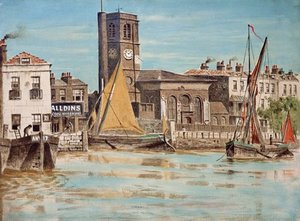
Strand
Reproduction Medium
Reproduction Size
-


Total Price
$ 313
Related Artworks


Artist Biography
The Thames Painter's Quiet Brilliance
To understand the soul of Walter Greaves, one must first understand the rhythmic pulse of the River Thames during the nineteenth century. Born in 1846 into the industrious heart of London, Greaves was not merely an observer of the water; he was a product of it. As the son of Charles William Greaves, a Chelsea boat builder and Waterman, his childhood was steeped in the sights, sounds, and textures of the bustling docks. This early immersion provided him with a unique, visceral connection to the river’s character—a perspective that would later transform his canvases into living chronicles of London's maritime life. His formative years were spent amidst the timber and tar of his father's craft, an upbringing that instilled in him a profound respect for meticulous craftsmanship and a keen eye for the subtle shifts in light and atmosphere that define the riverfront.
The trajectory of Greaves’s artistry was profoundly shaped by chance encounters with the giants of British art. In his youth, he gained practical experience as a shipwright and boatman, a role that brought him into the orbit of the legendary J.M.W. Turner. While not a formal apprentice, the experience of ferrying passengers—and witnessing Turner’s own rapid, atmospheric sketches from the water—left an indelible mark on his visual language. From Turner, Greaves inherited a fascination with the ephemeral qualities of light and weather, learning how to capture the fleeting essence of a mist-covered morning or a sun-drenched afternoon on the Thames. This foundation of atmospheric observation would become the bedrock of his later, more structured realism.
A Partnership of Light and Line
As Greaves matured, his artistic circle expanded to include one of the most influential figures of the era: James McNeill Whistler. Their encounter in 1863 ignited a lifelong friendship and a transformative artistic partnership. Where Turner provided the atmospheric inspiration, Whistler offered a new way of seeing through the lens of Aestheticism. Under Whistler’s mentorship, Greaves began to experiment with more daring color palettes and innovative compositional structures. This period saw Greaves moving beyond mere topographical documentation toward a more nuanced exploration of urban mood and tonal harmony. Together, they wandered the Thames landscape, capturing the changing tides of both the river and the city itself.
The brilliance of Greaves’s talent was perhaps most startlingly evident in his early achievements. At the tender age of sixteen, he produced “Hammersmith Bridge on Boat-Race Day,” a work that remains a cornerstone of British art history. This piece, often celebrated for its naïve charm, reveals a prodigious ability to render human energy and architectural scale with remarkable accuracy. It serves as a testament to a young artist capable of capturing the sheer excitement of London’s social spectacles through a lens of profound observation. Through his work, the river was never just a setting; it was a protagonist, subject to the same dramatic shifts in emotion and light as the people who lived along its banks.
Legacy of the Victorian Realist
Throughout a career spanning over five decades, Greaves maintained a steadfast dedication to the social landscape of his beloved London. His oeuvre is characterized by a beautiful tension between meticulous detail and impressionistic atmosphere. Whether he was depicting the gritty reality of “Unloading The Barge, Lindsey Wharf” or the hazy, dreamlike qualities of “Lindsay Wharf, Chelsea,” his work consistently sought to honor the dignity of labor and the quiet beauty of the industrial Thames. His ability to blend the realism of a topographical draftsman with the evocative textures of an etcher allowed him to document a vanishing era of London life.
The historical significance of Walter Greaves lies in his role as a vital chronicler of the Victorian social landscape. While names like Whistler and Turner often dominate the historical narrative, Greaves provided the essential connective tissue between the grand romanticism of the past and the burgeoning realism of the modern age. His paintings remain evocative windows into a world of coal offices, bustling wharves, and the enduring spirit of the river. Today, his work stands as a tribute to the power of observation and the enduring allure of the Thames, reminding us that true artistic brilliance often resides in the quiet, faithful recording of the world around us.

Walter Greaves
1846 - 1930 , United Kingdom
Quick Facts
- Artistic Movement Or Style: Naive Art
- Artists Or Movements Influenced By This Artist: ['Whistler']
- Artists Who Influenced This Artist: ['James McNeill Whistler']
- Date Of Birth: July 4, 1846
- Date Of Death: November 28, 1930
- Full Name: Walter Greaves
- Nationality: British
- Notable Artworks:
- Hammersmith Bridge on Boat-Race Day
- Lindsay Wharf, Chelsea
- Unloading The Barge
- Place Of Birth: London, United Kingdom
Related Articles

Impressionistic Realism: Bridging Perception & Representation in 19th-Century Painting
Explore the fascinating intersection of Impressionistic Realism! Discover how 19th-century artists balanced subjective perception with objective representation, revolutionizing art history. Learn about key techniques & masters.

Walter Greaves: A Study in Victorian Realism & the Social Landscape of British Art
Explore the life & work of Walter Greaves, a key Victorian realist painter influenced by Whistler. Discover his London streetscapes, portraits, and enduring legacy. Learn about art appraisal & reproduction options at ArtsDot.

John Frederick Lewis: Orientalism, Detail & Genre Painting in 19th-Century British Art
Explore the captivating Orientalist paintings of John Frederick Lewis! Discover his mastery of detail, genre scenes & influence on 19th-century British art. Learn about his life, techniques & legacy at ArtsDot.

Iconic Art of the 18th & 19th Centuries: Masterpieces for Your Home | ArtsDot
Journey through 18th & 19th century art! Explore iconic masterpieces by Monet, Van Gogh & more. Discover the stories behind these timeless paintings and find museum-quality reproductions for your home at ArtsDot.com.

Echoes of Change: Exploring Themes & Innovations in 19th-Century Art
Explore the revolutionary art of the 19th century! Discover Impressionism, Realism & beyond with expert insights into key artists, techniques, and lasting influence. ArtsDot offers museum-quality reproductions.