
- Home

- Oil Painting Reproduction
- Vasily Grigoryevich Perov
- Self-portrait

 Buy print
 Send
Send Share
Share
 Details

 Download
 Similars
 X-Ray
X-Ray Diaporama
Self-portrait
 Oil On Canvas
- WallArt
- Realism
 1870
1870- 19th Century
 63.0 x 52.0 cm
Hand Made Oil Reproduction
Hand-painted oil on canvas in your size and frame, made to order by our artists.




P118B S$10

P118H S$10

P118W S$10

P438Z S$10

P508JH S$12

P508YH S$12

P805H S$10

P805Z S$10

P919BZ S$10

P919G S$10

P919XJ S$10

P959ZH S$10

P968JZ S$12

W106C S$8

W218G S$10

W218JH S$8

W218Y S$10

W307PJ S$10

W316G S$10

W316PJ S$8

W316Y S$10

W398PJ S$8

W4111J S$10

W500HY S$15

W500JH S$15

W692G S$12

W849H S$8

W940BG S$15

W953PJ S$8




 Read more
Pick from our preset sizes that match the artwork's original proportions.

You may enter your own dimensions to fit a specific frame or space. If your selected size does not match the original image's proportions, we will either crop the artwork or extend the painting with additional hand-painted elements. A digital mockup will be sent for your approval before production begins.
Please note that the on-screen preview does not reflect the actual cropping or extension. Only the mockup will accurately show the final composition.
While custom sizes are available, we recommend selecting a dimension from the predefined list to preserve the original proportions.
After order, ArtsDot.com team will email client for instructions and provide a mockup preview
Worldwide Delivery () in 3/4 weeks instead of standard 5 weeks. (30 June). No compromise on quality.

Free Worldwide Express Shipping

High-Quality Linen Canvas

Full Shipping Insurance

Customs Tax Refund Guarantee

True Color Matching Guarantee

60-Day Return Policy (Defects Only)

100% Money-Back Guarantee

Bulk Discount Offer
 Glass option is only available in size under 110 CM

Self-portrait
Reproduction Medium
Reproduction Size
-


Total Price
-
Artwork Description
Self-Portrait by Vasily Grigoryevich Perov: A Glimpse into the Soul of a Realist
The Self-portrait by Vasily Grigoryevich Perov, created in 1870, is a captivating example of Realism that continues to fascinate art enthusiasts worldwide. This oil on canvas painting measures 63 x 52 cm and stands as a testament to the artist's skill in capturing an accurate depiction of visual reality while simultaneously revealing profound psychological depth.
Artistic Context and Style: The Rise of Russian Realism
Perov was a key figure in the Russian Realist movement, which emerged in the mid-19th century as a reaction against Romantic idealism. Realism sought to depict life as it truly was, focusing on everyday subjects and social issues with unflinching honesty. Perov’s work had a significant impact on the development of art in Russia, influencing subsequent generations of artists who embraced this commitment to portraying reality without embellishment. The Self-portrait showcases Perov's ability to blend elements of realism with a deep understanding of human emotion. The painting is characterized by its use of earthy tones, subtle lighting, and an emphasis on texture, which creates a sense of depth and dimensionality. This meticulous attention to detail was central to the Realist aesthetic.
A Detailed Examination: Technique and Composition
The Self-portrait demonstrates Perov’s mastery of oil painting techniques. The artist employs subtle gradations of color and light to model the face and clothing, creating a sense of volume and realism. Noticeable brushstrokes add texture and vitality to the surface, preventing the image from appearing overly smooth or artificial. The composition is carefully considered; the subject's face is centrally positioned within an oval frame, drawing the viewer’s eye directly to his gaze. The dark background serves to isolate Perov, intensifying the focus on his expression and conveying a sense of introspection. The lighting appears soft and diffused, highlighting the textures of the man’s clothing and facial features.
Symbolism and Emotional Impact: A Portrait of Introspection
Beyond its technical brilliance, the Self-portrait resonates with viewers due to its emotional depth. Perov's expression is serious, perhaps even melancholic, inviting speculation about his inner thoughts and feelings. The long beard and hair, rendered with meticulous detail, suggest a man of intellect and experience. The overall somber mood, created by the muted color palette and dark background, contributes to an atmosphere of formality and introspection. While Perov was known for depicting scenes of social hardship in his other works (such as The Queue at The Fountain and A Meal in the Monastery), this self-portrait offers a more personal glimpse into the artist's own psyche.
Perov and His Contemporaries: A Legacy of Realism
Vasily Grigoryevich Perov (1834 – 1882) was born in Tobolsk, Russia. His early life was marked by complexity due to his illegitimacy, a circumstance that likely informed his later social commentary through art. He received training at the Alexander Stupin Art School and the Moscow School of Painting. Perov’s contributions to the art world are not limited to his Self-portrait. Other artists who explored the Realist style include Jean Baptiste Camille Corot and Albert Edelfelt. For example, Corot’s A Ford with Large Trees and Edelfelt's Conveying a Child showcase the versatility and range of Realism.
Related Artworks


Artist Biography
A Life Etched in Realism: Vasily Perov and the Soul of Russia
Vasily Grigoryevich Perov, born Vasily Vasiliev in 1834 in the remote Siberian town of Tobolsk, emerged as a pivotal figure in Russian art, a painter whose work became synonymous with critical realism. His life story is itself imbued with the social complexities he would later portray on canvas. Born out of wedlock to Baron Grigory Kridener and Akulina Ivanova, Perov’s early years were marked by an unconventional upbringing that instilled within him a keen sensitivity to societal inequalities. The adoption of the surname “Perov,” derived from the Russian word for ‘feather,’ a nod to his early skill in calligraphy, foreshadowed his dedication to meticulously detailing the world around him—a world often overlooked or deliberately obscured. His formal artistic journey began at the Alexander Stupin Art School in Arzamas, where he honed fundamental skills before progressing to the Moscow School of Painting, Sculpture and Architecture in 1853. This period was crucial in shaping his technical abilities and exposing him to a broader range of artistic influences. Early recognition came with silver and gold medals awarded by the Imperial Academy of Arts for works like “Commissary of Rural Police Investigating” and, most notably, "Sermon in a Village" in 1861—a painting that would propel him into the national spotlight and earn him the opportunity to study abroad.The Voice of the Voiceless: Themes and Techniques
Perov’s artistic vision was deeply rooted in a commitment to portraying Russian society with unflinching honesty. He rejected the idealized depictions favored by many of his contemporaries, instead choosing to focus on the lives of ordinary people—peasants, laborers, the marginalized, and the forgotten. His paintings are not merely representations of reality; they are powerful social commentaries that expose the hardships, injustices, and spiritual emptiness prevalent in 19th-century Russia. “Sermon in a Village,” for example, subtly critiques religious hypocrisy by depicting a disengaged congregation during a church service, while "The Queue at the Fountain" starkly illustrates the daily struggles of rural life. His technique was characterized by meticulous detail, somber color palettes, and a masterful use of light and shadow to create dramatic effect. He wasn’t interested in romanticizing poverty or suffering; rather, he sought to present it with dignity and empathy, forcing viewers to confront uncomfortable truths about their own society. Works like “The Last Journey,” depicting a peasant funeral procession, and "Troika: Apprentice Workmen Carrying Water" are poignant examples of his ability to evoke profound emotional responses through realistic portrayals of everyday life. Perov’s skill extended beyond oil painting; he also excelled in etching, as demonstrated by the powerful monochromatic work “Naushnitsa. Before the storm,” which showcases his mastery of chiaroscuro and intricate detail.Founding a Movement: The Peredvizhniki
Perov’s dedication to realism aligned perfectly with the burgeoning spirit of artistic rebellion that led to the formation of the Peredvizhniki (Wanderers) in 1870. This collective of Russian realist painters broke away from the constraints of the Academy, establishing an independent society dedicated to exhibiting art throughout Russia—reaching audiences beyond the confines of St. Petersburg and Moscow.- The Peredvizhniki aimed to bring art directly to the people,
- to address social issues through their work,
- and to promote a uniquely Russian artistic identity.
Legacy and Enduring Influence
Vasily Perov’s untimely death from tuberculosis in 1882 at the age of 48 marked a significant loss for Russian art. However, his legacy continued to inspire generations of artists who followed in his footsteps. His influence can be seen in the works of Ilya Repin and Vasily Surikov, both masters of realist painting who further developed the tradition he helped establish. Perov’s paintings remain relevant today not only for their artistic merit but also for their enduring social commentary. They serve as a powerful reminder of the hardships faced by ordinary people throughout history and continue to provoke empathy and understanding. His works are now housed in prominent collections, including the Tropinin and Contemporary Moscow Artists Museum, ensuring that his vision continues to resonate with audiences worldwide. Perov’s contribution extends beyond mere artistic skill; he was a social conscience etched onto canvas, a voice for the voiceless, and a pioneer of Russian realism. He left behind a body of work that not only documented his time but also challenged it, forever changing the landscape of Russian art.
Vasily Grigoryevich Perov
1833 - 1882 , Russia
Quick Facts
- Artistic Movement Or Style: Critical Realism
- Artists Or Movements Influenced By This Artist:
- Ilya Repin
- Vasily Surikov
- Date Of Birth: January 2, 1834
- Date Of Death: May 29, 1882
- Full Name: Vasily Grigoryevich Perov
- Nationality: Russian
- Notable Artworks:
- Sermon in a Village
- The Queue at the Fountain
- Last Journey
- Troika
- Drowned Girl
- Place Of Birth: Tobolsk, Russia
Related Articles
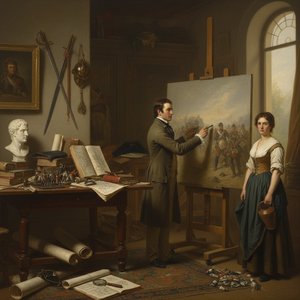
Historical Realism: A Pursuit of Truthful Representation in 19th-Century Art
Explore the captivating world of 19th-century Realism! Discover key artists like Courbet, groundbreaking techniques & the social context behind this influential art movement. Expert insights at ArtsDot.


The Evocative Embrace of Reality: Exploring Romantic Realism in 19th-Century Painting
Explore the captivating world of Romantic Realism! Discover key artists like Courbet & Millet, masterpieces, and the social context behind this influential art movement. Expert insights for collectors at ArtsDot.

The Poetic Truth of Observation: Exploring 19th-Century Realism in Painting
Explore the captivating world of 19th-century Realism! Discover key artists like Courbet & Millet, masterpieces, and the powerful social commentary behind this influential art movement. Expert insights at ArtsDot.

Ilya Repin: Realism, Revolution & the Russian Soul – A Comprehensive Exploration of Life and Legacy
Explore the life & legacy of Ilya Repin, Russia's leading realist painter. Discover his iconic works like 'Barge Haulers on the Volga,' social commentary, and profound portraits. A comprehensive guide for art enthusiasts.

Nikolai Ge: Realism, Religious Struggle & the Psychological Portrait of 19th-Century Russia
Explore the profound works of Nikolai Ge, a pivotal figure in Russian realism. Discover his powerful religious paintings, insightful portraits & enduring legacy. Find high-quality reproductions at ArtsDot.



