
 Preview
 Send
Send Share
Share
 Details
 Guide
Guide

 Download
 Similars
 X-Ray
X-Ray Diaporama
 Q&A
Q&A Stats
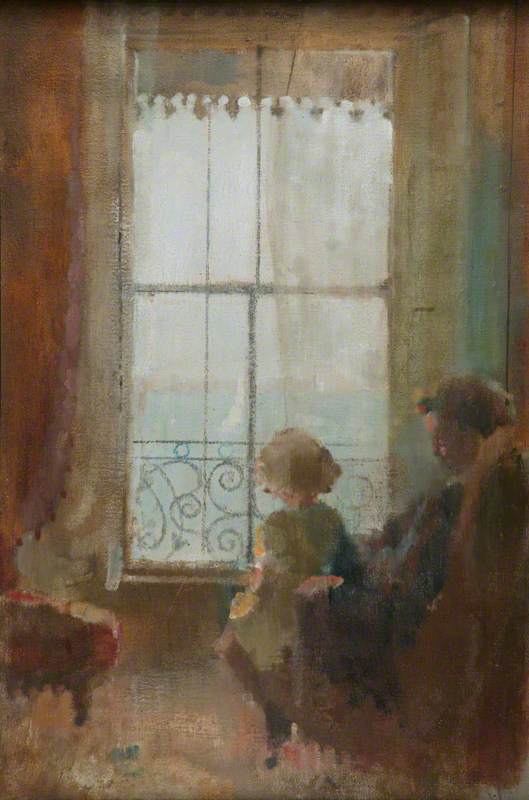
StatsThe Window

- 61.0 x 40.0 cm


 Read More
Get a print-ready file that goes far beyond the web preview. Every digital image we sell comes from a high-resolution master in our stock database — usually 5,000 to 15,000 pixels wide — so you can print large, crop tightly, or reproduce fine detail with confidence.
No file leaves our studio untouched. A digital expert checks the colors against the original painting and corrects them if needed, then improves clarity and detail with professional retouching tools — always staying faithful to the artist's brushwork and style. The result is an image that looks like the painting, not like a filtered scan.
You approve before you're done: our expert sends the image by e-mail within 72 hours for your review. Not satisfied? Ask for improvements or corrections, or request a refund if the quality falls short.
This is the quality relied on by publishers, design studios, galleries and print shops.
Digital Image
Download a high-resolution file for personal display, printing, and creative projects. ( Switch to Print Buy Hand Made Painting)
Included in Every Digital Image Order
Expert Digital Delivery, Guaranteed
When you choose ArtsDot.com, you're not just getting an image - you're receiving a professionally enhanced digital artwork, crafted with precision and backed by a satisfaction guarantee. Here's everything that comes with your order, automatically:

Fast Email Delivery
Your high-resolution digital image file will be emailed to you within 72 hours of ordering - ready for immediate use.

AI-Enhanced Digital File
Your artwork is professionally optimized using advanced AI tools and manual editing, ensuring maximum detail, clarity, and color accuracy.

Free Lifetime Re-Delivery
Accidentally deleted or lost your file? No worries - we'll resend it to you anytime, free of charge.

No Import Fees - Ever
Enjoy your artwork instantly with zero customs, duties, or delivery fees - digital downloads are always tax-free.

Color Accuracy Guarantee
We ensure your digital image reflects the original colors as closely as possible using professional tools and color management.

100-Day Satisfaction Guarantee
If you're not satisfied with your digital image, we'll revise it or refund 100% within 100 days - no questions asked.

100% Money-Back Guarantee
Not satisfied? Get a full refund within 100 days of receiving your digital file - no questions asked.

Bulk Order Discounts
Buy 3 images, save 10% - Buy 5, save 15% - Buy 10+, save 20%. Great for creative projects, galleries, and agencies.
Related Artworks


Artist Biography
Thomas James Carr: Weaver of Domestic Landscapes
Thomas James Carr (1909-1999) wasn’t a name that frequently echoed through the halls of 20th-century art, yet his quietly observant paintings offer a compelling window into the heartland of America – and, crucially, Ireland. Often categorized within the Euston Road School, a movement known for its restrained realism and focus on everyday life, Carr possessed a unique ability to imbue seemingly simple scenes with a profound sense of atmosphere and human connection. His work isn’t about grand pronouncements or dramatic gestures; it's a subtle exploration of rural existence, family routines, and the enduring beauty found in the commonplace.
Born in Belfast, Northern Ireland, into a comfortable family with strong connections to the stockbroking world – his grandfather was a watercolourist – Carr’s early life instilled within him an appreciation for visual representation. He received his initial artistic training at Oundle School in England, where he studied under E.M.O'R. Dickey and Christopher Perkins, gaining foundational skills in draughtsmanship and composition. A pivotal moment arrived in 1927 when he moved to London and enrolled at the Slade School of Art, studying under Henry Tonks. This period exposed him to a wider range of artistic approaches, though it was his subsequent year spent in Settignano, near Florence, that truly shaped his aesthetic sensibilities. Immersed in the Italian landscape and art tradition, Carr developed a deeper understanding of light, color, and the expressive potential of paint – a shift evident in the warmth and luminosity he brought to his later works.
Returning to London, Carr established himself as a respected painter of domestic scenes. He wasn’t simply documenting reality; he was actively interpreting it. His paintings frequently depict rural life—farmers tending their fields, families gathered around tables, or solitary figures engaged in quiet pursuits. While often described as a realist, Carr's work transcends mere imitation. He employed a loose, painterly technique, favoring broad brushstrokes and a muted color palette to create a sense of depth and atmosphere. Notably, he was included in the 1934 Objective Abstractionists exhibition at Zwemmer’s gallery, suggesting an awareness of modern artistic trends without fully embracing abstraction himself. This inclusion highlights his willingness to engage with contemporary art while maintaining his own distinct visual language.
Carr's career unfolded across several decades, punctuated by exhibitions in London and Ireland. He found a supportive audience at the Leicester Galleries, Redfern Gallery, and Agnew’s, showcasing his work alongside prominent artists of the time. During World War II, he returned to Northern Ireland and took on commissions from the War Artists’ Advisory Committee, capturing scenes of parachute manufacture and the construction of Short Sunderland flying-boats in Belfast – a testament to his adaptability and ability to depict industrial subjects with sensitivity. Following the war, he taught at the Belfast College of Art and later moved to Newcastle, County Down, where he continued to paint until his death in 1999. His final years were marked by a renewed focus on landscape painting, reflecting a lifelong connection to the natural world.
The Euston Road School and Carr’s Place Within It
Carr's association with the Euston Road School is central to understanding his artistic development and legacy. This group of artists, led by William Coldstream, formed a distinct movement within British painting in the mid-20th century. The Euston Road School rejected the overtly expressive styles of earlier movements, instead prioritizing observation, restraint, and a subtle exploration of form and color. They were deeply influenced by the work of Cézanne and focused on capturing the essence of their subjects rather than simply reproducing them realistically.
Carr’s paintings align closely with the Euston Road School's principles. Like his colleagues – Victor Pasmore, Claude Rogers, and others – he eschewed dramatic compositions or overtly emotional subject matter. Instead, he sought to create paintings that were quietly evocative, inviting viewers to contemplate the beauty and complexity of everyday life. His use of light and color is particularly noteworthy, reflecting a deep understanding of how these elements can shape our perception of a scene. While he shared a common aesthetic with the Euston Road School, Carr’s work also retained a distinctly Irish sensibility – a sensitivity to the landscape, the rhythms of rural life, and the cultural traditions of his homeland.
Themes and Symbolism in Carr's Work
Carr’s paintings are rich in subtle symbolism and thematic resonance. At their core, they explore themes of family, community, and the relationship between humans and nature. His depictions of rural life often convey a sense of nostalgia for a simpler time – a longing for connection to the land and to traditional values. The figures in his paintings are rarely idealized; they are presented as ordinary people engaged in everyday activities, reflecting Carr’s belief that beauty can be found in the mundane.
The landscapes he painted are equally significant. They aren't merely scenic representations but rather expressions of a deep connection to the natural world. Carr frequently employed muted color palettes and atmospheric effects to create a sense of mood and atmosphere, evoking the changing seasons and the rhythms of rural life. The use of light is particularly important – it’s often diffused and subtle, creating a feeling of quiet contemplation.
Legacy and Historical Significance
Thomas James Carr may not be as widely celebrated as some of his contemporaries, but his work holds considerable historical significance. He represents a vital link between the realist traditions of British painting and the emerging trends of mid-20th-century art. His association with the Euston Road School helped to shape the course of British painting, while his distinctive style – characterized by its quiet observation, atmospheric effects, and subtle symbolism – continues to resonate with viewers today.
Carr’s paintings offer a valuable glimpse into the social and cultural landscape of Ireland and Britain during the 20th century. They document the rhythms of rural life, the values of community, and the enduring beauty of the natural world. His legacy lies not in grand gestures or revolutionary innovations but in his ability to capture the essence of everyday life with quiet grace and profound insight.

Thomas James Carr
1909 - 1999
Quick Facts
- Full Name: Thomas James Carr
- Nationality: British
- Date Of Birth: 1909
- Date Of Death: 1999
- Place Of Birth: Belfast, Northern Ireland
- Notable Artworks:
- Domestic scenes
- Landscapes
- Parachute manufacture
- Artistic Movement Or Style: Euston Road School
- Artists Who Influenced This Artist:
- E.M.O'R. Dickey
- Christopher Perkins
- Artists Or Movements Influenced By This Artist:
- Victor Pasmore
- Claude Rogers