

 Preview
 Send
Send Share
Share
 Details
 Guide
Guide

 Download
 Similars
 X-Ray
X-Ray Diaporama
 Q&A
Q&A Stats
StatsClouds

- 22.0 x 28.0 cm


 Read More
Giclée / Art Print
Museum-quality giclée or canvas print with fast production and flexible finish options. ( Buy Hand Made Painting Switch to Digital Image)




P118B $10

P118H $10

P118W $10

P438Z $10

P508JH $12

P508YH $12

P805H $10

P805Z $10

P919BZ $10

P919G $10

P919XJ $10

P959ZH $10

P968JZ $12

W106C $8

W218G $10

W218JH $8

W218Y $10

W307PJ $10

W316G $10

W316PJ $8

W316Y $10

W398PJ $8

W4111J $10

W500HY $15

W500JH $15

W692G $12

W849H $8

W940BG $15

W953PJ $8




Pick from our preset sizes that match the artwork's original proportions.

Type the width and the height you need, to fit your frame or your wall. A print can only be cut, never made bigger than the picture, so a size with a different shape loses a part of the image. We send you a digital mockup to approve before we print anything. The picture shown on this page does not show the real cut — only the mockup does.
Worldwide Delivery () in 2 weeks instead of standard 4/5 weeks. (19 November)

Free Worldwide Express Shipping

High-Quality Linen Canvas

Full Shipping Insurance

Customs Tax Refund Guarantee

True Color Matching Guarantee

100-Day Return Policy (Defects Only)

100% Money-Back Guarantee

Bulk Discount Offer
 Glass option is only available in size under 110 CM

Clouds
Giclée / Art Print
Reproduction Size
-


Total Price
$ 63
A Vision of Tranquility: Exploring Thomas Cole’s ‘Clouds’
Thomas Cole's “Clouds,” painted in 1838, transcends mere depiction; it embodies the very essence of Romantic landscape painting and stands as a cornerstone of American artistic heritage. Executed on canvas measuring 22 x 28 cm, this artwork captures a serene vista dominated by an expansive sky brimming with billowing clouds—a motif that speaks volumes about Cole’s profound engagement with the spiritual dimension of nature. The scene centers around a solitary tree positioned prominently in the foreground, its branches reaching upwards towards the turbulent heavens, symbolizing resilience and connection to the divine. Complementing this central element are two smaller trees nestled in the background, subtly enhancing the depth and grandeur of the composition.- Style: Romanticism – Cole’s work firmly establishes itself within the Romantic movement, rejecting Neoclassical formalism for an emotive response to the natural world. This stylistic choice prioritized feeling over reason, mirroring the burgeoning philosophical currents of the era.
- Technique: Oil on Canvas – Cole skillfully employed oil paints on canvas, utilizing layering and blending techniques to achieve remarkable tonal gradations and atmospheric perspective. The meticulous attention to detail is evident in the rendering of textures—particularly within the tree trunks and branches—demonstrating Cole’s mastery of artistic craftmanship.
- Historical Context: Painted during a period of significant intellectual and social transformation, “Clouds” reflects the Hudson River School's fascination with sublime landscapes as expressions of God’s majesty. The painting emerged from a broader cultural preoccupation with conveying moral lessons through visual narratives, aligning seamlessly with the Victorian sensibility.
- Emotional Impact: “Clouds” possesses an undeniable emotional resonance—a palpable sense of peace interwoven with a subtle undercurrent of melancholy. Cole’s masterful use of color and light contributes to this evocative atmosphere, transporting viewers into a realm of serene contemplation and fostering a connection to the sublime beauty of the natural world.
- Further Exploration: Consider examining Cole's broader oeuvre—particularly “The Oxbow” and “Washington Crossing the Delaware”—to appreciate his sustained commitment to portraying American landscapes with unparalleled artistic integrity and spiritual depth. These works exemplify the Hudson River School’s enduring legacy as champions of Romantic idealism.
Questions & Answers
How do I download the image of "Clouds" by Thomas Cole?
The image of "Clouds" by Thomas Cole can be downloaded from the artwork's Download page: a high-resolution digital image download.
Is Thomas Cole, creator of "Clouds", known under other names?
Thomas Cole appears under the alternate names T. Cole, Cole, توماس كول, Томас Коул, Τόμας Κόουλ.
What mood does "Clouds" by Thomas Cole express within Hudson River School?
"Clouds" carries a calm emotional tone within the Hudson River School movement.
Related Artworks


Artist Biography
The Life and Art of Thomas Cole
Born on February 1, 1801, in Bolton le Moors, Lancashire, England, Thomas Cole began his life far from the landscapes that would eventually define his name. His family emigrated to the United States in 1818, seeking a new beginning in a land of vast, unmapped territories. In those early years, he was a man of many trades, working as an engraver and later finding steady work as a portrait painter starting in 1822. He was largely self-taught, developing his eye through observation and the study of books rather than formal academic training. This independence of spirit allowed him to look at the American wilderness through a lens that was entirely his own.
His focus eventually shifted from the faces of individuals to the grand scale of the natural world. By founding the Hudson River School, he provided a visual language for a nation still defining itself. His work often sought to find a spiritual resonance within the untamed forests and mountains, moving away from the structured traditions of Europe. He lived a life of constant observation, finding profound meaning in the interplay of light and shadow across the valleys of the New World. This dedication to the landscape continued until his death on February 11, 1848, in Catskill, New York.
Residency in Catskill and New York
After a period of living in Philadelphia, Cole moved to Catskill, New York, in 1825. This relocation proved to be the defining setting of his life and creative output. By 1827, he had established a permanent studio at Cedar Grove, a farm in Catskill that provided both a residence and a workspace. It was within this landscape that he transitioned from his early work as a portrait painter to the focused study of the American wilderness.
His domestic life in the Catskills was marked by a significant union in 1836, when he married Maria Bartow. This period of stability coincided with his most productive years, as he worked from his studio to translate the surrounding topography into his large-scale canvases. The environment of the Hudson River Valley was not merely a backdrop for his subjects but a constant presence in his daily existence.
The end of his life came as abruptly as the seasonal shifts he so often painted. Cole died in Catskill on February 11, 1848, following a struggle with pleurisy. He left behind a body of work that was deeply rooted in the soil and light of the region where he had spent his most formative decades.
Technique and Artistic Style
Cole worked primarily with oil on canvas, a medium that allowed him to develop a reputation for both romantic landscape and history paintings. His approach often involved placing small figures or solitary structures against moody, expansive natural landscapes. These compositions were rarely mere scenery; they were frequently allegorical, using the physical world to suggest deeper moral or spiritual meanings. He possessed a keen ability to render the textures of the American wilderness, often using the interplay of light and shadow to create a sense of atmosphere and depth.
His aesthetic was often viewed as conservative, reflecting a certain resistance to the rapid changes of his era. Through his brushwork, he offered a quiet critique of the contemporary trends of industrialism, urbanism, and the relentless push of westward expansion. He preferred to frame the New World as a pristine, natural eden, a sharp contrast to the smog-filled cityscapes of the Industrial Revolution-era Britain in which he grew up. This preference for the untamed over the built environment gave his work a distinct, often escapist, character.
- The Oxbow (about 1836)
- The Voyage of Life: Childhood (1842)
- The Voyage of Life: Manhood (1842)
- The Voyage of Life: Old Age (1842)
- Prometheus Bound (1847)
Key Works and Major Series
Cole’s early output revealed a growing fascination with the raw power of the American landscape. In 1826, he produced Kaaterskill Falls, a work that captured the vertical energy of the wilderness. As his ambitions expanded, he moved toward more complex compositions. Around 1833, he painted The Titan's Goblet, and by 1836, he had completed The Oxbow, a painting that juxtaposed the untamed river valley against the encroaching presence of cultivated farmland. This tension between the wild and the settled became a recurring theme in his visual language.
His most ambitious undertaking was the five-part series The Course of Empire, completed in 1836. Through these canvases, he traced the cyclical rise and fall of civilizations, from a pristine state to inevitable destruction. This interest in the passage of time and the human condition continued into his later years. In 1842, he painted The Voyage of Life, an allegorical series depicting the stages of an individual's existence. His final years saw a shift toward even more profound, often religious or mythological, subject matter. This is evident in The Architect's Dream, painted about 1840, and Prometheus Bound in 1847, a large-scale work based on the Greek tragedy. Even his 1845 work, The Hunter, reflected this ability to place human figures within a vast, sun-drenched valley.
- Kaaterskill Falls (1826)
- The Oxbow (1836)
- The Course of Empire (1836)
- The Voyage of Life (1842)
- The Hunter (1845)
- Prometheus Bound (1847)
Circle, Rivals and Pupils
Cole’s life was anchored by a network of intimate connections that extended from his immediate family to the most promising talents of his era. His sister, Sarah Cole, shared his inclination toward the landscape, establishing herself as a painter in her own right. Within his own household, the artistic impulse was a shared language; his daughter, Emily Cole, pursued a different but related path, working as a botanical artist with watercolors and applying her skill to the delicate medium of porcelain.
His professional influence was felt most directly through the mentorship of Frederic Edwin Church. By guiding Church, Cole ensured that the principles of the Hudson River School would find a powerful successor. This lineage was not merely a matter of technique but a passing of a specific way of seeing the American wilderness. Beyond his formal pupils, Cole maintained a deep and enduring friendship with Daniel Wadsworth, a connection that provided a steady presence amidst his prolific output.
Legacy and Enduring Influence
The departure of Thomas Cole in 1848 left a void in the American landscape that many spent decades attempting to fill. As the founder of the Hudson River School, he provided the first significant vocabulary for a nation seeking to define itself through its own soil and sky. His work moved beyond the mere recording of scenery, establishing a visual language that allowed subsequent generations of painters to explore the spiritual and moral dimensions of the wilderness. This shift helped transform American art from a provincial imitation of European traditions into a distinct and powerful force.
His influence reached far beyond the immediate circle of his contemporaries. By teaching the importance of direct observation paired with deep philosophical inquiry, he shaped the trajectory of American landscape painting for much of the nineteenth century. His ability to weave allegory into the natural world ensured that his impact was felt not only in the aesthetics of the brushstroke but in the very way the American wilderness was perceived by the public. He remains a cornerstone of American artistic achievement, a figure whose presence is felt in the continued study of the relationship between humanity and the untamed environment.
- The Voyage of Life (1842)
- The Course of Empire (completed 1836)
- The Oxbow (about 1836)
- Prometheus Bound (1847)
Where to See the Works Today
To encounter the physical traces of his vision, one must travel to the major repositories of American art. The Metropolitan Museum of Art in New York holds significant pieces of his output, including his study for the "Dream of Arcadia." In Washington D.C., the National Gallery of Art preserves several of his important canvases, such as "The Voyage of Life: Childhood," "The Voyage of Life: Manhood," and "The Voyage of Life: Old Age." These works allow for a direct study of his approach to the human experience through the lens of the natural landscape.
The Museum of Fine Arts in Boston also maintains a collection of his paintings, offering further insight into his development. For those seeking a connection to his personal environment, the Thomas Cole National Historic Site in Catskill, New York, preserves the actual home and studio where he lived and worked. This site, known as Cedar Grove, provides a rare glimpse into the domestic and creative spaces that shaped his life and his observations of the Hudson River Valley.
- The Titan's Goblet (1833)
- The Architect (1840)
- The Hunter (1845)
- Prometheus Bound (1847)

Thomas Cole
1801 - 1848 , United Kingdom
Quick Facts
- Artistic Movement Or Style: Hudson River School
- Artists Or Movements Influenced By This Artist:
- Frederic Edwin Church
- Hudson River School
- Artists Who Influenced This Artist:
- Claude Lorrain
- J.M.W. Turner
- Full Name: Thomas Cole
- Nationality: Anglo-American
- Notable Artworks:
- The Oxbow
- The Course of Empire
- The Voyage of Life
- Prometheus Bound
- Place Of Birth: Bolton, United Kingdom
- Date Of Birth: 1801
- Date Of Death: 1848
Related Articles

Robert Spencer: Luminism, Narrative & the American Landscape Tradition
Explore the captivating world of Luminism & the Hudson River School with our expert analysis. Discover the history, artists, and enduring beauty of 19th-century American landscape painting. Find museum-quality reproductions at ArtsDot.
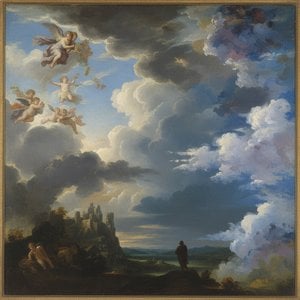
Ephemeral Visions: Clouds as Motif & Metaphor in Western Art History
Explore the captivating history of clouds in Western art! From Romantic masterpieces to Symbolist visions, discover how artists captured atmosphere, emotion & spirituality. A guide for collectors and enthusiasts.

Tempest and Transcendence: A Study of Stormy Skies and the Sublime in Landscape Painting
Explore the mastery of stormy skies through Romantic and Impressionist landscapes. Discover the power of the sublime today.

The Sublime Landscape: Exploring the Hudson River School Movement
Explore the captivating world of the Hudson River School! Discover the history, artists, and defining characteristics of this iconic American art movement. Learn about Romanticism's influence & find inspiration for your collection.

The Sublime Tempest: Capturing the Raw Power of Storms in Masterpiece Landscapes
Explore the raw power of Romanticism through Turner and Calame's storm landscapes. Discover the sublime beauty of nature's fury today.


