
- Home

- Oil Painting Reproduction
- solomon lewitt
- Wall Drawing #391
 Buy print
 Send
Send Share
Share
 Details

 Download
 Similars
 X-Ray
X-Ray Diaporama
Wall Drawing #391


Hand Made Oil Reproduction
Hand-painted oil on canvas in your size and frame, made to order by our artists.




P118B $10

P118H $10

P118W $10

P438Z $10

P508JH $12

P508YH $12

P805H $10

P805Z $10

P919BZ $10

P919G $10

P919XJ $10

P959ZH $10

P968JZ $12

W106C $8

W218G $10

W218JH $8

W218Y $10

W307PJ $10

W316G $10

W316PJ $8

W316Y $10

W398PJ $8

W4111J $10

W500HY $15

W500JH $15

W692G $12

W849H $8

W940BG $15

W953PJ $8




 Read more
Pick from our preset sizes that match the artwork's original proportions.

You may enter your own dimensions to fit a specific frame or space. If your selected size does not match the original image's proportions, we will either crop the artwork or extend the painting with additional hand-painted elements. A digital mockup will be sent for your approval before production begins.
Please note that the on-screen preview does not reflect the actual cropping or extension. Only the mockup will accurately show the final composition.
While custom sizes are available, we recommend selecting a dimension from the predefined list to preserve the original proportions.
After order, ArtsDot.com team will email client for instructions and provide a mockup preview
Worldwide Delivery () in 3/4 weeks instead of standard 5 weeks. (1 July). No compromise on quality.

Free Worldwide Express Shipping

High-Quality Linen Canvas

Full Shipping Insurance

Customs Tax Refund Guarantee

True Color Matching Guarantee

60-Day Return Policy (Defects Only)

100% Money-Back Guarantee

Bulk Discount Offer
 Glass option is only available in size under 110 CM

Wall Drawing #391
Reproduction Medium
Reproduction Size
-


Total Price
-
Artwork Description
Solomon Lewitt’s Wall Drawing #391: A Minimalist Exploration of Geometry and Color
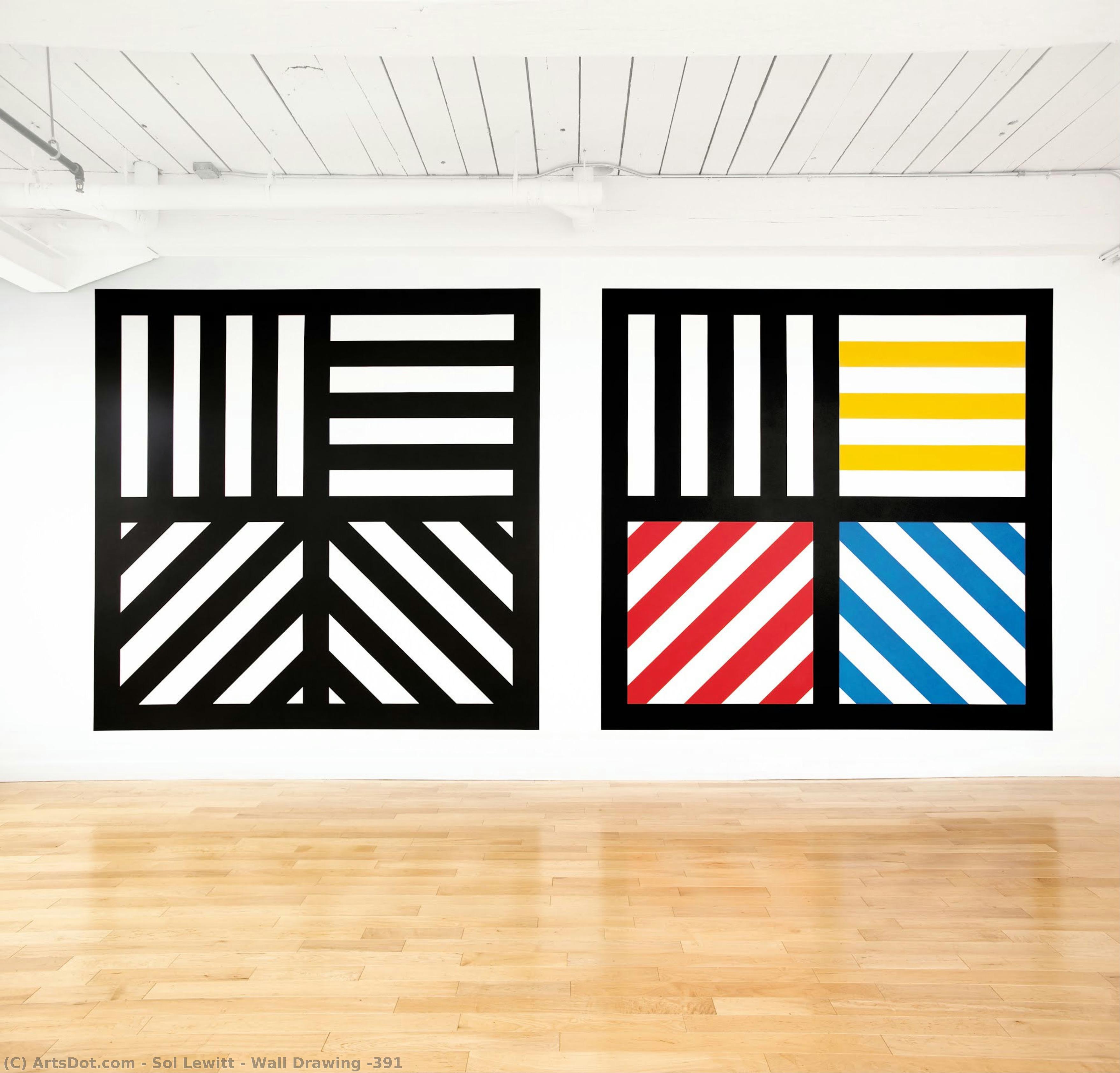
Solomon Lewitt's "Wall Drawing #391," created in April 1983, stands as a cornerstone of minimalist art and conceptual sculpture. More than just pigment on canvas, it embodies Lewitt’s radical philosophy—that the artwork resides solely in its conception and execution, challenging traditional notions of artistic representation. This piece exemplifies Lewitt's unwavering commitment to geometric abstraction, transforming simple lines into powerful visual statements that resonate with profound intellectual depth.The Conceptual Framework
Lewitt’s approach stemmed from a deep fascination with mathematics and geometry, disciplines he rigorously applied throughout his career. He famously articulated the core principle of minimalism: “The artwork is the idea behind it.” This statement encapsulates Lewitt's belief that the artist should prioritize conceptual exploration over purely aesthetic considerations—a revolutionary stance that fundamentally altered the trajectory of modern art. "Wall Drawing #391" isn’t about capturing a visual scene; rather, it’s an embodiment of pure form and logic, reflecting Lewitt’s conviction that art could communicate ideas without relying on illusion or sensory stimulation.Technique and Materiality
The drawing itself is executed with meticulous precision using black India ink and color ink washes applied to two adjacent walls. Each wall is divided horizontally and vertically into four equal parts—creating a grid structure that reinforces the geometric underpinning of the artwork. The lines are drawn in four directions, one direction in each quadrant, resulting in a symmetrical pattern that emphasizes balance and order. Lewitt’s deliberate choice of materials – India ink for its tonal range and color washes for layering hues – underscores his commitment to materiality while simultaneously serving as conduits for conveying abstract concepts. This technique is remarkably simple yet profoundly effective, demonstrating how minimal means can yield maximal impact.Historical Context and Influence
“Wall Drawing #391” emerged during a period of significant artistic experimentation in the 1980s, coinciding with the rise of conceptual art and the rejection of representational painting. Lewitt’s work directly responded to the burgeoning interest in geometric abstraction championed by artists like Josef Albers and Agnes Martin—artists who similarly sought to distill visual experience into its purest form. The drawing's influence extends far beyond its immediate context, inspiring countless subsequent artists to explore similar reductive strategies and prioritizing conceptual ideas over decorative embellishments. It remains a testament to Lewitt’s enduring legacy as a pioneer of minimalist aesthetics and a champion of intellectual rigor within the art world.Symbolism Beyond Geometry
While seemingly devoid of overt imagery, “Wall Drawing #391” possesses subtle symbolic resonance rooted in Lewitt's philosophical framework. The grid structure represents order and rationality—values central to Lewitt’s worldview—while the four colors – Onyx (black), Sunglow (yellow), Alizarin Crimson (red), Navy Blue – serve as visual anchors, grounding the composition and inviting contemplation. These hues are carefully chosen not for their expressive qualities but rather for their ability to establish a harmonious balance within the geometric framework. Ultimately, Lewitt’s intention was to create an artwork that transcends mere visual perception, prompting viewers to engage in a dialogue with fundamental questions about art and thought.A Legacy of Minimalism
Solomon Lewitt's "Wall Drawing #391" continues to captivate audiences today as a quintessential example of minimalist sculpture. Its enduring appeal lies in its uncompromising simplicity—a deliberate rejection of superfluous ornamentation that prioritizes intellectual engagement over sensory gratification. The drawing stands as a powerful reminder that art can communicate profound ideas through the purest forms of visual expression, cementing Lewitt’s place as one of the most influential figures in 20th-century artistic history.Related Artworks


Artist Biography
Solomon Lewitt: Pioneer of Minimalism and Conceptual Art
Solomon Lewitt, born September 9, 1928, in Hartford, Connecticut, stands as a monumental figure in the history of modern art. He revolutionized artistic practice with his unwavering commitment to conceptual ideas—a radical departure from traditional aesthetics—establishing himself as one of the foremost proponents of minimalism and profoundly influencing generations of artists. His work transcends mere visual representation, prioritizing intellectual exploration and challenging conventional notions of sculpture and painting.Early Life and Artistic Formation
Lewitt’s formative years were marked by a fascination with mathematics and geometry, disciplines that would become central to his artistic vision. Studying at Syracuse University from 1945-9 instilled in him a rigorous analytical approach—a cornerstone of his subsequent creative endeavors. Initially drawn to painting, Lewitt swiftly transitioned towards exploring the possibilities inherent in geometric abstraction, recognizing its capacity to convey complex concepts with unparalleled clarity and precision. This early experimentation foreshadowed his groundbreaking contribution to minimalist art.The Emergence of Wall Drawings
Lewitt’s artistic breakthrough arrived in the late 1960s with the invention of “wall drawings”—a technique that fundamentally altered sculptural practice. Rejecting the physicality of traditional sculpture, Lewitt conceived of artworks as sequences of instructions—precise geometric patterns meticulously executed by assistants. This method underscored his belief that the artist's role was to conceptualize and disseminate ideas rather than physically constructing objects. The resulting wall drawings, characterized by their austere simplicity and unwavering adherence to mathematical principles, became instantly iconic, encapsulating the essence of minimalism’s aesthetic ethos.Conceptual Art and Structural Principles
Lewitt firmly positioned himself at the forefront of conceptual art—a movement that prioritized intellectual inquiry over visual sensation. He championed structural principles—the deliberate arrangement of elements according to geometric rules—as a means of achieving artistic expression. These structures, often consisting of repeating lines or squares, demanded meticulous execution but ultimately served as conduits for conveying profound philosophical ideas about order, repetition, and the relationship between artist and viewer. His work challenged viewers to contemplate the underlying logic governing visual experience.Notable Achievements and Legacy
Lewitt’s prolific output spanned diverse mediums—drawing, printmaking, photography, painting, installation, and artist's books—demonstrating his versatility as an innovator. He gained international acclaim for his monumental wall drawings in locations such as Cologne Cathedral and Harvard Yard, cementing his reputation as a visionary artist. Furthermore, Lewitt’s influence extended far beyond the confines of minimalist art, inspiring artists across disciplines to embrace conceptual approaches and explore new frontiers of artistic expression. His legacy continues to resonate within contemporary art discourse, reminding us that true artistry resides not merely in skillful craftsmanship but in the articulation of transformative ideas—a testament to Solomon Lewitt's enduring contribution to the history of modern art.
solomon lewitt
1928 - 2007 , United States of America
Quick Facts
- Artistic Movement Or Style: Minimalism & Conceptual Art
- Artists Or Movements Influenced By This Artist: ['Minimalism']
- Artists Who Influenced This Artist: ['Frank Lloyd Wright']
- Date Of Birth: September 9, 1928
- Date Of Death: April 8, 2007
- Full Name: Solomon Lewitt
- Nationality: American
- Notable Artworks:
- Distorted Cubes Bozuk Küpler
- Kaldor Public Art Project 11: Sol LeWitt 1998
- Place Of Birth: Hartford, United States
Related Articles

Beyond Form & Color: Geometric Abstraction's Evolution in 20th/21st Century Art
Explore the evolution of geometric abstraction from Cubism to contemporary art. Discover key artists like Malevich & Mondrian, investment insights, and expert collecting advice at ArtsDot.


Beyond Form & Color: Geometric Abstraction's Enduring Legacy in Art History
Explore the captivating world of geometric abstraction! Discover its origins, key artists like Malevich & Mondrian, and why this movement remains highly valued by art collectors today. Expert insights at ArtsDot.

Beyond Form: Exploring Geometric Abstraction's Enduring Legacy in Art History
Explore the captivating world of geometric abstraction! Discover its origins, key artists like Kandinsky & Mondrian, and why this movement remains highly valued by art collectors today. Expert insights at ArtsDot.

The Quiet Resonance of Restraint: Minimal Abstract Art as a Catalyst for Serene Interior Spaces
Discover how minimalist abstract art transforms your home into a serene sanctuary. Expert guidance on color, placement & investment from ArtsDot.com – museum-quality reproductions & custom artwork.

Kazimir Malevich: 25 Masterpieces of Suprematism & Abstract Art | ArtsDot
Explore 25 iconic artworks by Kazimir Malevich, pioneer of Suprematism & abstract art. Discover the stories behind 'Black Square' and more! Find museum-quality prints & elevate your home decor with ArtsDot.com.



