- Home

- Oil Painting Reproduction
- Sir Eduardo Paolozzi
- What is pop art

 Buy print
 Send
Send Share
Share
 Details

 Download
 Similars
 X-Ray
X-Ray Diaporama
What is pop art

Hand Made Oil Reproduction
Hand-painted oil on canvas in your size and frame, made to order by our artists.




































 Read more
Pick from our preset sizes that match the artwork's original proportions.

You may enter your own dimensions to fit a specific frame or space. If your selected size does not match the original image's proportions, we will either crop the artwork or extend the painting with additional hand-painted elements. A digital mockup will be sent for your approval before production begins.
Please note that the on-screen preview does not reflect the actual cropping or extension. Only the mockup will accurately show the final composition.
While custom sizes are available, we recommend selecting a dimension from the predefined list to preserve the original proportions.
After order, ArtsDot.com team will email client for instructions and provide a mockup preview
Worldwide Delivery () in 3/4 weeks instead of standard 5 weeks. (1 July). No compromise on quality.

Free Worldwide Express Shipping

High-Quality Linen Canvas

Full Shipping Insurance

Customs Tax Refund Guarantee

True Color Matching Guarantee

60-Day Return Policy (Defects Only)

100% Money-Back Guarantee

Bulk Discount Offer
 Glass option is only available in size under 110 CM

What is pop art
Reproduction Medium
Reproduction Size
-


Total Price
-
Related Artworks


Artist Biography
A Pioneer of Pop: The Life and Art of Eduardo Paolozzi
Sir Eduardo Luigi Paolozzi, born in 1924 in the port district of Leith, Edinburgh, was a figure who irrevocably altered the landscape of post-war art. His story is one woven with threads of immigration, internment, and an insatiable curiosity for the burgeoning world of mass culture. The son of Italian immigrants—his father ran an ice cream parlor—Paolozzi’s early life was steeped in a dual heritage that would profoundly shape his artistic vision. This background instilled within him a unique perspective, poised between Old World traditions and the dynamic energy of modern Britain. The shadow of war fell heavily upon Paolozzi's youth; in 1940, branded an enemy alien following Italy’s entry into WWII, he was interned, a traumatic experience compounded by the tragic loss of his father and grandfather when their transport ship to Canada was sunk by a U-boat. This early hardship undoubtedly fueled a sense of displacement and questioning that permeated his later work.
Forging a New Visual Language
Paolozzi’s formal artistic training began at the Edinburgh College of Art in 1943, followed by studies at Saint Martin's School of Art and the Slade School of Fine Art in London. However, it was his time in Paris between 1947 and 1949 that proved truly transformative. Immersed in the vibrant artistic milieu of post-war France, he encountered giants like Alberto Giacometti, Jean Arp, Constantin Brâncuși, Georges Braque, and Fernand Léger. These encounters sparked a critical shift in his aesthetic sensibilities, moving him away from traditional sculptural forms towards a more experimental approach. He began to incorporate found objects—fragments of the machine age, discarded consumer goods—into his sculptures, foreshadowing the Pop Art movement that would soon explode onto the art scene. I Was A Rich Man’s Plaything, created in 1947 but not publicly exhibited until 1952 at the inaugural meeting of the Independent Group, is often cited as a pivotal work—a collage assembled from American magazines brought over by visiting US servicemen, it boldly declared an embrace of popular culture and challenged prevailing artistic norms.
The Independent Group and the Birth of Pop
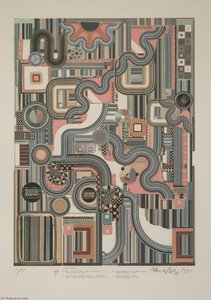
Paolozzi was a founding member of the Independent Group (IG), a collective of artists, architects, and critics who met regularly at the Institute of Contemporary Arts in London during the 1950s. The IG’s discussions centered on the impact of American mass culture—advertising, Hollywood films, science fiction—on contemporary life. They sought to analyze and deconstruct these influences, viewing them not as vulgar intrusions but as potent symbols of a new reality. Paolozzi's contributions to the group were instrumental in shaping its direction; his collages, brimming with images of pin-up girls, robots, and consumer products, served as visual manifestos for their ideas. His groundbreaking 1952 presentation of Bunk!, a slide show featuring these collages projected onto a screen, is considered a seminal moment in the development of Pop Art. This wasn’t merely an aesthetic shift; it was a philosophical one—a rejection of high art pretension and an embrace of the everyday. Moonstrips Empire News (1967), a series of 100 silkscreen prints, further exemplifies his innovative use of mass-production techniques to explore themes of technology, consumerism, and the fragmented nature of modern experience.
Sculpture, Public Art, and Lasting Legacy
While initially renowned for his collages and printmaking, Paolozzi’s artistic practice expanded significantly to encompass sculpture. His sculptures often feature a distinctive robotic aesthetic—polished bronze figures assembled from machine parts, evoking both the promise and the anxieties of technological advancement. He was a prolific public artist, undertaking large-scale commissions that transformed urban spaces. Perhaps his most iconic work in this realm is the mosaic covering the walls of Tottenham Court Road tube station in London (1986), a vibrant explosion of color and geometric forms that continues to captivate commuters today. Another notable example is Newton after Blake (1995), a monumental bronze sculpture installed outside the British Library, inspired by William Blake’s depiction of Isaac Newton. Paolozzi's work transcends simple categorization; it blends Surrealism, Futurism, and Pop Art into a unique visual language that reflects the complexities of the 20th and 21st centuries. He received numerous accolades throughout his career, including a CBE in 1968 and a knighthood in 1989. Eduardo Paolozzi died in London in 2005, leaving behind a legacy as one of the most influential artists of his generation—a true pioneer who dared to find beauty and meaning in the detritus of modern life.
A Continuing Influence
- Paolozzi’s exploration of technology and its impact on humanity remains remarkably relevant today, as we grapple with the ever-increasing presence of artificial intelligence and digital culture.
- His innovative use of collage and printmaking continues to inspire artists working in a variety of media.
- His public art commissions demonstrate the power of art to transform urban spaces and engage with wider audiences.
- He paved the way for subsequent generations of Pop Artists, challenging conventional notions of artistic subject matter and technique.
Paolozzi’s work serves as a potent reminder that art can be found in the most unexpected places—in the discarded objects, the mass-produced images, and the everyday experiences that shape our world. His enduring influence ensures that his vision will continue to resonate with audiences for years to come.

Sir Eduardo Paolozzi
1924 - 2005 , United Kingdom
Quick Facts
- Artistic Movement Or Style: Pop Art
- Artists Or Movements Influenced By This Artist: ['Pop Art pioneers']
- Artists Who Influenced This Artist:
- Alberto Giacometti
- Jean Arp
- Constantin Brâncuși
- Date Of Birth: March 7, 1924
- Date Of Death: April 22, 2005
- Full Name: Sir Eduardo Paolozzi
- Nationality: Scottish
- Notable Artworks:
- Moonstrips Empire News
- Universal Electronic Vacuu
- General Dynamic Fun
- Place Of Birth: Leith, UK