
- Home

- Oil Painting Reproduction
- Sir Anthony van Dyck
- Marie de Raet

 Buy print
 Send
Send Share
Share
 Details

 Download
 Similars
 X-Ray
X-Ray Diaporama
Marie de Raet
 Oil On Canvas
- WallArt
- Baroque Portraiture
 1631
1631- Early Modern
 213.0 x 115.0 cm
 Wallace Collection
Hand Made Oil Reproduction
Hand-painted oil on canvas in your size and frame, made to order by our artists.




P118B $10

P118H $10

P118W $10

P438Z $10

P508JH $12

P508YH $12

P805H $10

P805Z $10

P919BZ $10

P919G $10

P919XJ $10

P959ZH $10

P968JZ $12

W106C $8

W218G $10

W218JH $8

W218Y $10

W307PJ $10

W316G $10

W316PJ $8

W316Y $10

W398PJ $8

W4111J $10

W500HY $15

W500JH $15

W692G $12

W849H $8

W940BG $15

W953PJ $8




 Read more
Pick from our preset sizes that match the artwork's original proportions.

You may enter your own dimensions to fit a specific frame or space. If your selected size does not match the original image's proportions, we will either crop the artwork or extend the painting with additional hand-painted elements. A digital mockup will be sent for your approval before production begins.
Please note that the on-screen preview does not reflect the actual cropping or extension. Only the mockup will accurately show the final composition.
While custom sizes are available, we recommend selecting a dimension from the predefined list to preserve the original proportions.
After order, ArtsDot.com team will email client for instructions and provide a mockup preview
Worldwide Delivery () in 3/4 weeks instead of standard 5 weeks. (1 July). No compromise on quality.

Free Worldwide Express Shipping

High-Quality Linen Canvas

Full Shipping Insurance

Customs Tax Refund Guarantee

True Color Matching Guarantee

60-Day Return Policy (Defects Only)

100% Money-Back Guarantee

Bulk Discount Offer
 Glass option is only available in size under 110 CM

Marie de Raet
Reproduction Medium
Reproduction Size
-


Total Price
-
Artwork Description
The Regal Gaze of Baroque Elegance
To stand before Marie de Raet is to be enveloped in the profound stillness of the early seventeenth century. This magnificent portrait by Sir Anthony van Dyck, dating from 1631, transcends a mere likeness; it is a carefully constructed tableau of aristocratic power and refined grace. The subject, Marie de Raet, is presented with an almost monumental dignity. Her gaze, directed outward toward the viewer, is not merely observed but rather confronts—it possesses a contemplative depth that seems to draw the observer into the very moment captured by the artist's brush. Van Dyck masterfully captures the essence of high society during the Baroque period; every fold of fabric, every strand of hair, speaks of immense wealth and established lineage.
Mastery in Texture and Shadow
Technically, the painting is a breathtaking display of Flemish mastery. Observe how van Dyck handles the interplay between light and shadow—the dramatic chiaroscuro that defines so much of Baroque art. The dark background curtain serves not as an empty void, but as a velvet stage upon which the luminous presence of Marie de Raet is spotlighted. Notice the exquisite rendering of her attire: the rich, heavy folds of the cloak, perhaps lined with fur, contrast sharply with the delicate lacework at her bodice and neckline. These details are rendered with such painstaking precision that one can almost feel the weight of the velvet and the cool touch of the lace. The artist’s ability to differentiate between the sheen of silk, the softness of skin, and the intricate pattern of embroidery is nothing short of miraculous.
A Reflection of Courtly Life
Historically, this work situates itself within the zenith of court portraiture. Van Dyck was the quintessential painter for European royalty, and Marie de Raet embodies that tradition. The fashion—the elaborate headpiece adorning her cascade of red curls, the structured silhouette—speaks volumes about the rigid yet opulent social codes of the time. It is a visual document of status. For the collector or designer seeking to infuse a space with historical gravitas and undeniable artistry, this piece offers an unparalleled connection to the grandeur of European aristocracy.
Enduring Emotional Resonance
Beyond the technical brilliance and the historical context, the true power of Marie de Raet lies in its emotional resonance. There is a palpable sense of quiet authority emanating from the subject. It suggests untold stories behind that composed expression—stories of court intrigue, familial duty, and enduring beauty. Owning or displaying a reproduction of this work allows one to partake in that sophisticated atmosphere, transforming any room into a gallery echoing with Baroque splendor. It is an object that commands attention while simultaneously inviting intimate contemplation.
Related Artworks


Artist Biography
A Flemish Master at the Courts of Europe
Sir Anthony van Dyck, born in Antwerp in 1599, emerged as one of the most celebrated and influential portraitists of the Baroque era. His life, though tragically cut short at just forty-two years old, was a whirlwind of artistic exploration and prestigious commissions that took him from his native Flanders to Italy and ultimately to the heart of the English court. From an early age, van Dyck displayed remarkable talent, entering Hendrick van Balen’s workshop as a young apprentice and quickly absorbing the prevailing styles of the time. However, it was his association with Peter Paul Rubens – not merely as a student but as a collaborator – that truly shaped his artistic foundation. He learned from Rubens' dynamic compositions, rich color palettes, and masterful handling of light and shadow, yet van Dyck soon began to forge his own distinct path, one characterized by an elegance and refinement that would become his signature.Italian Sojourns and the Birth of a Style
The years van Dyck spent in Italy, beginning around 1621, proved pivotal in his artistic development. He resided primarily in Genoa, where he found favor among the city’s aristocratic families. It was here that he began to cultivate the sophisticated style for which he would become renowned – a style marked by graceful poses, luxurious fabrics, and an almost palpable sense of nobility. Unlike the robust energy often found in Rubens' work, van Dyck’s Italian portraits exude a refined composure, capturing not just physical likeness but also the inner character and social standing of his sitters. During this period, he also embarked on his *Iconography*, a series of meticulously rendered portrait etchings featuring prominent figures of his time – artists, scholars, and rulers alike. This project showcased his exceptional technical skill and established him as a leading printmaker. These etchings weren’t simply records; they were carefully constructed images designed to immortalize the subjects and convey their status and intellect.The King's Painter: Van Dyck in England
In 1632, van Dyck received an invitation that would forever alter his career trajectory – a summons from Charles I of England to become the court painter. This appointment marked a turning point, not only for van Dyck but also for English portraiture. He arrived in London with a considerable reputation and quickly became indispensable to the king, tasked with creating images that projected an aura of power, majesty, and divine right. Van Dyck’s portraits of Charles I are particularly noteworthy; he moved away from the stiff, formal representations favored by earlier artists, instead portraying the king as a dynamic, charismatic leader. He employed innovative techniques – dramatic lighting, sweeping gestures, and carefully chosen backgrounds – to create images that were both visually stunning and politically charged. His influence extended beyond the royal family, shaping the visual culture of the English aristocracy for generations to come. He didn’t just paint portraits; he crafted an image of kingship, influencing how royalty was perceived for over a century.Legacy and Enduring Influence
Van Dyck's untimely death in 1641 robbed the art world of a prodigious talent, but his legacy endures to this day. His impact on English portraiture is immeasurable; he established a standard of elegance and sophistication that subsequent artists would strive to emulate.- Technical Innovation: He was a master of both oil painting and etching, constantly experimenting with new techniques.
- Stylistic Refinement: His portraits are characterized by their graceful poses, luxurious fabrics, and subtle psychological insights.
- Courtly Influence: He transformed the image of the English monarchy, creating a visual language of power and prestige.

Sir Anthony van Dyck
1599 - 1641 , Belgium
Quick Facts
- Artistic Movement Or Style: Baroque
- Artists Or Movements Influenced By This Artist: ['English portrait painting']
- Artists Who Influenced This Artist: ['Peter Paul Rubens']
- Date Of Birth: March 22, 1599
- Date Of Death: December 9, 1641
- Full Name: Sir Anthony van Dyck
- Nationality: Flemish
- Notable Artworks:
- Portrait of a woman and child
- Equestrian portrait of Charles I
- Lord John Stuart & brother
- Charity
- Charles I in Three Positions
- Rinaldo and Armida
- Portrait of Nicolaes van der Borght
- Place Of Birth: Antwerp, Belgium
Related Articles

Georges de La Tour: Luminosity, Spirituality & Realism in Baroque Painting
Discover the captivating world of Georges de La Tour, a Baroque master renowned for his dramatic chiaroscuro & spiritual realism. Explore key works, influences, and his remarkable rediscovery. Learn more at ArtsDot.


Anthony De Francisci: A Sculptural Synthesis of Classical Tradition & American Modernism
Explore the life & art of Anthony de Francisci, master sculptor of the Peace Dollar & exquisite medals. Discover his classical influences and enduring legacy – a must-read for collectors.

Maurice Quentin de La Tour: Light, Shadow & the Rococo Portrait
Explore the captivating world of Maurice Quentin de La Tour, a master of Rococo portraiture. Discover his innovative pastel techniques, intimate depictions of French aristocracy, and lasting artistic legacy. Learn more at ArtsDot.

From Renaissance Memes to Viral Portraits: The Rise of Customized Classical Paintings in the Age of Instagram
Discover the captivating world of customized classical paintings! Explore how memes sparked a renaissance & learn to commission your own personalized portrait. Expert art consultation & museum-quality reproductions at ArtsDot.
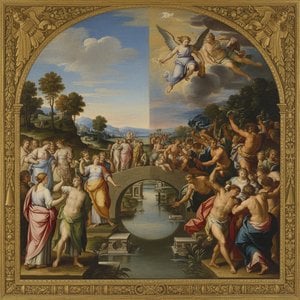
Annibale Carracci: Bridging Renaissance Ideals & Baroque Innovation
Explore the life & art of Annibale Carracci, a pivotal figure bridging Renaissance ideals with Baroque innovation. Discover his masterpieces and lasting influence on Italian painting.



