

- 300.0 x 500.0 cm


The picture follows your choices: , .
Collectible Description
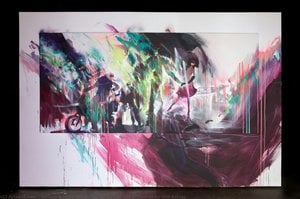
Sigmar Polke’s ‘Levitation,’ created in 2005, is a monumental black and white photograph depicting a painterly image featuring astonished witnesses and hinting at hidden depths beyond the frame. It exemplifies Polke's signature blend of experimental techniques and subversive commentary.
 Read More
Artist Biography
Explore the innovative world of Sigmar Polke (1941-2010), a German painter & photographer renowned for experimental techniques, subversive commentary, and blending art with everyday life.
Hand Made Oil Reproduction
Hand-painted oil on canvas in your size and frame, made to order by our artists. ( Switch to Print Switch to Digital Image)
This Artwork Is Under Copyright Protection
The artwork displayed on this page is protected by copyright law, which means we cannot legally create or sell an identical reproduction. This protection is enforced under international agreements such as the Berne Convention and by national laws, including those outlined by the U.S. Copyright Law - Title 17.
As a respectful and legal alternative, we offer custom, hand-painted artworks inspired by the original. Our skilled and professional artists carefully study the original's style, mood, and artistic essence to create a new, unique piece that evokes the same feeling - while remaining an original creation in its own right.
This method fully complies with copyright regulations because it does not involve copying or duplicating the protected artwork. Instead, it is a creative reinterpretation - a new painting that is influenced by the original but not identical to it.
More about this painting
 Preview
 Send
Send Share
Share
 Details
 Guide
Guide

 Download
 Similars
 X-Ray
X-Ray Diaporama
 Q&A
Q&A Stats
StatsOrder your painting in four simple steps
Take your time. You can change any answer; the price in your order card follows each choice.
1 Step one of four
Which size would you like?
These sizes keep the proportions of the original painting. The drawing shows your choice on a wall, above a two-metre sofa.
Or give your own measurements
Pick from our preset sizes that match the artwork's original proportions.

Type the width and the height you need, to fit your frame or your wall. This is hand-painted, so for a size with a different shape the artist can paint a bit more around the picture, or cut a bit — you choose. We send you a digital mockup to approve before the painting starts. The picture shown on this page does not show the real result — only the mockup does.
2 Step two of four
How should it be prepared: rolled, stretched or framed?
The prices below are for the size you chose in step one.
Choose the edges of the stretched canvas
Choose your frame

White $1

Blurside $1

Extended $1

P118B $10

P118H $10

P118W $10

P438Z $10

P508JH $12

P508YH $12

P805H $10

P805Z $10

P919BZ $10

P919G $10

P919XJ $10

P959ZH $10

P968JZ $12

W106C $8

W218G $10

W218JH $8

W218Y $10

W307PJ $10

W316G $10

W316PJ $8

W316Y $10

W398PJ $8

W4111J $10

W500HY $15

W500JH $15

W692G $12

W849H $8

W940BG $15

W953PJ $8

H24-GOLD $30

H24-SILVER $30

H36-GOLD $45

H36-SILVER $45
Framed
Moulding: . Overall size with the frame: .
3 Step three of four
Would you like anything changed in the painting?
Most people answer no. Because each painting is made by hand, our artist can also adapt it for you.
After order, ArtsDot.com team will email client for instructions and provide a mockup preview
4 Step four of four
A few finishing options
All of them are optional. The answers already selected cost nothing extra.
Who paints it?
Worldwide Delivery () in 3/4 weeks instead of standard 5 weeks. (8 November). No compromise on quality.
A nameplate, as in a museum?
Engraved Bronze Plaque Details
This elegant plaque features the artist's name and the title of the artwork, finely engraved for a timeless presentation.
It is made from bronze with a refined, elegant finish. The text is precisely laser-engraved for a sharp and permanent result. Measuring 9x2 cm, the plaque is compact yet easy to read. It's built to be durable and scratch-resistant, offering a professional, museum-quality look. Mounting is simple thanks to the included adhesive backing.
Transparent Acrylic Plaque Details
The plaque includes essential engraved details such as the artist's name, the title of the artwork, the date it was created, the type of media used-like oil on canvas or watercolor-a brief description of the piece, and a QR code that links to the complete artwork information.
It is crafted from clear acrylic, offering a sleek, modern appearance. The text is UV-engraved in black to ensure strong visual contrast. With a size of 10x15 cm, it ensures optimal readability. It comes equipped with two metal hooks for secure wall mounting. The plaque is designed to be weather-resistant, making it suitable for various environments, and it includes interactive features that work seamlessly with smartphone scanning.
Black Acrylic Plaque Details
This elegant plaque includes engraved information such as the artist's name, the title of the artwork, the date it was created, the type of media used (like oil on canvas or watercolor), a short description of the artwork, and a QR code for quick access to more information.
The plaque itself is made from refined black acrylic with a premium finish. The text is laser-engraved in white for high contrast and readability. Its size is 10x15 cm, designed to be easy to read. It comes with two metal hooks for professional mounting. The design is sleek and fits any interior style. It is also weather-resistant and durable, with built-in digital integration for mobile compatibility.
A protective varnish?
When do you need it?
✓ Check and order
Your painting, as you ordered it

Levitation
Reproduction Medium
Reproduction Size
-

Elite Senior Artist
More detail, finesse, and extra production time
-

Reproduction Frame
-
-
For artworks or reproductions larger than 105 cm (approximately 41 inches) on any side, the frame will be shipped as a kit, disassembled. This method ensures safe delivery and prevents damage during transport.
Professional assembly required - this is not a DIY product.
The kit must be assembled and the canvas stretched by an experienced professional framer, using wood glue (not supplied), a canvas stretching plier and clamps to hold the bars square while the glue dries. Incorrect assembly or uneven canvas tension can permanently damage the artwork and is not covered by our warranty.
 For artworks or reproductions larger than 105 cm (approximately 41 inches) on any side, the frame will be shipped as a kit, disassembled. This method ensures safe delivery and prevents damage during transport.
All solid wood bars are included, precisely cut to size.
Assembled with the screws provided, plus wood glue for the corner joints, which is not supplied and must be sourced by your framer.
Professional tools are required and not included: a canvas stretching plier (tensioner) and clamps to hold the bars square while the glue dries.
Important:
The corner joints require wood glue, the bars must be held with clamps until the glue is fully dry, and tightening the canvas on the assembled frame requires a canvas stretching plier. None of these are included in the kit. Please arrange an experienced professional framer before ordering this size.

Nameplate
-
-

Protective Varnish
Glossy Varnish (enhances colors, protects against light/moisture)
-

Customize My Artwork
Examples of what can be changed: Replace face with customer photo; Add pet (e.g., replace cat with dog); Include hidden message in background; Change background landscape or elements.
-

Urgent
Worldwide Delivery () in 3/4 weeks instead of standard 5 weeks. (8 November). No compromise on quality.
-
Express Shipping
Worldwide Delivery () in 5 weeks. (15 November).
Included
Total Price
$ 263
Glass option is only available in size under 110 CM
Included with every order
- Free Worldwide Express Shipping
- High-Quality Linen Canvas
- Full Shipping Insurance
- Customs Tax Refund Guarantee
- True Color Matching Guarantee
- 100-Day Return Policy (Defects Only)
- 100% Money-Back Guarantee
- Bulk Discount Offer


A Vision Suspended in Time: The Enigmatic World of Sigmar Polke
In the vast landscape of contemporary art, few names resonate with as much mystery and technical audacity as Sigmar Polke. His masterpiece, Levitation, created in 2005, serves as a profound meditation on the very nature of perception. At first glance, the viewer is met with a seemingly banal tableau—a table laden with objects that ground the scene in reality—yet this familiarity is quickly subverted by an underlying sense of existential weight. A group of figures stands before this arrangement, their faces captured in a moment of shared perplexity and quiet observation. It is a scene that feels simultaneously frozen in a cinematic still and vibrating with the tension of an unfolding drama, inviting those who gaze upon it to question what is truly visible and what remains hidden beneath the surface of our daily lives.
The emotional resonance of Levitation lies in its ability to evoke a sense of profound displacement. Polke, whose early life was shaped by the tumultuous migrations of post-war Europe, infused his work with a lifelong skepticism toward fixed truths. In this monumental canvas, measuring an imposing 300 x 500 cm, that skepticism transforms into a haunting beauty. The artwork does not merely depict a moment; it captures the feeling of being suspended between memory and reality, between the tangible world we touch and the ephemeral shadows of history that haunt our collective consciousness.
The Alchemy of Decay: Technique and Texture
To encounter Levitation is to witness a masterclass in the manipulation of medium. Polke’s distinctive style is a breathtaking blend of photographic realism and painterly abstraction, achieved through the demanding technique of encaustic. By layering beeswax, resin, and pigment, he creates a surface that possesses an almost organic vitality. This process allows for a luminous quality that seems to glow from within, yet it is simultaneously interrupted by subtle distress and fractures. These intentional imperfections imbue the work with an inherent sense of decay, mirroring the artist's preoccupation with the passage of time and the inevitable transformation of all things.
For the discerning collector or interior designer, this texture offers an unparalleled sensory experience. The way light interacts with the resinous layers creates a dynamic visual field that changes as one moves around the piece. It is not a static image but a living entity. This layering process serves as a metaphor for memory itself—built upon layers of experience, some bright and clear, others obscured by the weathered patina of time. The result is a work of art that demands presence, offering a sophisticated depth that elevates any space it inhabits.
Historical Echoes and Symbolic Depth
The historical context of Levitation adds a layer of poignant gravity to its visual splendor. Produced in the wake of the September 11th attacks, the painting reflects Polke’s broader engagement with global instability and the fragility of established narratives. By drawing inspiration from filmic conventions, he utilizes the language of mass media to heighten the emotional impact, prompting viewers to consider how much of our "reality" is actually a construction of the images we consume. The figures in the painting, caught in their moment of observation, act as proxies for the viewer, reflecting our own anxieties and our search for meaning in an increasingly fractured world.
Symbolically, the artwork operates on multiple planes. The table, with its collection of objects, represents the material world, while the title Levitation suggests a spiritual or psychological transcendence—a lifting away from the mundane into the realm of pure thought and perception. For those seeking to bring a piece of art history into their homes, this reproduction offers more than mere decoration; it provides a gateway to a complex dialogue about existence, loss, and the enduring power of the human gaze. It is an investment in a profound intellectual and aesthetic experience that continues to challenge and inspire.
Questions & Answers
How big is the original "Levitation"?
"Levitation" measures 300 x 500 cm in its original form. Original dimensions are a useful reference when choosing a reproduction size.
In what period was "Levitation" by Sigmar Polke made?
The historical period of "Levitation" by Sigmar Polke is Contemporary. This classification situates the work in art history.
For what occasion is "Levitation" by Sigmar Polke suggested as a present?
As a present, "Levitation" by Sigmar Polke is suggested for corporate gift. Other occasions can fit as well.
Related Artworks




Sigmar Polke
1941 - 2010, Poland
Artist Biography
A Life Forged in Displacement: The Early Years and Artistic Formation of Sigmar Polke
Sigmar Polke’s artistic journey was profoundly shaped by the tumultuous currents of 20th-century history, beginning with his birth in Olsztyn, Poland, in 1941. His early life was marked by displacement; as a child, he fled with his family first to Thuringia and then, seeking refuge from Communist rule, to West Germany in 1953. This experience of being uprooted, of existing between worlds, instilled within him a lifelong skepticism towards fixed ideologies and a fascination with the instability of perception – themes that would become central to his art. Before dedicating himself fully to painting, Polke underwent an apprenticeship as a stained-glass worker in Düsseldorf (1959-1960), a formative experience that honed his technical skill and introduced him to the possibilities of manipulating light and color. He then formally studied at the Kunstakademie Düsseldorf (1961-1967) under a constellation of influential figures: Karl Otto Götz, Gerhard Hoehme, and most significantly, Joseph Beuys. It was within this environment that Polke began to forge his unique artistic voice, one characterized by experimentation, irony, and a relentless questioning of established norms.Capitalist Realism and the Subversion of Ideology
Emerging in the early 1960s, Polke’s work quickly aligned with a burgeoning counter-cultural movement. In 1963, alongside Gerhard Richter, Konrad Lueg, and Manfred Kuttner, he co-founded *Kapitalistischer Realismus* (Capitalist Realism). This was not an artistic style in the traditional sense but rather a provocative gesture—a critique of both Western consumer culture and the rigid dogma of Soviet Socialist Realism. The movement’s name itself was deliberately ambiguous, suggesting that both systems were equally capable of producing artificial realities. Polke's early paintings from this period often appropriated imagery from advertising, comics, and popular media, presenting them with a detached irony that exposed their underlying ideological structures. He wasn’t simply rejecting capitalism; he was demonstrating its pervasive influence on perception itself. This initial foray into critical commentary established a pattern of subversive engagement that would define his career.Wanderlust, Photography, and the Alchemy of Materials
The 1970s witnessed a significant shift in Polke’s artistic focus towards photography. Driven by an insatiable curiosity, he embarked on extensive travels to Afghanistan, Brazil, France, Pakistan, and the United States, documenting everyday life with a keen eye for the absurd and the unexpected. However, these weren't straightforward documentary photographs; Polke subjected his images to radical chemical manipulation, altering their colors, textures, and meanings. He embraced chance operations and deliberately introduced imperfections, challenging the notion of photography as an objective record of reality. This period reflects a deep exploration of perception—how our understanding of the world is shaped by subjective experience and mediated through technology. In the 1980s, Polke dramatically returned to painting, but not in any conventional sense. He began experimenting with unconventional materials – arsenic, meteor dust, turquoise, beeswax – incorporating them into his canvases alongside traditional pigments. This alchemical approach was driven by a desire to unlock hidden properties within matter and to create works that were constantly evolving, defying easy categorization.Neo-Expressionism, Historical Commentary, and Lasting Legacy
Polke’s later work often engaged with historical events and perceptions thereof, frequently adopting a sardonic or critical perspective. While his style was sometimes associated with Neo-Expressionism due to its expressive brushwork and emotionally charged imagery, he remained fundamentally resistant to categorization. He continued to challenge the boundaries of painting, layering images, incorporating commercial fabrics, and embracing chance as an integral part of his creative process. His work is not easily deciphered; it resists simple interpretations and demands active engagement from the viewer. Sigmar Polke died in Cologne in June 2010 after a long battle with cancer, leaving behind a body of work that continues to inspire and provoke. He stands as one of the most important and influential artists of the postwar era, bridging Pop art, Conceptual art, and Neo-Expressionism. His experimental approach, his relentless questioning of established norms, and his profound understanding of the complexities of perception ensure his enduring legacy in contemporary art. Polke’s influence can be seen in the work of countless artists who followed, those who dare to challenge conventions and embrace ambiguity as a source of creative power.Influences and Artistic Kinships
Throughout his career, Polke engaged with a diverse range of artistic influences. Joseph Beuys, his teacher at the Düsseldorf Kunstakademie, was particularly significant, shaping Polke’s exploration of unconventional materials and social commentary. The bold imagery and consumer culture critique of American Pop Art also resonated with him, though he filtered these influences through a distinctly German lens of skepticism and irony. Furthermore, his work engaged with the broader context of German Art Informel, an abstract expressionist movement that emphasized spontaneous gesture and material exploration. Polke’s artistic kinship with figures like Karl Otto Götz and Konrad Lüg—both fellow travelers in the early days of Capitalist Realism—further illuminates the collaborative spirit and intellectual ferment that characterized his formative years. Ultimately, Polke transcended any single label or movement, forging a unique path that continues to inspire artists today.


Related Articles

Pictorialism: A Search for Artistic Photography's Soul – Aesthetics, Techniques & Legacy
Explore the captivating world of Pictorialism – a pivotal movement that transformed photography into fine art. Discover key artists like Stieglitz & Käsebier, techniques, and collecting tips from experts.

Beyond the Lens: Photography's Enduring Influence on Modern & Contemporary Art
Explore photography's pivotal role in shaping modern & contemporary art. Discover key movements, influential artists like Stieglitz, and expert collecting advice from ArtsDot.

Monochrome Visions: Exploring the Aesthetic & Historical Significance of Black & White Photography
Explore the rich history & artistic power of black and white photography. From early techniques to iconic masters like Ansel Adams, discover why monochrome continues to captivate art lovers today. Expert insights for collectors.