


 Preview
 Send
Send Share
Share
 Details
 Guide
Guide

 Download
 Similars
 X-Ray
X-Ray Diaporama
 Stats
StatsPierrot lunaire, op. 21 - Night
 Acrylic On Canvas
- WallArt
- Expressionistic Modernism
 1912
1912 26.0 x 34.0 cm
 Arnold Schönberg Center
 Read More
Hand Made Oil Reproduction
Hand-painted oil on canvas in your size and frame, made to order by our artists. ( Switch to Print Switch to Digital Image)




P118B $10

P118H $10

P118W $10

P438Z $10

P508JH $12

P508YH $12

P805H $10

P805Z $10

P919BZ $10

P919G $10

P919XJ $10

P959ZH $10

P968JZ $12

W106C $8

W218G $10

W218JH $8

W218Y $10

W307PJ $10

W316G $10

W316PJ $8

W316Y $10

W398PJ $8

W4111J $10

W500HY $15

W500JH $15

W692G $12

W849H $8

W940BG $15

W953PJ $8




Pick from our preset sizes that match the artwork's original proportions.

You may enter your own dimensions to fit a specific frame or space. If your selected size does not match the original image's proportions, we will either crop the artwork or extend the painting with additional hand-painted elements. A digital mockup will be sent for your approval before production begins.
Please note that the on-screen preview does not reflect the actual cropping or extension. Only the mockup will accurately show the final composition.
While custom sizes are available, we recommend selecting a dimension from the predefined list to preserve the original proportions.
After order, ArtsDot.com team will email client for instructions and provide a mockup preview
Worldwide Delivery () in 3/4 weeks instead of standard 5 weeks. (21 September). No compromise on quality.

Free Worldwide Express Shipping

High-Quality Linen Canvas

Full Shipping Insurance

Customs Tax Refund Guarantee

True Color Matching Guarantee

100-Day Return Policy (Defects Only)

100% Money-Back Guarantee

Bulk Discount Offer
 Glass option is only available in size under 110 CM

Pierrot lunaire, op. 21 - Night
Reproduction Medium
Reproduction Size
-


Total Price
$ 263
A Descent into Night: Exploring Schönberg's *Pierrot Lunaire*, Op. 21 – Night
Arnold Schönberg’s *Pierrot lunaire*, op. 21, stands as a monumental achievement in the evolution of modern music, a work born from the anxieties and aesthetic explorations of early 20th-century Europe. This particular rendition, “Night,” meticulously captured in this evocative photographic reproduction, offers a profound glimpse into Schönberg’s expressionistic vision – a world of fractured emotion, haunting beauty, and unsettling psychological depth. Composed in Berlin in 1912, the piece was commissioned by Albertine Zehme, whose unique recitations were intended to “recapture the ear’s prerogative in life,” shaping the very essence of this dramatic exploration.
- Historical Context: Created during a period of immense social and artistic upheaval, *Pierrot lunaire* reflects the burgeoning anxieties surrounding modernity. Schönberg's move towards atonality – abandoning traditional tonal harmony – mirrored a broader rejection of established norms, aligning with the expressionistic movement’s focus on subjective experience and emotional intensity.
- The Figure of Pierrot: The work centers around the enigmatic figure of Pierrot, a character steeped in French folklore, transformed here into a vessel for profound melancholy and despair. He is “with waxen countenance,” a symbol of fragility and vulnerability, lost within a dreamscape of nighttime phantasms.
- Musical Technique: Schönberg masterfully employs a passacaglia form – a variation on a bass ostinato – to build tension and release. The insistent repeated figure in the bass creates a hypnotic effect, while dynamic alterations within the variations allow for shifts in mood and intensity, mirroring Pierrot’s emotional turmoil.
Decoding the Score: A Symphony of Innovation
The photograph reveals a meticulously crafted music sheet, a testament to Schönberg's rigorous approach to composition. The German text, interwoven with musical notation, speaks to the work’s roots in European musical tradition while simultaneously pushing boundaries. Note the complex interplay between static ostinato and dynamic variation – this is not merely music; it’s a carefully constructed psychological landscape. The use of motivic development, tracing recurring melodic fragments throughout the piece, further reinforces the thematic unity despite Schönberg's deliberate avoidance of tonal harmony.
- The Passacaglia Form: This structural choice is crucial to understanding *Pierrot lunaire*. The repeating bass line provides a grounding element, while the variations layered upon it create a sense of unease and instability.
- Atonality and Harmony: Schönberg’s rejection of traditional harmony creates a dissonant soundscape that reflects Pierrot's emotional state – a world devoid of resolution or comfort.
Symbolism and Emotional Resonance
“Night” specifically delves into themes of isolation, loss, and the subconscious. The title itself evokes a sense of mystery and dread, aligning with the overall mood of the piece. Pierrot’s descent into this nocturnal realm represents a confrontation with one's deepest fears and desires. The work is profoundly unsettling, yet undeniably beautiful – a testament to Schönberg’s ability to translate complex emotions into sound.
- Waxen Countenance: This iconic image symbolizes Pierrot’s vulnerability and the fragility of human existence.
- Night as Metaphor: The night setting represents the realm of dreams, illusion, and repressed emotion.
Details of the Reproduction
This hand-painted reproduction captures every nuance of Schönberg's original score. Printed on high-quality archival paper with meticulous attention to detail, this artwork is not just a representation; it’s an experience. The black and white photography itself serves as a poignant reminder of the work’s inherent austerity and emotional power. Dimensions: 26 x 34 cm. Date: 1912.
Related Artworks


Artist Biography
early life and musical beginnings
arnold schoenberg, an austrian-american composer, was born on september 13, 1874, in vienna, austria. his early life was marked by a humble beginning, with his father being a shoe-shopkeeper. despite this, schoenberg's innate passion for music led him to largely self-educate himself in the field.- schoenberg explored film music and wrote more tonal music, completing his chamber symphony no. 2 in 1939.
- he satirized fascist tyrants in ode to napoleon (1942), after byron.
- post-war vienna offered him honorary citizenship, but he was ill, as depicted in his string trio (1946).

arnold schoenberg
1874 - 1951 , Austria
Quick Facts
- Artistic Movement Or Style: Twelve-tone technique; Expressionism
- Artists Or Movements Influenced By This Artist:
- Anton Webern
- Alban Berg
- Artists Who Influenced This Artist:
- Johannes Brahms
- Richard Wagner
- Date Of Birth: September 13, 1874
- Date Of Death: 1951
- Full Name: Arnold Schoenberg
- Nationality: Austrian-American
- Notable Artworks:
- Suite, op. 29
- Music Typewriter
- Staffliner
- Place Of Birth: Vienna, Austria
Related Articles

The Visceral Self: Exploring Emotion & Identity in Expressionist Portraiture
Explore the powerful world of Expressionist portraiture with ArtsDot. Discover how artists captured raw emotion & identity through bold color and distortion. Expert insights for collectors.

Beyond Reality: The Raw Emotion and Distorted Beauty of Expressionist Landscapes
Explore the profound emotional depth of Expressionist landscapes. From Munch to Kirchner, discover how bold colors and distorted forms redefine reality through art history's most evocative masterpieces.

Expressionist Painting: 10 Masterpieces That Defined a Movement | ArtsDot
Explore 10 Expressionist paintings that revolutionized art! Discover Munch, Kirchner & Kandinsky's iconic works. Find museum-quality reproductions and vibrant canvas prints to elevate your home decor on ArtsDot.com.

August Macke: Expressionist Visions of Harmony & Modern Life
Explore the vibrant Expressionist paintings of August Macke (1887-1914). Discover his key role in Der Blaue Reiter, Fauvist influences, and captivating depictions of modern life. A comprehensive guide for art enthusiasts & collectors.
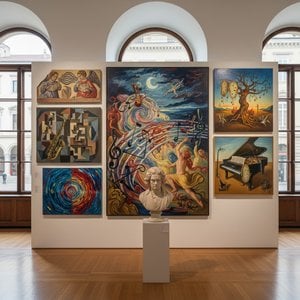
Harmonies on Canvas: Exploring the Visual Representation of Music in Art History
Explore the fascinating history of music's visual representation in art! From ancient symbolism to modern abstraction, discover how artists have captured sound and emotion on canvas. Expert insights & stunning examples.


