


 Preview
 Send
Send Share
Share
 Details

 Download
 Similars
 X-Ray
X-Ray Diaporama
Snow on the sand dunes


 Read More
Hand Made Oil Reproduction
Hand-painted oil on canvas in your size and frame, made to order by our artists. ( Buy Print Buy Image)




P118B S$10

P118H S$10

P118W S$10

P438Z S$10

P508JH S$12

P508YH S$12

P805H S$10

P805Z S$10

P919BZ S$10

P919G S$10

P919XJ S$10

P959ZH S$10

P968JZ S$12

W106C S$8

W218G S$10

W218JH S$8

W218Y S$10

W307PJ S$10

W316G S$10

W316PJ S$8

W316Y S$10

W398PJ S$8

W4111J S$10

W500HY S$15

W500JH S$15

W692G S$12

W849H S$8

W940BG S$15

W953PJ S$8




Pick from our preset sizes that match the artwork's original proportions.

You may enter your own dimensions to fit a specific frame or space. If your selected size does not match the original image's proportions, we will either crop the artwork or extend the painting with additional hand-painted elements. A digital mockup will be sent for your approval before production begins.
Please note that the on-screen preview does not reflect the actual cropping or extension. Only the mockup will accurately show the final composition.
While custom sizes are available, we recommend selecting a dimension from the predefined list to preserve the original proportions.
After order, ArtsDot.com team will email client for instructions and provide a mockup preview
Worldwide Delivery () in 3/4 weeks instead of standard 5 weeks. (13 August). No compromise on quality.

Free Worldwide Express Shipping

High-Quality Linen Canvas

Full Shipping Insurance

Customs Tax Refund Guarantee

True Color Matching Guarantee

60-Day Return Policy (Defects Only)

100% Money-Back Guarantee

Bulk Discount Offer
 Glass option is only available in size under 110 CM

Snow on the sand dunes
Reproduction Medium
Reproduction Size
-


Total Price
S$ 339
Artwork Description
A Threshold of Seasons: The Expressive Solitude of Van der Velden
In the quiet, textured expanse of Snow on the sand dunes, we encounter a moment frozen in time, captured by the masterful hand of Paulus van der Velden in 1889. This evocative work serves as a profound bridge between two worlds, standing at the precipice of the artist's departure from his native Netherlands to the rugged landscapes of New Zealand. It is more than a mere landscape; it is a visceral meditation on transition. The painting captures a rare, delicate intersection where the warmth of the earth meets the biting chill of winter, presenting a scene that feels both intimately familiar and hauntingly otherworldly.
The composition invites the viewer into a serene yet rugged coastal environment, where the undulating forms of sand dunes are draped in a light, wintry shroud. Amidst the muted tones of ochre and white, the artist has woven a tapestry of natural textures—scattered bushes, tufts of hardy grass, and the subtle presence of wildlife that breathes life into the stillness. There is a rhythmic quality to the landscape, where the movement of the wind seems captured within the very grain of the paint, creating a sense of motion even in the deepest silence of the snow.
Mastery of Texture and Tonal Harmony
Technically, this piece is a triumph of impasto and gestural expression. Van der Velden eschews the polished, smooth finishes common in much of the academic art of his era, opting instead for a vigorous, tactile application of pigment. The paint is laid on thickly, creating a physical topography that mimics the very dunes it depicts. This heavy, sculptural approach to the medium allows light to play across the surface of the canvas, catching the ridges of white and cream to simulate the crystalline shimmer of frost and snow.
The color palette is strikingly disciplined, almost monochromatic in its restraint. By limiting himself to a sophisticated range of whites, creams, and earthy ochres, Van der Velden achieves a profound atmospheric depth. This tonal unity creates a sense of quietude and introspection, making the work an ideal centerpiece for spaces that value minimalism, organic textures, or a sophisticated, neutral aesthetic. The lack of jarring color allows the viewer to focus entirely on the interplay of light, shadow, and the raw energy of the brushstrokes.
An Eternal Connection for the Discerning Collector
For the art collector or interior designer, Snow on the sand dunes offers a unique opportunity to possess a piece of historical metamorphosis. It represents the "end point" of his Dutch period and the "beginning" of his New Zealand legacy, making it a work of immense scholarly and emotional weight. The painting does not merely decorate a room; it anchors it with a sense of history and natural grace.
Whether placed in a contemporary gallery-style setting or a classic, cozy study, a high-quality reproduction of this masterpiece brings with it an aura of tranquil strength. It serves as a reminder of the beauty found in transition and the enduring power of nature's simplest elements. To display this work is to invite a sense of contemplative peace and a deep appreciation for the expressive evolution of one of the nineteenth century's most compelling landscape painters.
Related Artworks


Artist Biography
**early life and training**
paulus van der velden, a dutch artist, was born on may 5, 1837, in rotterdam, netherlands. his parents were jacoba van essel and joannes van der velden, a warehouse manager. from a young age, petrus (also known as paulus) began drawing lessons, later enrolling at the rotterdam academy of fine arts and applied arts. he furthered his artistic training by traveling to germany, france, and italy.**artistic career in the netherlands and new zealand**
van der velden's early work focused on marine studies, a quintessential dutch genre. as seen in snow on the sand dunes, one of his few finished paintings from this period, his style was already showing signs of evolution towards more expressive works. in 1890, van der velden emigrated to new zealand with his family, where he continued to paint, often focusing on landscapes and harbor scenes. his work sketch of a sailing ship no. 1, now part of the te papa collection in wellington, showcases his skill in capturing the essence of maritime life.**notable works and legacy**
- **snow on the sand dunes (te papa, wellington, new zealand)**: a small, yet powerful study of sand dunes, showcasing van der velden's expressive use of paint. - **sketch of a sailing ship no. 1 (te papa, wellington, new zealand)**: demonstrates his ability to capture the beauty of maritime scenes.**museums and collections featuring van der velden’s work**
- the museum mauritshuis (netherlands): while not specifically featuring van der velden's work, it is a significant dutch art museum that showcases the country's rich artistic heritage. - rijksdienst beeldende kunst (the hague, netherlands): another notable dutch museum, its collection reflects the breadth of dutch art, including works from the golden age.- view van der velden's artworks on ArtsDot.com
- explore more about dutch art and museums at museum boijmans van beuningen
- learn about other artists like kaleb de groot on ArtsDot.com

paulus van der velden
1837 - 1913 , Netherlands
Quick Facts
- Artistic Movement Or Style: Marine painting
- Artists Or Movements Influenced By This Artist: ['Dutch Golden Age']
- Artists Who Influenced This Artist: ['Romanticism']
- Date Of Birth: May 5, 1837
- Date Of Death: November 11, 1913
- Full Name: Petrus van der Velden
- Nationality: Dutch
- Notable Artworks:
- Snow on the sand dunes
- Sketch of a sailing ship no. 1
- Marken funeral barge
- Place Of Birth: Rotterdam, Netherlands
Related Articles

White on Canvas: 10 Masterpieces & Timeless Elegance for Your Home Decor
Explore 10 iconic white paintings by Monet, Whistler & Rothko! Discover the stories behind these serene masterpieces and their impact on art history. Find museum-quality reproductions for your home decor at .

Sandstone & Sunlight: 10 Masterpieces of Earth-Toned Art |
Journey through 10 iconic paintings bathed in 'sand' tones – from Van Gogh to Monet. Explore the stories, techniques & warm palettes of these timeless masterpieces. Find museum-quality art reproductions at and bring classic beauty home.
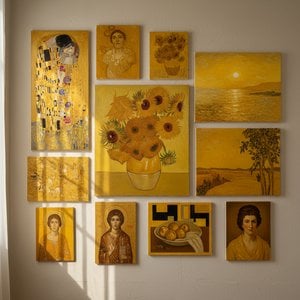
Golden Hues: Top 10 Paintings Dominated by Yellow Ochre |
Explore 10 iconic paintings bathed in golden yellow ochre! From Van Gogh's sunflowers to Monet’s haystacks, discover the stories behind these masterpieces. Find museum-quality art reproductions & elevate your home decor on .
The Subtleties of White: Exploring Absence, Light & Symbolism in Art History
Explore the profound symbolism & history of white in art! From ancient purity to modern abstraction, discover how artists have used absence & light. Expert insights from ArtsDot.

Monochrome Masters: 10 Artworks That Define Color Intensity |
Explore 10 iconic monochrome artworks – from Yves Klein to Rothko – that masterfully showcase color intensity. Discover the stories behind these timeless paintings & find museum-quality reproductions for your home at .



