
Menu
FREE ART CONSULTATION
PreviewPreview AR previewAR preview Switch to Print Switch to PrintSwitch to Image Switch to Image SendSend
DetailsDetails Add to favorites Add to favorites DownloadDownload SimilarsSimilars X-RayX-Ray DiaporamaDiaporama

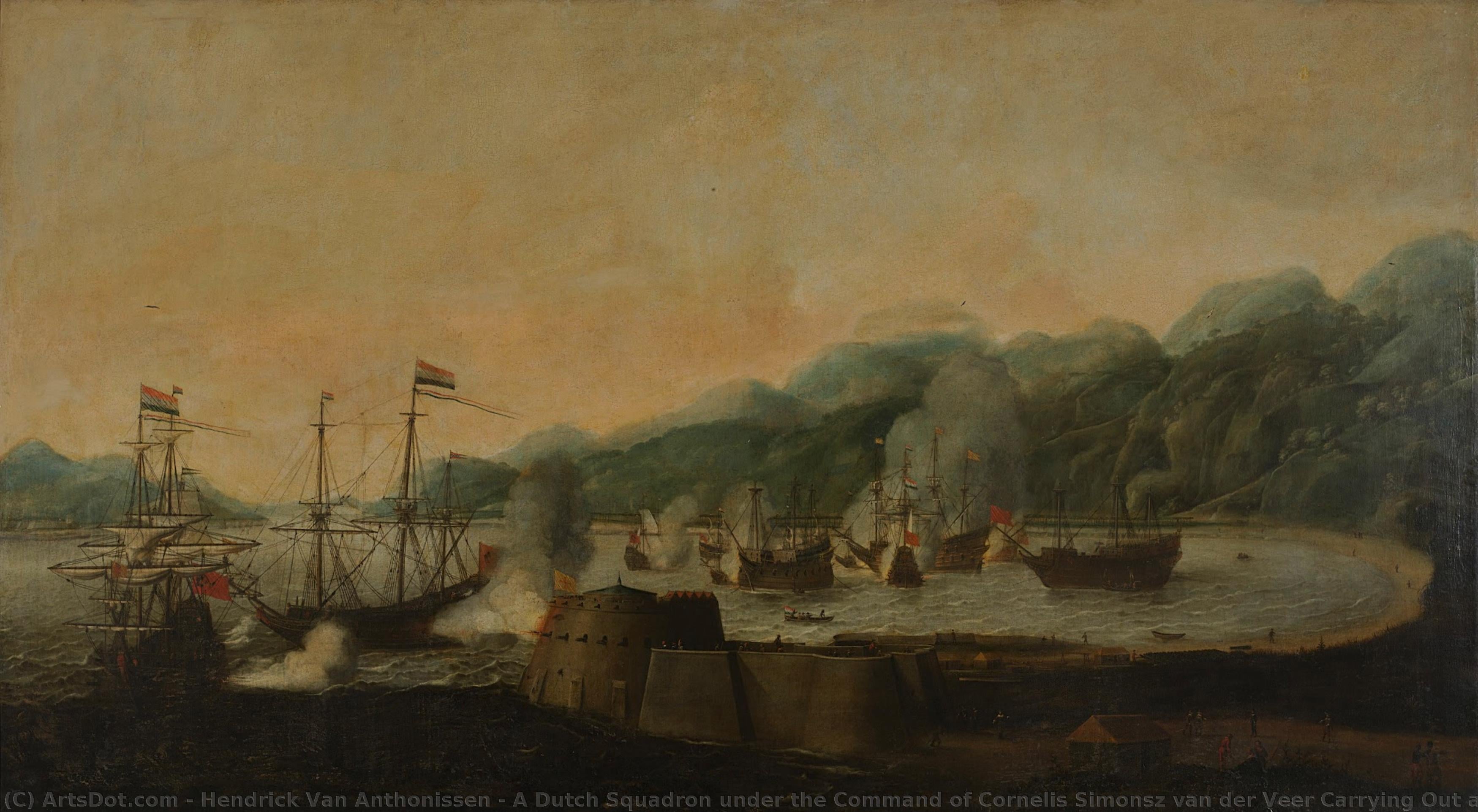
A Dutch Squadron under the Command of Cornelis Simonsz van der Veer Carrying Out a Surprise Attack on Three Portuguese Galleons in the Bay of Goa Velha, 30 September 1639, Hendrick van Anthonissen, 1653

  • Creation date1653
  • Dimensions152.0 x 276.0 cm

Discover Hendrick van Anthonissen (Hendrick Aerts), a Dutch marine painter known for evocative beach scenes & seascapes in grisaille, influenced by Jan Porcellis.

Hand Made Oil Reproduction

Hand-painted oil on canvas in your size and frame, made to order by our artists. (Switch to Print Switch to PrintSwitch to Image Switch to Image)

Standard
custom
CM
INCH

Pick from our preset sizes that match the artwork's original proportions.

width
height

You may enter your own dimensions to fit a specific frame or space. If your selected size does not match the original image's proportions, we will either crop the artwork or extend the painting with additional hand-painted elements. A digital mockup will be sent for your approval before production begins.
Please note that the on-screen preview does not reflect the actual cropping or extension. Only the mockup will accurately show the final composition.
While custom sizes are available, we recommend selecting a dimension from the predefined list to preserve the original proportions.

Examples of what can be changed: Replace face with customer photo; Add pet (e.g., replace cat with dog); Include hidden message in background; Change background landscape or elements.
After order, ArtsDot.com team will email client for instructions and provide a mockup preview

Worldwide Delivery () in 3/4 weeks instead of standard 5 weeks. (6 August). No compromise on quality.

why_choose_icon
Free Worldwide Express Shipping
why_choose_icon
High-Quality Linen Canvas
why_choose_icon
Full Shipping Insurance
why_choose_icon
Customs Tax Refund Guarantee
why_choose_icon
True Color Matching Guarantee
why_choose_icon
60-Day Return Policy (Defects Only)
why_choose_icon
100% Money-Back Guarantee
why_choose_icon
Bulk Discount Offer

Total Price

$ 263

reproduction

A Dutch Squadron under the Command of Cornelis Simonsz van der Veer Carrying Out a Surprise Attack on Three Portuguese Galleons in the Bay of Goa Velha, 30 September 1639, Hendrick van Anthonissen, 1653

Reproduction Medium

Reproduction Size

-

Total Price

$ 263

Artwork Description

This is Hendrick van Anthonissen’s largest painting by far, and is also his last known dated work. The fact that he was the artist was only discovered when his signature was revealed by cleaning shortly after the acquisition, and a little later the subject was identified by De Balbian Verster.3 The Dutch East India Company (VOC) fought bitter battles with the Portuguese in order to dominate trade with the East Indies. When Antonio van Diemen was appointed governor-general in 1636 he imposed an annual blockade near the Bay of Goa – the Portuguese headquarters in India – to make it impossible for their merchantmen to sail out. On 25 July 1639 a squadron of seven ships under the command of Admiral Cornelis Simonsz van der Veer departed from Batavia, followed by two yachts on 6 August. News reached the fleet, which had assembled just off Goa on 15 September, that the governor of the Portuguese post had died on 6 June and that his successor had sailed northward to put down an uprising by the local population. It was also rumoured that there were three unarmed galleons in the Bay of Goa Velha (Old Goa) by Fort Mormugao at the mouth of the river Zuari. Van der Veer decided to capture or destroy them in a surprise attack, which took place on 30 September. We are well-informed about the campaign from the journal of the admiral’s flagship preserved in the VOC archives.4 There are also two private eyewitness accounts, one on the Portuguese side, the other a Dutch report that was published as a pamphlet in 1640 and was also translated into English that year.5 In view of the large size of Van Anthonissen’s painting and its unusual subject, it is likely that it was made on commission. It is certainly odd that it was awarded so many years after the event, by which time the principal character, Admiral Van der Veer, was already dead. Given the accuracy of the picture and the detailed record of the fighting, the work must have been ordered by a person or body with some involvement in the action and was thus in a position to serve as a source of information for the artist. Van Anthonissen’s account is precise in both its broad outline and numerous details. While the other Dutch ships have already sailed into the bay, the Middelburch and Nieuw Haerlem in the left foreground, identified by their city coats of arms on the foredecks, are under fire from the fort. Both were heavily laden with trade goods, which is why they brought up the rear after the smaller vessels had hoisted flags to signal that there was safe passage to deep water. The Nieuw Haerlem was the flagship and is recognizable as such from the admiral’s pennant flying from the main topmast. But Admiral Van der Veer, who had initially sailed into the bay aboard the Zierikzee, can be seen here in a rowing boat, wearing his sash and giving orders with a gesture of his arm. The Dutch reports do indeed state that he commanded the action from a launch. Further off in the background are the cumbersome shapes of the three Portuguese galleons: São Boaventura in the middle, armed but not ready to sail, flanked by the Bom Jesus and the São Sebastião, which lay unarmed in the bay. Van Anthonissen depicted them without cannon, yards or sails, and they are being overmastered by Dutch soldiers clambering up over the hull to the deck from rowing boats lying alongside. There are more details showing that the artist was very well informed indeed. The fact that the Middelburch anchored off the fort is described in the official record, while the statement that the guns from the two unarmed galleons were lying on the beach is mentioned in the Portuguese files. Van Anthonissen would also have been able to learn a great deal from an eyewitness, if there was one to hand, but he very probably just consulted written sources. It is not clear whether he saw a copy of the Portuguese report, but it cannot be ruled that the VOC archives had more accounts of the battle than have come down to us. All of them were secret, anyway, and only the company could have given permission for an outsider to see them. De Balbian Verster’s suggestion that the painting was ordered by the VOC is therefore plausible.6 His proposition that it was intended for a meeting room of its board is also very possible, given the work’s size, but cannot be verified. It is uncertain whether the directors or one of the six chambers of the corporation awarded the commission, and it is not even known precisely what was to be seen in the assembly hall of the VOC’s main office, that of Amsterdam. The composition does not appear to have been copied directly from another visual source with a view of Goa Velha. The company’s chartrooms were anyway amply supplied with cartographic and other material that an artist could have consulted in preparation. A realistic depiction of the fort was evidently felt to be less important, for it appears to be a figment of the artist’s imagination.7 The attack was not depicted again until a good deal../..

Artist Biography

early life and career

hendrick van anthonissen was a dutch marine painter, born on may 29, 1605, in amsterdam. he was the son of aert anthonisz and painted in the style of his brother-in-law and teacher jan porcellis. van anthonissen's early life and career are not well-documented, but it is known that he lived in the hague, leiden, and leiderdorp in the 1630s.

artistic style and works

van anthonissen is known for his beach scenes and seascapes, often painted in grisaille, a style characterized by the use of shades of gray to create a sense of depth and atmosphere. his paintings are reminiscent of those by jan porcellis, who was a prominent marine painter of the time. van anthonissen's works can be found in various museums, including the hermitage in st. petersburg and the prague gallery.

influences and legacy

van anthonissen was influenced by his brother-in-law jan porcellis, who is known for his innovative approach to marine painting. jan porcellis is credited with initiating a "decisive transition from early realism to the tonal phase" in marine painting, and van anthonissen's works reflect this style. for more information on jan porcellis, visit https://en.wikipedia.org/wiki/jan_porcellis.

notable works and collections

some of van anthonissen's notable works can be found on ArtsDot.com, including his beach scenes and seascapes. his paintings are also part of the collection at the rijksdienst beeldende kunst in the hague, netherlands. for more information on the museum's collection, visit https://ArtsDot.com/@@/a@d3blbp-the-museum-rijksdienst-beeldende-kunst-(the-hague-netherlands).
  • hendrick van anthonissen was a dutch marine painter who lived in amsterdam.
  • he painted in the style of his brother-in-law and teacher jan porcellis.
  • van anthonissen's works can be found in various museums, including the hermitage and the prague gallery.
  • he was influenced by jan porcellis, who is known for his innovative approach to marine painting.
important works by van anthonissen can be found on ArtsDot.com, and more information on his life and career can be found on https://en.wikipedia.org/wiki/jan_porcellis.
hendrick van anthonissen

hendrick van anthonissen

1605 - 1656 , Netherlands

Quick Facts

  • Artistic Movement Or Style: Romanist
  • Artists Or Movements Influenced By This Artist: ['Accademia e Compagnia']
  • Artists Who Influenced This Artist: ['Pieter Aertsen']
  • Date Of Birth: 1523
  • Date Of Death: 1605
  • Full Name: Johannes Stradanus
  • Nationality: Flemish
  • Notable Artworks:
    • Altarpieces
    • Tapestry designs
    • Prints
  • Place Of Birth: Bruges, Flanders
Explore artworks organized by themes, styles, and characteristics.



































