

 Preview
 Send
Send Share
Share
 Details

 Download
 Similars
 X-Ray
X-Ray Diaporama
Title in Swedish: Frukostdags
 Oil On Canvas
- WallArt
- Impressionism
 1887
1887- 19th Century
 910.0 x 870.0 cm
 Nationalmuseum
 Read More
Hand Made Oil Reproduction
Hand-painted oil on canvas in your size and frame, made to order by our artists. ( Switch to Print Switch to Image)




P118B $10

P118H $10

P118W $10

P438Z $10

P508JH $12

P508YH $12

P805H $10

P805Z $10

P919BZ $10

P919G $10

P919XJ $10

P959ZH $10

P968JZ $12

W106C $8

W218G $10

W218JH $8

W218Y $10

W307PJ $10

W316G $10

W316PJ $8

W316Y $10

W398PJ $8

W4111J $10

W500HY $15

W500JH $15

W692G $12

W849H $8

W940BG $15

W953PJ $8




Pick from our preset sizes that match the artwork's original proportions.

You may enter your own dimensions to fit a specific frame or space. If your selected size does not match the original image's proportions, we will either crop the artwork or extend the painting with additional hand-painted elements. A digital mockup will be sent for your approval before production begins.
Please note that the on-screen preview does not reflect the actual cropping or extension. Only the mockup will accurately show the final composition.
While custom sizes are available, we recommend selecting a dimension from the predefined list to preserve the original proportions.
After order, ArtsDot.com team will email client for instructions and provide a mockup preview
Worldwide Delivery () in 3/4 weeks instead of standard 5 weeks. (8 August). No compromise on quality.

Free Worldwide Express Shipping

High-Quality Linen Canvas

Full Shipping Insurance

Customs Tax Refund Guarantee

True Color Matching Guarantee

60-Day Return Policy (Defects Only)

100% Money-Back Guarantee

Bulk Discount Offer
 Glass option is only available in size under 110 CM

Title in Swedish: Frukostdags
Reproduction Medium
Reproduction Size
-


Total Price
$ 263
Artwork Description
A Morning Captured in Light: The Enchantment of Breakfast-Time
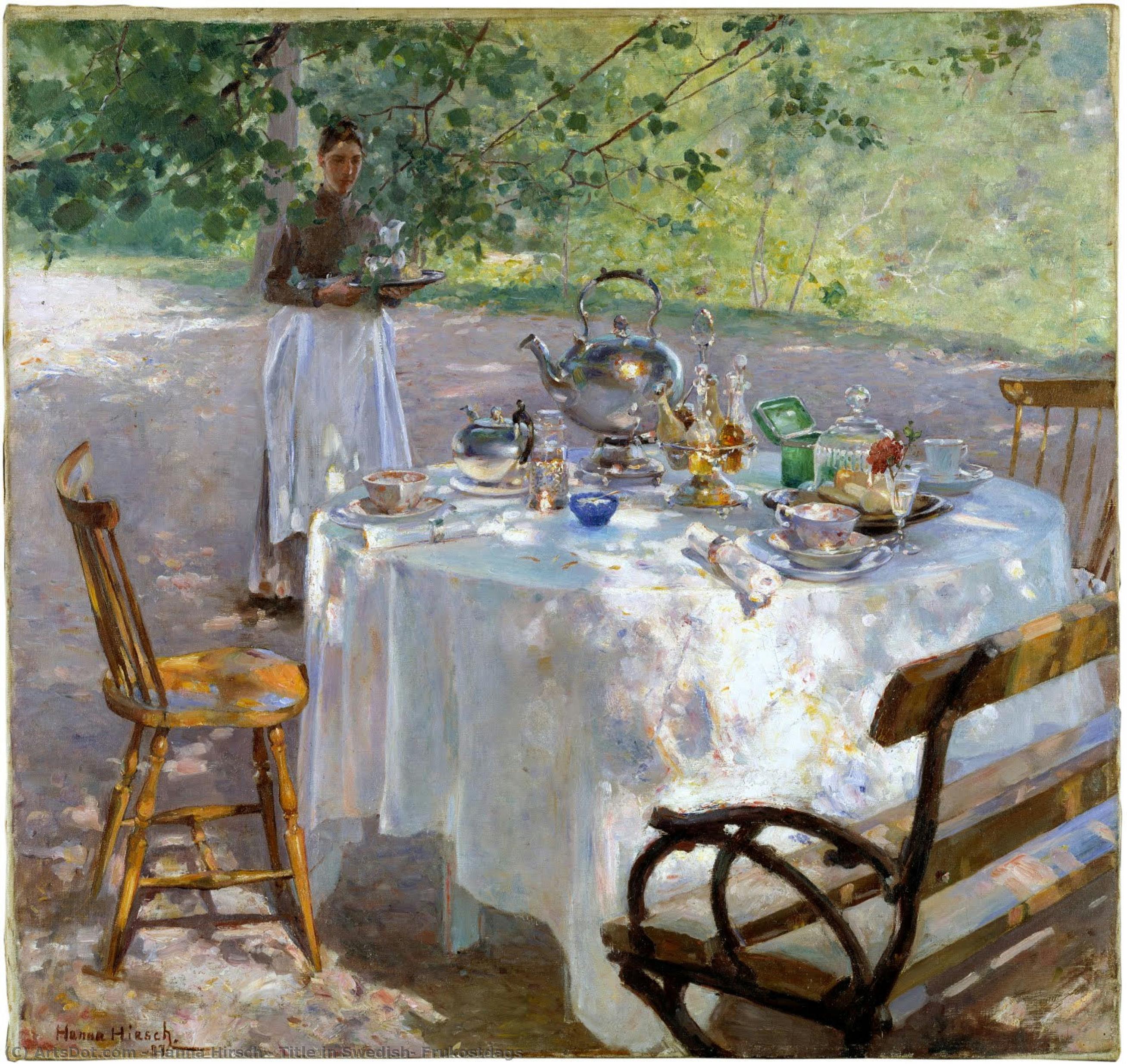
There is a profound, quiet magic found in the ritual of a morning meal, a sensation that Hanna Hirsch-Pauli captures with breathtaking intimacy in her 1887 masterpiece, Frukostdags (Breakfast-Time). To gaze upon this canvas is to be instantly transported into a sun-drenched garden, where the boundaries between the domestic sphere and the natural world dissolve. The painting does more than merely depict a scene; it invites the viewer to pull up a chair. One can almost feel the weight of the heavy teapot as it tilts, the cool touch of the porcelain, and the gentle warmth of the dappled sunlight filtering through the leaves. It is an invitation to slow down, to breathe, and to find beauty in the most mundane moments of our daily lives.
The composition serves as a bridge between two worlds, blending the structured elegance of the classicist tradition with the vibrant, sensory energy of Impressionism. While Hirsch-Pauli utilizes a precise linear perspective to ground the dining table and its various objects—cups, bowls, spoons, and bottles—she breathes life into the scene through a technique known as juste-milieu. This approach allows her to maintain the formal integrity of the bourgeois setting while embracing the revolutionary way light interacts with color. The sunlight does not merely illuminate the scene; it dances across the tablecloth in shimmering flecks, creating a suggestive luster that makes the objects appear to vibrate with life.
Technique and the Controversy of Brilliance
For the discerning collector or lover of fine art, the technical execution of Frukostdags offers a fascinating study in courage. At the time of its debut, Hirsch-Pauli’s lively brushstrokes and thick application of paint were met with skepticism by certain Swedish critics, who disparagingly labeled her technique as "slipshod." Some even suggested that the brilliant flecks of light on the linen were nothing more than the accidental marks of a messy brush. However, what the critics perceived as lack of control was, in reality, a masterful command of colorism. Hirsch-Pauli used light not just as an effect, but as a physical presence, using texture to mimic the way sunlight breaks through a canopy of trees.
This mastery of light and texture is precisely what makes a high-quality reproduction of this work so impactful for interior design. The painting possesses a unique ability to breathe life into a room, acting as a window to an eternal summer morning. Whether placed in a sunlit breakfast nook or a sophisticated dining hall, the artwork brings a sense of airy luminosity and organic warmth. It serves as a focal point that stimulates conversation, drawing the eye toward its intricate details—the glint of a spoon, the soft shadows beneath a chair, and the lush, verdant backdrop that promises peace and tranquility.
A Legacy of Domestic Grace and Feminine Perspective
Beyond its aesthetic brilliance, Frukostdags stands as a significant milestone in the career of Hanna Hirsch-Pauli, marking her breakthrough into the upper echelons of the Swedish art scene. As an artist who studied in Paris and exhibited at the prestigious Salon, she brought a cosmopolitan sophistication to her depictions of Swedish life. Her work often explores the nuances of women’s roles and the quiet dignity found within domesticity. In this painting, the woman at the table is not merely a subject but a participant in a serene, almost sacred ritual of nourishment and presence.
For those seeking to adorn their homes with art that evokes emotion, this piece offers an unparalleled sense of sensual pleasure and nostalgia. It captures a "corner of reality" where the heavy architecture of the dining room has been replaced by the lightness of the garden. Owning a reproduction of such a significant work allows one to preserve this feeling of domestic harmony and light-filled grace, ensuring that the inviting atmosphere of Hirsch-Pauli’s vision remains a permanent part of your personal sanctuary.
Related Artworks
![Wheat Field With Rising Sun [1889] — Vincent Willem Van Gogh, Post-impressionism](/media/artworks/images/thumbnails/4e/b7/4eb78d0852474b23b1a57fdd8bb7f333.jpg)


Artist Biography
**early life and education**
hanna hirsch, later hanna pauli (stockholm, 13 january 1864 – 29 december 1940, solna), was a swedish painter primarily of genre scenes and portraits. born in stockholm, sweden, hirsch received her early education at the august-malström school of painting for women.**artistic career**
hanna hirsch's artistic career began with studies at the konstakademien (1881-85) and later in paris, where she honed her skills. her work is characterized by its focus on genre scenes and portraits, often depicting the lives of women and their daily routines.- breakfast-time (1887), a painting showcasing a moment of domesticity, is one of her most notable works. this piece can be found in the nationalmuseum (stockholm, sweden) and is a testament to hirsch's ability to capture the essence of everyday life.
- vänner (circa 1890), another significant work, highlights her skill in portraying the warmth of friendships. this painting is also housed at the nationalmuseum.
**feminism and art**
hirsch's work not only showcases her artistic prowess but also reflects her feminist stance. her depictions of women in their daily lives, free from the constraints of traditional roles, are a testament to her progressive views. this is particularly evident in her letters written during her study trips to paris (1885-87), which offer a unique insight into her experiences as a woman artist in a male-dominated field.**legacy and resources**
for those interested in delving deeper into hanna hirsch's life and work, the following resources are recommended:- wikiart.org: provides an extensive collection of her artworks.
- wikipedia: offers a concise biography and overview of her artistic career.
- nationalmuseum's collection: features several of her notable works, including breakfast-time and vänner.
**conclusion**
hanna hirsch's legacy as a swedish painter is not only marked by her captivating genre scenes and portraits but also by her contribution to the feminist movement through her art. her work continues to inspire, offering a unique window into the lives of women in late 19th-century sweden.
hanna hirsch
1864 - 1940 , Sweden
Quick Facts
- Artistic Movement Or Style: Post-Impressionism
- Artists Or Movements Influenced By This Artist: ['George Seurat']
- Artists Who Influenced This Artist:
- Paul Cézanne
- Vincent van Gogh
- Date Of Birth: November 24, 1864
- Date Of Death: September 9, 1901
- Full Name: Henri Marie Raymond de Toulouse-Lautrec
- Nationality: French
- Notable Artworks:
- La Blanchisseuse
- Moulin Rouge
- Place Of Birth: Camjac, Aveyron, France
Related Articles

Cultivating Paradise: A Historical & Artistic Exploration of Gardens in Painting
Explore the rich history of gardens in painting! Discover masterpieces from Renaissance to Impressionism & beyond. Learn about symbolism, artists like Monet & Klimt, and find your perfect artwork at ArtsDot.
Impressionist Landscapes: 10 Masterpieces for Your Home | ArtsDot
Journey through 10 iconic Impressionist landscapes by Monet, Renoir & Degas. Explore the history, techniques & emotions behind these masterpieces. Find museum-quality reproductions for your home at ArtsDot.com – where art comes to life! Discover all masterpieces on ArtsDot.com

Renoir's Masterpieces: Explore 25 Iconic Paintings & Bring Art Home | ArtsDot
Explore 25 iconic Pierre-Auguste Renoir paintings! Discover the stories behind Impressionist masterpieces like 'Dance at Le Moulin de la Galette' & 'Luncheon of the Boating Party'. Find museum-quality art reproductions and elevate your home decor with ArtsDot.com.

Impressionistic Landscapes: 10 Masterpieces That Changed Art & Decor
Journey into the heart of Impressionism! Explore 10 masterpieces by Monet, Renoir & Degas that revolutionized landscape art. Discover their stories, techniques & find museum-quality reproductions to elevate your home decor on ArtsDot.com.

Impressionism's Finest: 10 Masterpieces That Revolutionized Art | ArtsDot
Journey through Impressionism's golden age! Explore 10 masterpieces by Monet, Renoir & Degas that redefined art. Discover the stories behind these iconic paintings and find museum-quality reproductions to elevate your home decor on ArtsDot.com.



