- Home

- Oil Painting Reproduction
- Severin Roesen
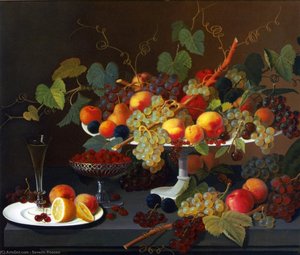
- Still Life, Flowers, and Fruit

 Buy print
 Send
Send Share
Share
 Details

 Download
 Similars
 X-Ray
X-Ray Diaporama
Still Life, Flowers, and Fruit
 Baroque Realism
 1848
1848 108.0 x 83.0 cm
Hand Made Oil Reproduction
Hand-painted oil on canvas in your size and frame, made to order by our artists.




































 Read more
Pick from our preset sizes that match the artwork's original proportions.

You may enter your own dimensions to fit a specific frame or space. If your selected size does not match the original image's proportions, we will either crop the artwork or extend the painting with additional hand-painted elements. A digital mockup will be sent for your approval before production begins.
Please note that the on-screen preview does not reflect the actual cropping or extension. Only the mockup will accurately show the final composition.
While custom sizes are available, we recommend selecting a dimension from the predefined list to preserve the original proportions.
After order, ArtsDot.com team will email client for instructions and provide a mockup preview
Worldwide Delivery () in 3/4 weeks instead of standard 5 weeks. (1 July). No compromise on quality.

Free Worldwide Express Shipping

High-Quality Linen Canvas

Full Shipping Insurance

Customs Tax Refund Guarantee

True Color Matching Guarantee

60-Day Return Policy (Defects Only)

100% Money-Back Guarantee

Bulk Discount Offer
 Glass option is only available in size under 110 CM

Still Life, Flowers, and Fruit
Reproduction Medium
Reproduction Size
-


Total Price
-
Artwork Description
Related Artworks


Artist Biography
Severin Roesen (1815 – After 1872): The Painter of Fruitful Abundance
Severin Roesen remains an enigmatic figure in American art history, a German immigrant who achieved considerable renown for his captivating depictions of fruit and flower still lifes. Despite the scarcity of biographical details—primarily centered around his birth in Boppard, Germany—Roesen’s prolific output and distinctive artistic style cemented his place as one of the foremost practitioners of this genre during the mid-nineteenth century.
Little is known about Roesen's formative years. He was baptized on February 5, 1816, in Boppard, Prussia (now Germany), into a family with roots tracing back to Stephanus and Margaretha Krebs. While precise information regarding his formal education remains elusive, evidence suggests he honed his artistic skills as a porcelain painter in Cologne—a craft that would inform his later explorations of color and texture.
His marriage to Sophia Jacobina Lambricht in 1847 marked the beginning of a family life that included two children. Roesen’s relocation to New York City in December 1847 coincided with his involvement in the American Art-Union, where he showcased eleven paintings between 1848 and 1852—a pivotal moment demonstrating his commitment to establishing himself within the burgeoning artistic landscape of America.
The untimely death of Sophia Lambricht in October 1849 prompted Roesen’s second marriage to Wilhelmine Ludwig, with whom he established a home in Pennsylvania. Their family continued to grow, welcoming Minnie (born 1854) and Oscar (born 1857), further enriching his personal life.
Roesen's artistic trajectory shifted decisively when he moved to Williamsport, Pennsylvania, around 1863—a location that would become synonymous with his creative output. During this period, he actively participated in the artistic community of Pennsylvania and exhibited works at institutions like the Maryland Historical Society and the Pennsylvania Academy of Fine Arts.
Roesen’s distinctive style—characterized by meticulous attention to detail and a masterful manipulation of color—was profoundly influenced by Dutch still life painters of the seventeenth century, particularly Jan van Huysum. He adopted techniques that prioritized precise arrangement and luminous brushwork, mirroring the conventions established by his predecessors.
Perhaps Roesen’s most remarkable achievement was his prolific production of over three hundred still lifes—a staggering number considering the limited biographical data available. Remarkably, only approximately two dozen paintings bear dates, highlighting the artist's dedication to capturing fleeting moments of beauty and preserving them in enduring compositions.
A testament to Roesen’s artistic legacy is the discovery of his paintings in Williamsport—a treasure trove unearthed by art historian Judith Hansen O’Toole. These works exemplify the aesthetic sensibilities of the era, reflecting a widespread appreciation for the richness and abundance of American life during the mid-nineteenth century.
Notably, Jacob Flock, a prominent hotelier and brewer in Williamsport, amassed more than fifty paintings by Roesen—a gesture indicative of the artist’s popularity within the town's German-American community. These paintings were exchanged for lodging and beer—Roesen’s favored beverage—demonstrating the symbiotic relationship between art and daily life.
His final dated painting dates back to 1872, marking the culmination of a lifetime devoted to artistic exploration. Despite the absence of comprehensive biographical information regarding his subsequent years, Roesen's enduring contribution to American still life painting remains undeniable—a legacy preserved through the remarkable survival of his oeuvre.

Severin Roesen
1815 - 1872 , Germany
Quick Facts
- Artistic Movement Or Style: Realism
- Artists Or Movements Influenced By This Artist: ['Dutch Still Life']
- Artists Who Influenced This Artist: ['Jan van Huysum']
- Date Of Death: c. 1872
- Full Name: Severin Roesen
- Nationality: German
- Notable Artworks:
- Still Life with Fruit
- Flower Still Life
- Place Of Birth: Boppard, Germany
Related Articles

Bridging Centuries: Digital Visualization & Classical Oil Painting Techniques in Contemporary Art Commissioning
Discover the art of commissioning bespoke oil paintings blending classical techniques with modern digital precision. Expert artists, personalized service & museum-quality results. Invest in a timeless masterpiece today.


John Frederick Lewis: Orientalism, Detail & Genre Painting in 19th-Century British Art
Explore the captivating Orientalist paintings of John Frederick Lewis! Discover his mastery of detail, genre scenes & influence on 19th-century British art. Learn about his life, techniques & legacy at ArtsDot.

Iconic Art of the 18th & 19th Centuries: Masterpieces for Your Home | ArtsDot
Journey through 18th & 19th century art! Explore iconic masterpieces by Monet, Van Gogh & more. Discover the stories behind these timeless paintings and find museum-quality reproductions for your home at ArtsDot.com.

Abraham Hendricksz van Beyeren: Pioneering Dutch Still Life & the Banquet Tradition
Explore the captivating world of Dutch Golden Age still life with Abraham van Beyeren. Discover his innovative techniques, symbolic banquet scenes & lasting influence on art history. Learn about collecting these masterpieces.

Jan Jansz Wijnants: A Study in Dutch Golden Age Still Life & Floral Transience
Explore the captivating world of Jan Wijnants and Dutch Golden Age still life painting. Discover symbolism, masterful techniques & lasting influence on floral art history. Learn more!