Preview
 Send
Send Share
Share
 Details
 Guide
Guide

 Download
 Similars
 X-Ray
X-Ray Diaporama
 Q&A
Q&A Stats
StatsHuman Fragility

- 199.0 x 134.0 cm


 Read More
Giclée / Art Print
Museum-quality giclée or canvas print with fast production and flexible finish options. ( Buy Hand Made Painting Switch to Digital Image)




P118B $10

P118H $10

P118W $10

P438Z $10

P508JH $12

P508YH $12

P805H $10

P805Z $10

P919BZ $10

P919G $10

P919XJ $10

P959ZH $10

P968JZ $12

W106C $8

W218G $10

W218JH $8

W218Y $10

W307PJ $10

W316G $10

W316PJ $8

W316Y $10

W398PJ $8

W4111J $10

W500HY $15

W500JH $15

W692G $12

W849H $8

W940BG $15

W953PJ $8




Pick from our preset sizes that match the artwork's original proportions.

Type the width and the height you need, to fit your frame or your wall. A print can only be cut, never made bigger than the picture, so a size with a different shape loses a part of the image. We send you a digital mockup to approve before we print anything. The picture shown on this page does not show the real cut — only the mockup does.
Worldwide Delivery () in 2 weeks instead of standard 4/5 weeks. (5 November)

Free Worldwide Express Shipping

High-Quality Linen Canvas

Full Shipping Insurance

Customs Tax Refund Guarantee

True Color Matching Guarantee

100-Day Return Policy (Defects Only)

100% Money-Back Guarantee

Bulk Discount Offer
 Glass option is only available in size under 110 CM

Human Fragility
Giclée / Art Print
Reproduction Size
-


Total Price
$ 63
A Portrait of Mortality: Salvator Rosa’s “Human Fragility”
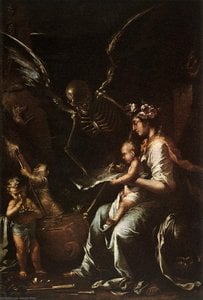
Salvator Rosa's "Human Fragility," painted in 1656 during the devastating Naples plague, is more than just a depiction of a somber scene; it’s a profound meditation on life, death, and the precariousness of human existence. Housed within the hallowed halls of the Fitzwilliam Museum in Cambridge, this oil-on-canvas masterpiece transcends its historical context to resonate powerfully with viewers today. Measuring an imposing 199 x 134 cm, the painting immediately commands attention with its dramatic chiaroscuro – a masterful manipulation of light and shadow characteristic of the Baroque period, yet imbued with Rosa’s distinctly personal vision.
At first glance, the composition appears straightforward: a woman seated with her child, a skeletal figure looming in the background. However, a closer examination reveals a complex tapestry of symbolism woven into every element. The central figures – Lucrezia, Rosa's mistress and mother to his son Rosalvo – are rendered with an unsettling stillness, their faces betraying neither joy nor sorrow, reflecting perhaps the acceptance of fate that accompanies profound loss. The child’s clenched wrist, gripped by the skeletal hand of Death, is a potent memento mori, a stark reminder of the fleeting nature of youth and vitality. The angel of death, not depicted as a terrifying demon but rather as a subtly manipulative force, guides the boy's hand to write the chilling inscription: “Conceptio Culpa, Nasci Pena, Labor Vita, Necesse Mori” – ‘Conception is a sin, Birth is pain, Life is toil, Death a necessity.’ This concise yet devastating phrase encapsulates the entire painting’s theme, highlighting the inherent burdens of existence.
Baroque Drama and Personal Vision
Rosa's artistic style in “Human Fragility” seamlessly blends elements of Baroque drama with his own intensely personal vision. He was deeply influenced by the naturalism of Italian painter Carlo Dolci, particularly in his use of light and shadow to create a sense of depth and atmosphere. Yet, unlike Dolci’s often serene depictions of religious subjects, Rosa injects a palpable sense of unease and melancholy into his work. The dark, almost claustrophobic background, punctuated by the stark white of the skeleton, creates a dramatic contrast with the figures in the foreground, drawing the viewer's eye to their plight. His brushwork is loose and expressive, conveying both meticulous detail and an underlying sense of urgency – as if he were attempting to capture a fleeting moment before it vanished entirely.
Rosa’s decision to depict this particular scene during a period of immense personal tragedy adds another layer of complexity to the painting. The plague that ravaged Naples in 1655 claimed the lives of his son, brother, sister, and her husband – a devastating loss that undoubtedly informed the work's somber tone. The inclusion of elements like the ring of pale roses around Lucrezia’s head—a reference to her family name—suggests a deeply personal connection to the subject matter, transforming the painting from a generic allegory into a poignant portrait of grief and acceptance.
Symbolism Beyond Mortality
Beyond its immediate message about mortality, “Human Fragility” is rich in symbolic detail. The bubbles floating upwards from the child’s hand represent the brevity of human life – a fleeting existence compared to the vastness of eternity. The statue of Terminus, the Roman god of death, positioned at the left edge of the painting, further reinforces this theme. Rosa's inclusion of his own initials on the blade of a knife—a symbol of death—adds a layer of self-awareness and perhaps even regret to the composition. The painting is not simply about death; it’s about confronting the inevitability of loss and finding meaning in the face of suffering.
A Legacy of Influence
Salvator Rosa's “Human Fragility” stands as a pivotal work in the history of art, influencing generations of artists with its dramatic intensity and profound exploration of human themes. His innovative landscapes, often depicting wild and untamed nature, paved the way for the Romantic movement, inspiring artists to embrace emotion and individualism. Today, reproductions of this powerful painting continue to captivate audiences worldwide, serving as a timeless reminder of our shared mortality and the enduring beauty of the human spirit.
Questions & Answers
What is the dominant hue of "Human Fragility" by Salvator Rosa?
A golden yellow range hue runs through "Human Fragility" by Salvator Rosa.
Is "Human Fragility" by Salvator Rosa a well-known artwork?
"Human Fragility" by Salvator Rosa has a recognized popularity level. This classification reflects how widely the work is recognized.
Who is the artist behind "Human Fragility"?
"Human Fragility" is attributed to Salvator Rosa.
Related Artworks


Artist Biography
**early life and training**
salvator rosa, an italian baroque painter, poet, and printmaker, was born in arenella, naples, on either june 20 or july 21, 1615. his mother, giulia greca rosa, was a member of one of the greek families of sicily. despite his father's wishes for him to become a lawyer or priest, salvator showed a preference for the arts from an early age.**artistic career**
salvator rosa's artistic career was marked by his unorthodox and extravagant style, which set him apart from his contemporaries. he was active in naples, rome, and florence, and his work was influenced by the naturalism of ribera and the classicism of poussin. however, he refused to be tied down by any particular style or movement.- pythagoras emerging from the underworld (kimbell art museum, fort worth, united states), one of his most famous works, showcases his unique blend of philosophical and artistic themes.
- his the baptism of the eunuch (chrysler museum of art, norfolk, united states) demonstrates his ability to infuse high drama into even minor bible stories.
**influences and legacy**
salvator rosa's work had a significant impact on the development of baroque art. his influence can be seen in the works of later artists, such as luca giordano, who continued to push the boundaries of artistic expression. **important links:** salvator rosa's profile on ArtsDot wikipedia: salvator rosa pythagoras emerging from the underworld on ArtsDot**conclusion**
salvator rosa's life and work continue to fascinate art lovers and historians alike. his unorthodox style and perpetual rebellion against the norms of his time have cemented his place in the annals of baroque art. as a painter, poet, and printmaker, he remains an enigmatic figure, and his work continues to inspire new generations of artists and art enthusiasts.
Salvator Rosa
1615 - 1673 , Italy
Quick Facts
- Full Name: Salvator Rosa
- Nationality: Italian
- Date Of Birth: 1615
- Date Of Death: 1673
- Place Of Birth: Arenella, Italy
- Notable Artworks:
- View of the Gulf of Salerno
- Study for 'Il Genio di Rosa
- Grotto with Cascades
- Artistic Movement Or Style: Baroque art
- Artists Who Influenced This Artist: ['José de Ribera']
- Artists Or Movements Influenced By This Artist: ['Luca Giordano']
Related Articles

Baroque Masterpieces: 10 Paintings That Defined an Era |
Journey through the drama & grandeur of Baroque art! Explore 10 masterpieces by Caravaggio, Rembrandt, Rubens & more. Discover stunning oil paintings, rich colors & timeless stories. Find museum-quality reproductions at .

Salvator Rosa: A Baroque Rebel's Vision of Landscape, Allegory & the Human Condition
Explore the captivating world of Salvator Rosa, a rebellious Baroque master. Discover his dramatic landscapes, allegorical paintings & lasting influence on Romanticism. Hand-painted reproductions available at ArtsDot.

The Enduring Power of Painting: A Historical & Contemporary Exploration of Form and Emotion
Explore the rich history & enduring techniques of oil painting with ArtsDot. Discover masterpieces, learn about art collecting, and find authentic handmade reproductions crafted by skilled artists.

Baroque Drama: Bringing Opulence & Emotion into Contemporary Interiors
Explore the opulent world of Baroque interior design! Discover key elements, modern applications & how to bring dramatic elegance into your home with ArtsDot.com's authentic reproductions.

The Enduring Legacy of Oil on Canvas: Technique, History & Aesthetic Impact
Explore the rich history & techniques of oil painting – from Renaissance masters to Impressionism. Discover pigments, layering methods, and why this timeless medium endures. Expert insights for artists & art enthusiasts.