

 Preview
 Send
Send Share
Share
 Details
 Guide
Guide

 Download
 Similars
 X-Ray
X-Ray Diaporama
 Q&A
Q&A Stats
StatsInvisible Man


 Read More
The artwork displayed on this page is protected by copyright law, which means we cannot legally create or sell an identical reproduction. This protection is enforced under international agreements such as the Berne Convention and by national laws, including those outlined by the U.S. Copyright Law - Title 17.
This method fully complies with copyright regulations because it does not involve copying or duplicating the protected artwork. Instead, it is a creative reinterpretation - a new painting that is influenced by the original but not identical to it.
Giclée / Art Print
Museum-quality giclée or canvas print with fast production and flexible finish options. ( Buy Hand Made Painting Switch to Digital Image)




P118B $10

P118H $10

P118W $10

P438Z $10

P508JH $12

P508YH $12

P805H $10

P805Z $10

P919BZ $10

P919G $10

P919XJ $10

P959ZH $10

P968JZ $12

W106C $8

W218G $10

W218JH $8

W218Y $10

W307PJ $10

W316G $10

W316PJ $8

W316Y $10

W398PJ $8

W4111J $10

W500HY $15

W500JH $15

W692G $12

W849H $8

W940BG $15

W953PJ $8




Pick from our preset sizes that match the artwork's original proportions.

Type the width and the height you need, to fit your frame or your wall. A print can only be cut, never made bigger than the picture, so a size with a different shape loses a part of the image. We send you a digital mockup to approve before we print anything. The picture shown on this page does not show the real cut — only the mockup does.
Worldwide Delivery () in 2 weeks instead of standard 4/5 weeks. (8 November)

Free Worldwide Express Shipping

High-Quality Linen Canvas

Full Shipping Insurance

Customs Tax Refund Guarantee

True Color Matching Guarantee

100-Day Return Policy (Defects Only)

100% Money-Back Guarantee

Bulk Discount Offer
 Glass option is only available in size under 110 CM

Invisible Man
Giclée / Art Print
Reproduction Size
-


Total Price
$ 63
Introduction
Salvador Dalí, one of the most famous surrealist painters, created a masterpiece called 'The Invisible Man' between 1929 and 1932. This painting is now part of the collection at the Museo Nacional Centro de Arte Reina Sofía in Madrid. The Invisible Man is an experimental work that combines ancient Egyptian art and the work of Giuseppe Arcimboldo, resulting in a unique and thought-provoking piece.Background
Dalí was born in Figueres, Spain, in 1904 and died in 1989. He is best known for his surrealist paintings, which often featured dreamlike and fantastical scenes. The Invisible Man is no exception, as it showcases the artist's fascination with the subconscious mind and its ability to create unexpected juxtapositions.Analysis
The Invisible Man measures 140 cm x 81 cm and is painted in oil on canvas. The painting features a man's face, which appears to be made up of various objects, such as a clock, a telephone, and a shoe. These objects are arranged in a way that creates an illusion of depth and perspective, making the face appear three-dimensional. The title of the painting, 'The Invisible Man,' suggests that the man's face is not visible, but rather made up of various objects. This interpretation is supported by the fact that the face is not painted in a realistic manner, but rather as an abstract composition of different elements.Interpretation
The Invisible Man can be interpreted in many ways, but one possible interpretation is that it represents the idea that our perception of reality is influenced by our experiences and preconceptions. The various objects that make up the face could represent different aspects of the man's personality or his past experiences. Another interpretation is that the painting is a commentary on the role of technology in modern society. The inclusion of objects such as a telephone and a clock suggests that technology has become an integral part of our lives, shaping how we perceive and interact with the world around us.Conclusion
The Invisible Man is a masterpiece of surrealist art that challenges our perception of reality. Through its abstract composition and thought-provoking title, the painting invites viewers to consider the relationship between our experiences, preconceptions, and the world around us. The Invisible Man is a must-see for anyone interested in surrealism or modern art. Salvador Dalí: The Invisible Man, oil on canvas, 140 cm x 81 cm, Museo Nacional Centro de Arte Reina Sofía , Madrid. References: - The Invisible Man by Salvador Dalí, ArtsDot.com. - The Invisible Man (painting) - Wikipedia. - 3.7: Dada and Surrealism (II) - Humanities LibreTexts. - The Invisible Man | Fundació Gala - Salvador Dalí.Questions & Answers
Where can I buy a print of "Invisible Man" by Salvador Dalí?
To get a print of "Invisible Man" by Salvador Dalí, simply order it on its Fine Art Print page: a fine art print on cotton canvas or archival canvas paper.
What is "Invisible Man" about, and what atmosphere does it have?
"Invisible Man" shows salvador dalí, surrealism, face, objects, illusion, depth, time, technology, and its recorded mood is mystical.
What space is suggested for "Invisible Man" by Salvador Dalí?
"Invisible Man" by Salvador Dalí is recommended for a living room. This suggestion is based on the work's subject, colors and mood.
Related Artworks


Artist Biography
A Life Shaped by Shadows and Dreams
In the sun-drenched town of Figueres, Spain, a child arrived into a world already marked by a profound sense of loss. Nine months before his birth, an older brother, also named Salvador, had passed away, leaving behind a heavy shadow that would later haunt the artist's canvases with themes of duality and replacement. This early trauma, set against the backdrop of a strict father and a nurturing mother, forged a spirit that was simultaneously flamboyant and deeply intros Century-old memories of his brother would resurface decades later in works like Portrait of My Dead Brother.
His path toward the canvas began with formal training at the San Fernando Academy of Fine Arts in Madrid. While he initially drew strength from the traditions of the Renaissance masters and the light of the Impressionists, a restless curiosity drove him toward the edges of the known. A move to Paris in 1926 placed him in the center of a cultural earthquake. There, amidst the rebellious energy of Dadaism, he found the seeds of his own revolution. He did not merely join the Surrealist group; he transformed it through his invention of the paranoiac-critical method, a way to access the irrationality of the subconscious by inducing a state of controlled delirium.
The Language of the Subconscious
To look upon his work is to witness the precise rendering of the impossible. He possessed a technical skill that allowed him to paint dreams with the clarity of a photograph, making the most unsettling visions feel tangibly real. His canvases became populated by a private vocabulary of symbols: ants representing decay, eggs signifying new life, and the famous melting clocks that suggest the instability of time itself. In The Persistence of Memory, completed in 1931, these elements coalesce to explore the fragility of human perception.
His creative reach extended far beyond the limits of oil on canvas. He moved through various mediums with an almost frantic energy, producing:
- Sculptures and objects d'art that brought his dreamscapes into three dimensions
- Film collaborations, including work with figures like Alfred Hitchcock and Walt Disney
- Graphic arts, jewelry design, and even stage sets for ballet
- Illustrations for books and various commercial designs
As his career progressed, he moved toward a style some called "nuclear mysticism," where his interest in science and the Catholic faith began to merge with his earlier surrealist obsessions. This period saw him applying his meticulous draftsmanship to religious themes, as seen in The Sacrament of the Last Supper.
Gala and the Final Act
No account of his life is complete without mentioning Gala. She was much more than his wife; she was his muse, his business manager, and the steadying force behind his eccentric public persona. Their bond, which began in 1929, provided the emotional and structural foundation for his most prolific years. She appeared frequently in his paintings, often cast in roles of religious or maternal importance, such as in The Madonna of Port Lligat.
His later years were marked by a complex relationship with fame and controversy, yet his influence remained undeniable. He had become a cultural icon whose imagery leaked into fashion, advertising, and popular culture. When he passed away in 1989, he left behind a massive body of work that continues to challenge the boundaries between the waking world and the deep, dark recesses of the human mind.

Salvador Dalí
1904 - 1989 , Spain
Quick Facts
- Full Name: Salvador Domingo Felipe Jacinto Dalí i Domènech
- Nationality: Spanish
- Date Of Birth: 1904
- Date Of Death: 1989
- Place Of Birth: Figueres, Spain
- Notable Artworks:
- Persistence of Memory
- Juliet's Tomb
- Mannequin
- Landscape with Flies
- The Angelus of Gala
- Artistic Movement Or Style: Surrealism
- Artists Who Influenced This Artist:
- Cubism
- Dada
- Pablo Picasso
- Artists Or Movements Influenced By This Artist:
- Pop art
- Contemporary artists
Related Articles

Surrealism's Visionaries: 10 Masterpieces for Your Home | ArtsDot
Journey into the dreamlike world of Surrealism! Explore 10 masterpieces by Dali, Magritte & Miró that redefined art. Discover their stories & find museum-quality reproductions to elevate your home decor on ArtsDot.com.

Decoding Dalí: The Secrets of the Paranoiac-Critical Method and Surrealist Symbols
Unlock the mysteries of Salvador Dalí. Explore the profound secrets behind his Paranoiac-Critical Method and decode the surrealist symbols that define his legendary dreamscapes in this expert art history guide.

Mastering the Surreal: The Top 25 Salvador Dalí Artworks Ever Created
Explore 25 surrealist masterpieces by Salvador Dalí. Discover iconic dreamscapes and museum-quality art on ArtsDot.com.
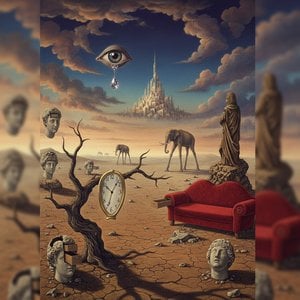
Salvador Dalí: Surrealism, Subconscious Exploration & Artistic Innovation
Explore the captivating world of Salvador Dalí! Discover his surrealist masterpieces, profound connection to Freud's theories, and lasting impact on art & culture. A deep dive into a visionary artist.

Surrealism's Greatest Hits: 10 Masterpieces for Your Home |
Journey into the dreamlike world of Surrealism! Explore 10 masterpieces by Dali, Magritte & Miró. Discover the stories behind these iconic paintings and find museum-quality art reproductions for your home at .


