

- 85.0 x 36.0 cm


The picture follows your choices: , .
Collectible Description
Discover 'White-Robed Kannon' by Sakai Hōitsu (1823). A serene Buddhist masterpiece featuring a radiant figure in monochrome ink wash, embodying tranquility & Rinpa style. Explore Edo period artistry.
 Read More
Artist Biography
Discover Sakai Hōitsu (1761-1829), a Rinpa master who revitalized Ogata Kōrin’s style! Explore exquisite Japanese paintings, floral motifs & Edo period artistry.
Hand Made Oil Reproduction
Hand-painted oil on canvas in your size and frame, made to order by our artists. ( Switch to Print Switch to Digital Image)
More about this painting
 Preview
 Send
Send Share
Share
 Details
 Guide
Guide

 Download
 Similars
 X-Ray
X-Ray Diaporama
 Q&A
Q&A Stats
StatsOrder your painting in four simple steps
Take your time. You can change any answer; the price in your order card follows each choice.
1 Step one of four
Which size would you like?
These sizes keep the proportions of the original painting. The drawing shows your choice on a wall, above a two-metre sofa.
Or give your own measurements
Pick from our preset sizes that match the artwork's original proportions.

Type the width and the height you need, to fit your frame or your wall. This is hand-painted, so for a size with a different shape the artist can paint a bit more around the picture, or cut a bit — you choose. We send you a digital mockup to approve before the painting starts. The picture shown on this page does not show the real result — only the mockup does.
2 Step two of four
How should it be prepared: rolled, stretched or framed?
The prices below are for the size you chose in step one.
Choose the edges of the stretched canvas
Choose your frame

White $1

Blurside $1

Extended $1

P118B $10

P118H $10

P118W $10

P438Z $10

P508JH $12

P508YH $12

P805H $10

P805Z $10

P919BZ $10

P919G $10

P919XJ $10

P959ZH $10

P968JZ $12

W106C $8

W218G $10

W218JH $8

W218Y $10

W307PJ $10

W316G $10

W316PJ $8

W316Y $10

W398PJ $8

W4111J $10

W500HY $15

W500JH $15

W692G $12

W849H $8

W940BG $15

W953PJ $8

H24-GOLD $30

H24-SILVER $30

H36-GOLD $45

H36-SILVER $45
Framed
Moulding: . Overall size with the frame: .
3 Step three of four
Would you like anything changed in the painting?
Most people answer no. Because each painting is made by hand, our artist can also adapt it for you.
After order, ArtsDot.com team will email client for instructions and provide a mockup preview
4 Step four of four
A few finishing options
All of them are optional. The answers already selected cost nothing extra.
Who paints it?
Worldwide Delivery () in 3/4 weeks instead of standard 5 weeks. (2 November). No compromise on quality.
A nameplate, as in a museum?
Engraved Bronze Plaque Details
This elegant plaque features the artist's name and the title of the artwork, finely engraved for a timeless presentation.
It is made from bronze with a refined, elegant finish. The text is precisely laser-engraved for a sharp and permanent result. Measuring 9x2 cm, the plaque is compact yet easy to read. It's built to be durable and scratch-resistant, offering a professional, museum-quality look. Mounting is simple thanks to the included adhesive backing.
Transparent Acrylic Plaque Details
The plaque includes essential engraved details such as the artist's name, the title of the artwork, the date it was created, the type of media used-like oil on canvas or watercolor-a brief description of the piece, and a QR code that links to the complete artwork information.
It is crafted from clear acrylic, offering a sleek, modern appearance. The text is UV-engraved in black to ensure strong visual contrast. With a size of 10x15 cm, it ensures optimal readability. It comes equipped with two metal hooks for secure wall mounting. The plaque is designed to be weather-resistant, making it suitable for various environments, and it includes interactive features that work seamlessly with smartphone scanning.
Black Acrylic Plaque Details
This elegant plaque includes engraved information such as the artist's name, the title of the artwork, the date it was created, the type of media used (like oil on canvas or watercolor), a short description of the artwork, and a QR code for quick access to more information.
The plaque itself is made from refined black acrylic with a premium finish. The text is laser-engraved in white for high contrast and readability. Its size is 10x15 cm, designed to be easy to read. It comes with two metal hooks for professional mounting. The design is sleek and fits any interior style. It is also weather-resistant and durable, with built-in digital integration for mobile compatibility.
A protective varnish?
When do you need it?
✓ Check and order
Your painting, as you ordered it

White-Robed Kannon
Reproduction Medium
Reproduction Size
-

Elite Senior Artist
More detail, finesse, and extra production time
-

Reproduction Frame
-
-
For artworks or reproductions larger than 105 cm (approximately 41 inches) on any side, the frame will be shipped as a kit, disassembled. This method ensures safe delivery and prevents damage during transport.
Professional assembly required - this is not a DIY product.
The kit must be assembled and the canvas stretched by an experienced professional framer, using wood glue (not supplied), a canvas stretching plier and clamps to hold the bars square while the glue dries. Incorrect assembly or uneven canvas tension can permanently damage the artwork and is not covered by our warranty.
 For artworks or reproductions larger than 105 cm (approximately 41 inches) on any side, the frame will be shipped as a kit, disassembled. This method ensures safe delivery and prevents damage during transport.
All solid wood bars are included, precisely cut to size.
Assembled with the screws provided, plus wood glue for the corner joints, which is not supplied and must be sourced by your framer.
Professional tools are required and not included: a canvas stretching plier (tensioner) and clamps to hold the bars square while the glue dries.
Important:
The corner joints require wood glue, the bars must be held with clamps until the glue is fully dry, and tightening the canvas on the assembled frame requires a canvas stretching plier. None of these are included in the kit. Please arrange an experienced professional framer before ordering this size.

Nameplate
-
-

Protective Varnish
Glossy Varnish (enhances colors, protects against light/moisture)
-

Customize My Artwork
Examples of what can be changed: Replace face with customer photo; Add pet (e.g., replace cat with dog); Include hidden message in background; Change background landscape or elements.
-

Urgent
Worldwide Delivery () in 3/4 weeks instead of standard 5 weeks. (2 November). No compromise on quality.
-
Express Shipping
Worldwide Delivery () in 5 weeks. (9 November).
Included
Total Price
$ 263
Glass option is only available in size under 110 CM
Included with every order
- Free Worldwide Express Shipping
- High-Quality Linen Canvas
- Full Shipping Insurance
- Customs Tax Refund Guarantee
- True Color Matching Guarantee
- 100-Day Return Policy (Defects Only)
- 100% Money-Back Guarantee
- Bulk Discount Offer


Questions & Answers
Can I see "White-Robed Kannon" by Sakai Hōitsu under different lights?
The X-Ray page of "White-Robed Kannon" by Sakai Hōitsu is an interactive viewer that lets you slide through eleven optical layers of the artwork's image, including an X-ray style view.
Is "White-Robed Kannon" typical of what Sakai Hōitsu usually created?
"White-Robed Kannon" depicts buddhist art, japanese painting, monochrome landscape, kannon figure, zen aesthetics, ink wash technique, edo period style, while Sakai Hōitsu's recorded themes are chinese landscape influence, zen buddhist devotion, muromachi period style, ogata kōrin's legacy, monastic artistic tradition, spiritual contemplation, floral rinpa motif", artist's religious phase. Comparing the two shows how the work relates to the artist's usual subjects.
What is the perceived brightness of "White-Robed Kannon" by Sakai Hōitsu?
The perceived brightness of "White-Robed Kannon" by Sakai Hōitsu is deep_shadow. It can be matched to the light of the intended space.
Related Artworks


Sakai Hōitsu
1761 - 1829, Japan
Artist Biography
A Life Steeped in Tradition and Revival
Sakai Hōitsu, born Sakai Tadanao in 1761 in Edo (modern-day Tokyo), emerged from a world of privilege and refinement. As the second son of Lord Sakai of Himeji Castle, his upbringing was steeped in the traditions of the noble class—a foundation that afforded him access to both martial training and a comprehensive education in the literary arts. This unique blend would profoundly shape his artistic trajectory. His family’s lineage traced back through centuries of samurai history, instilling within him a deep respect for heritage and an appreciation for aesthetic discipline. However, Hōitsu's path wasn’t solely defined by ancestral expectations; he possessed an innate sensitivity to beauty and a restless spirit that led him on a journey of artistic exploration across various schools of Japanese painting. Initially immersed in the established Kanō school—renowned for its formal, classical style—he soon broadened his horizons, venturing into the dynamic world of ukiyo-e under the tutelage of Utagawa Toyoharu. This exposure to the “pictures of the floating world” introduced him to a more vibrant and accessible aesthetic, influencing his later work with elements of realism and everyday life. Further studies with Watanabe Nangaku of the Maruyama school and Sō Shiseki in the nanga style continued to refine his skills, but it was ultimately the art of Ogata Kōrin that would capture his imagination and define his legacy.Embracing the Rinpa Aesthetic
The turning point in Hōitsu’s artistic development came with a profound encounter with the works of Ogata Kōrin, a master of the Rinpa school who had passed away nearly half a century prior. Encouraged by Tani Bunchō, a prominent scholar and artist, Hōitsu dedicated himself to understanding and reviving Kōrin's distinctive style—a bold move that would solidify his place in art history. The Rinpa school, characterized by its decorative elegance, vibrant colors, and stylized depictions of nature, had experienced a period of decline after Kōrin’s death. Hōitsu recognized the enduring beauty and artistic merit of this tradition and embarked on a mission to restore it to prominence. This wasn't merely imitation; rather, it was an act of reverence combined with creative interpretation. He meticulously studied Kōrin’s techniques, absorbing his mastery of composition, color harmony, and expressive brushwork. The Sakai family possessed a significant collection of Kōrin’s paintings, providing Hōitsu with invaluable access to the artist's original works. This intimate familiarity allowed him to not only reproduce Kōrin’s masterpieces but also to infuse them with his own unique sensibility.A Master of Reproduction and Innovation
Hōitsu’s dedication to preserving Kōrin’s legacy manifested in several significant publications. He created Kōrin Hyakuzu (One Hundred Paintings by Kōrin) in 1815, followed by Kenzan Iboku Gafu (Album of Portraits by Kenzan) in 1823, and his own collection, Ōson Gafu. These woodblock print reproductions were instrumental in disseminating Kōrin’s art to a wider audience and re-establishing the Rinpa school's influence. However, Hōitsu was not simply a copyist; he brought his own artistic voice to these reinterpretations. He skillfully blended Kōrin’s decorative aesthetic with elements of realism gleaned from his earlier studies in ukiyo-e, creating a distinctive style that balanced elegance and detailed observation. Furthermore, Hōitsu experimented with materials and techniques, utilizing mineral pigments and organic substances on silk or paper to achieve unique visual effects. His innovative approach extended beyond reproduction; he created original compositions that showcased his mastery of the Rinpa aesthetic while reflecting his own artistic vision.Lasting Legacy and Enduring Appeal
In 1797, Hōitsu entered a Buddhist monastery, seeking solace and spiritual enlightenment. While this marked a period of seclusion, it did not diminish his artistic output; rather, it provided him with the space and tranquility to further refine his skills and deepen his understanding of art and nature. He continued to paint prolifically until his death in 1829, leaving behind a body of work that is celebrated for its beauty, technical skill, and profound connection to Japanese culture. His most renowned works, such as Flowers and Grasses of Summer and Autumn, exemplify his ability to capture the essence of nature with delicate detail and vibrant color. Other notable pieces include Persimmon Tree, Birds and Flowers of the Twelve Months and Autumn Maple, each showcasing his skill in portraying seasonal changes and evoking a sense of serenity. Hōitsu’s influence extended to subsequent generations of artists, most notably Suzuki Kiitsu, who continued to develop the Rinpa aesthetic. Today, his paintings are held in prestigious collections worldwide, including the Seiji Togo Memorial Yasuda Kasai Museum of Art, serving as a testament to his enduring legacy and the timeless appeal of his art. He remains a pivotal figure in Japanese art history—a master who not only revived a cherished tradition but also infused it with new life and vitality.


Related Articles

Ephemeral Lines: Exploring Emotional Resonance in Ink Sketching Traditions
Explore the profound art of ink sketching! Discover techniques to express emotion, master line work, and cultivate artistic sensitivity. Learn from historical masters & unlock your creative potential.

Mastering the Great Wave: The Top 25 Iconic Artworks by Katsushika Hokusai
Explore 25 iconic Hokusai masterpieces and the soul of Ukiyo-e. Discover museum-quality art on ArtsDot.com.
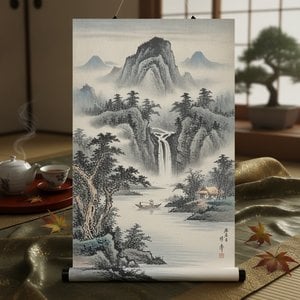
Serenity on Canvas: A Guide to the Timeless Beauty of Japanese Landscape Painting
Discover the serene beauty of Japanese landscape painting. From Hokusai's iconic woodblock prints to meditative sumi-e ink washes, explore a visual journey through the 'floating world' and learn how to bring this timeless Zen aesthetic into your modern home decor.