


 Preview
 Send
Send Share
Share
 Details
 Guide
Guide

 Download
 Similars
 X-Ray
X-Ray Diaporama
 Stats
StatsEpic (Ground Rules)

 Read More
The artwork displayed on this page is protected by copyright law, which means we cannot legally create or sell an identical reproduction. This protection is enforced under international agreements such as the Berne Convention and by national laws, including those outlined by the U.S. Copyright Law - Title 17.
This method fully complies with copyright regulations because it does not involve copying or duplicating the protected artwork. Instead, it is a creative reinterpretation - a new painting that is influenced by the original but not identical to it.
Giclée / Art Print
Museum-quality giclée or canvas print with fast production and flexible finish options. ( Buy Hand Made Painting Switch to Digital Image)




P118B $10

P118H $10

P118W $10

P438Z $10

P508JH $12

P508YH $12

P805H $10

P805Z $10

P919BZ $10

P919G $10

P919XJ $10

P959ZH $10

P968JZ $12

W106C $8

W218G $10

W218JH $8

W218Y $10

W307PJ $10

W316G $10

W316PJ $8

W316Y $10

W398PJ $8

W4111J $10

W500HY $15

W500JH $15

W692G $12

W849H $8

W940BG $15

W953PJ $8




Pick from our preset sizes that match the artwork's original proportions.

You may enter your own dimensions to fit a specific frame or space. If your selected size does not match the original image's proportions, we will either crop the artwork or extend the image with a mirrored or solid-fill edge. A digital mockup will be sent for your approval before production begins.
Please note that the on-screen preview does not reflect the actual cropping or extension. Only the mockup will accurately show the final composition.
While custom sizes are available, we recommend selecting a dimension from the predefined list to preserve the original proportions.
Worldwide Delivery () in 2 weeks instead of standard 4/5 weeks. (8 October)

Free Worldwide Express Shipping

High-Quality Linen Canvas

Full Shipping Insurance

Customs Tax Refund Guarantee

True Color Matching Guarantee

100-Day Return Policy (Defects Only)

100% Money-Back Guarantee

Bulk Discount Offer
 Glass option is only available in size under 110 CM

Epic (Ground Rules)
Giclée / Art Print
Reproduction Size
-


Total Price
$ 63
Related Artworks


Artist Biography
A Life Forged in Transition
Robert Rauschenberg, born Milton Ernest Rauschenberg in 1925 amidst the oil-rich landscapes of Port Arthur, Texas, was an artist whose very existence seemed to echo the dynamic energy and transformative spirit he brought to the art world. His childhood wasn’t defined by a single location; his father's profession necessitated a nomadic lifestyle, traversing diverse terrains that subtly instilled within him a receptiveness to varied visual stimuli and a willingness to embrace change. This early exposure fostered a sensibility attuned to the textures and rhythms of American life—an undercurrent profoundly shaping his artistic explorations. Though initially drawn towards pharmacology at the University of Texas, Rauschenberg’s path swiftly diverged, leading him into art – first through necessity during wartime service in the Navy, then with focused study at the Kansas City Art Institute and crucially, at Black Mountain College in North Carolina. It was within this hothouse of avant-garde thought, alongside luminaries like Josef Albers, Merce Cunningham, John Cage, and Cy Twombly, that his experimental spirit truly ignited. This environment wasn’t merely educational; it was a crucible forging a new artistic sensibility, laying the groundwork for an approach fundamentally challenging established norms.The Birth of the “Combine”
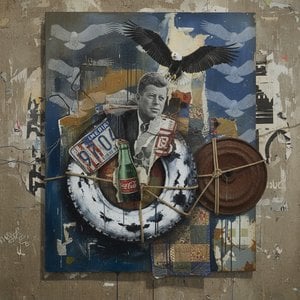
Rauschenberg's most enduring legacy lies in his revolutionary "Combines," artworks that deliberately blurred the boundaries between painting, sculpture, and assemblage. These weren’t simply paintings *or* sculptures; they were complex constructions incorporating found objects – everything from everyday detritus like tires and wood scraps to photographs, newspaper clippings, even taxidermied animals. This radical departure wasn't about novelty for its own sake; it was a fundamental questioning of what constituted art itself. His style evolved as a conscious rejection of the prevailing Abstract Expressionist aesthetic, embracing instead the imagery and energy of popular culture and the discarded remnants of modern life. Influenced by the anti-art stance of Dada and the readymades of Marcel Duchamp, Rauschenberg challenged the notion that artistic merit resided solely in technical skill or original conception. He believed in incorporating chance, spontaneity, and the unexpected into his creative process, allowing the inherent qualities of found objects to contribute their own narratives to the artwork. Monogram, with its jarring juxtaposition of a stuffed goat head mounted on an automobile tire, stands as perhaps the most iconic example – a provocative statement about consumer culture, decay, and the collision between organic and industrial elements. This willingness to embrace the unconventional wasn’t merely aesthetic; it was philosophical, reflecting a broader cultural shift questioning traditional values and hierarchies. The Combines weren't just objects; they were statements—fragments of a rapidly changing world reassembled into something new and challenging.Expanding Horizons: Silkscreen, Performance, and Beyond
Rauschenberg’s artistic explorations didn’t remain confined to the Combines. He continually pushed boundaries, experimenting with new techniques and materials. His engagement with silkscreen printing in the early 1960s, exemplified by works like Retroactive I & II, allowed him to incorporate images from newspapers and magazines, reflecting the political and social anxieties of the era and anticipating Pop Art’s embrace of popular imagery. The Overseas Tech Series (1964), created using transfer techniques during travels in Italy and France, explored themes of cultural exchange and globalization by combining photographs taken abroad with silkscreened images. But his influence extended beyond the visual arts; his collaborations with choreographer Merce Cunningham were equally significant. These partnerships resulted in groundbreaking performance pieces that seamlessly integrated dance and visual art, further blurring disciplinary lines and creating immersive experiences challenging conventional notions of artistic expression. He wasn’t simply creating objects or images; he was constructing environments, orchestrating events—a holistic approach to artmaking anticipating the multimedia installations of later generations. This collaborative spirit underscored his belief in art's potential to transcend traditional boundaries and engage with a wider audience.A Lasting Legacy
Robert Rauschenberg’s impact on American art is undeniable. He played a crucial role in bridging the gap between Abstract Expressionism and Pop Art, paving the way for subsequent artists who embraced appropriation, collage, and mixed media. His “Combines” fundamentally redefined the very definition of art, challenging traditional notions of painting and sculpture and expanding the possibilities of artistic expression exponentially. He wasn’t simply creating objects; he was constructing environments reflecting the complexities and contradictions of modern life. Rauschenberg's willingness to experiment with materials, his embrace of chance operations, and his engagement with popular culture served as a powerful inspiration for countless artists who followed in his wake. His work continues to be exhibited in major museums worldwide, serving as a vital source of inspiration for contemporary artists exploring the intersection of art, technology, and everyday life. He left behind not just a body of artwork but a legacy of innovation, challenging us to reconsider our assumptions about what art can be and how it interacts with the world around us. His influence resonates today in the work of artists who continue to push boundaries and explore new forms of creative expression, solidifying his place as one of the most important and influential figures in 20th-century art.Key Themes & Influences
- Dada & Marcel Duchamp: Rauschenberg’s use of found objects and rejection of traditional artistic values were directly influenced by the Dada movement's anti-art stance and Duchamp’s concept of “readymades.”
- Abstract Expressionism’s Aftermath: He consciously moved away from the emotional intensity and subjective expression of Abstract Expressionism, seeking a more objective and inclusive approach to artmaking.
- Popular Culture & Mass Media: Rauschenberg embraced imagery from newspapers, magazines, and advertising, reflecting the growing influence of mass media on American society.
- Collaboration & Interdisciplinarity: His collaborations with Merce Cunningham and John Cage demonstrated his belief in the power of artistic exchange and the blurring of disciplinary boundaries.
- Chance & Spontaneity: He incorporated elements of chance into his creative process, allowing for unexpected juxtapositions and a sense of openness to new possibilities.

Robert Rauschenberg
1925 - 2008 , United States of America
Quick Facts
- Full Name: Robert Rauschenberg
- Nationality: American
- Date Of Birth: 1925
- Date Of Death: 2008
- Place Of Birth: Port Arthur, United States of America
- Notable Artworks:
- Monogram
- Untitled (Runt)
- Black Painting
- Artistic Movement Or Style: Pop Art, Neo-Dada
- Artists Who Influenced This Artist: ['Marcel Duchamp']
- Artists Or Movements Influenced By This Artist:
- Pop Art
- Mixed Media artists
Related Articles
The Enduring Legacy of Printmaking: Techniques, Themes & Artistic Innovation Across Centuries
Explore the rich history of printmaking with ArtsDot. Discover techniques from intaglio to lithography, learn about collecting valuable prints & find museum-quality reproductions. Expert insights for art enthusiasts and collectors.

Giclée Prints: Archival Quality & Aesthetic Nuances for the Discerning Collector
Explore the world of giclée prints with ArtsDot. Learn about archival quality, aesthetic nuances & investment potential. Expert guidance for discerning art collectors seeking museum-quality reproductions and lasting value.
Robert Rauschenberg: Bridging Painting & Life – A Comprehensive Exploration of Combines, Silkscreens, and the Erasure of Boundaries
Explore the revolutionary art of Robert Rauschenberg – Combines, silkscreens & more. Discover his impact on Pop Art, investment potential & collecting insights for discerning art collectors.

The Enduring Legacy of Fine Art Prints: Technique, History & Aesthetic Impact
Explore the rich history & techniques of fine art prints. Discover investment potential, assess authenticity, and learn how to preserve your collection with expert guidance. Trusted insights for discerning collectors.

Echoes of Time: Exploring the Enduring Appeal & Historical Context of Vintage Art Prints
Explore the captivating world of vintage art prints! Discover their history, collecting tips & enduring appeal. Expert insights on chromolithography and building a legacy collection with ArtsDot.


