- Home

- Oil Painting Reproduction
- René Magritte
- The red model
 Buy print
 Send
Send Share
Share
 Details

 Download
 Similars
 X-Ray
X-Ray Diaporama
The red model
 Oil On Canvas
- WallArt
- Surrealism
 1934
1934- Modern
 183.0 x 136.0 cm
Hand Made Oil Reproduction
Hand-painted oil on canvas in your size and frame, made to order by our artists.




P118B $10

P118H $10

P118W $10

P438Z $10

P508JH $12

P508YH $12

P805H $10

P805Z $10

P919BZ $10

P919G $10

P919XJ $10

P959ZH $10

P968JZ $12

W106C $8

W218G $10

W218JH $8

W218Y $10

W307PJ $10

W316G $10

W316PJ $8

W316Y $10

W398PJ $8

W4111J $10

W500HY $15

W500JH $15

W692G $12

W849H $8

W940BG $15

W953PJ $8




 Read more
Pick from our preset sizes that match the artwork's original proportions.

You may enter your own dimensions to fit a specific frame or space. If your selected size does not match the original image's proportions, we will either crop the artwork or extend the painting with additional hand-painted elements. A digital mockup will be sent for your approval before production begins.
Please note that the on-screen preview does not reflect the actual cropping or extension. Only the mockup will accurately show the final composition.
While custom sizes are available, we recommend selecting a dimension from the predefined list to preserve the original proportions.
After order, ArtsDot.com team will email client for instructions and provide a mockup preview
Worldwide Delivery () in 3/4 weeks instead of standard 5 weeks. (1 July). No compromise on quality.

Free Worldwide Express Shipping

High-Quality Linen Canvas

Full Shipping Insurance

Customs Tax Refund Guarantee

True Color Matching Guarantee

60-Day Return Policy (Defects Only)

100% Money-Back Guarantee

Bulk Discount Offer
 Glass option is only available in size under 110 CM

The red model
Reproduction Medium
Reproduction Size
-


Total Price
-
Artwork Description
A Stillness Within the Surreal: Exploring René Magritte’s “The Red Model”
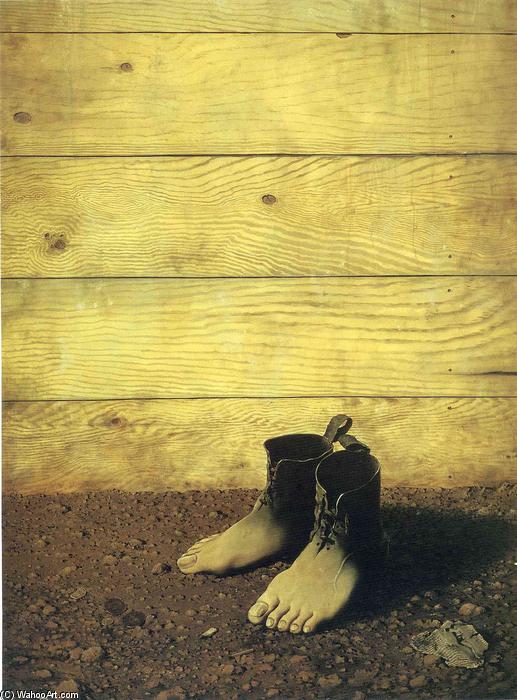
René Magritte's 1934 oil painting, “The Red Model,” is a deceptively simple yet profoundly evocative work that encapsulates many of the core tenets of his surrealist vision. Measuring an impressive 183 x 136 cm, this piece draws the viewer into a quiet contemplation of form, texture, and the unsettling beauty of everyday objects.
Subject & Composition: A Fragmented Narrative
- Central Focus: The composition centers on a pair of well-worn leather boots resting upon a patch of reddish-brown earth. A single, disembodied foot is positioned alongside them, creating an immediate sense of incompleteness and mystery.
- Rustic Setting: The scene unfolds against the backdrop of a textured wooden wall, its vertical planks adding depth and a rustic quality to the overall atmosphere. This grounding element contrasts with the more ambiguous elements in the foreground.
- Directional Light & Shadow: Magritte masterfully employs warm, directional lighting that emphasizes the textures – the rough wood grain, the weathered leather, and the granular earth. Shadows play a crucial role in defining form and adding to the painting’s melancholic mood.
Style & Technique: Realism with a Surrealist Twist
- Realistic Rendering: Magritte's technique leans towards realism, particularly in his meticulous depiction of the boots and foot. The smooth blending of colors and subtle gradations in light and shadow demonstrate his technical skill.
- Surrealist Juxtaposition: However, it is the *juxtaposition* of these realistically rendered elements – the disembodied foot, the isolated boots – that firmly places this work within the realm of Surrealism. This unexpected combination challenges our perceptions and invites interpretation.
- Oil Painting Mastery: Executed in oil paint, the artwork benefits from the medium’s richness and versatility, allowing Magritte to achieve both precise detail and atmospheric depth.
Symbolism & Interpretation: Journeys and Isolation
- The Boots as Metaphor: The worn leather boots immediately suggest travel, journey, or perhaps a life lived. Their aged appearance hints at past experiences and the passage of time.
- The Disembodied Foot: The solitary foot introduces an element of isolation and vulnerability. It evokes questions about identity, presence, and absence.
- Earth & Grounding: The reddish-brown earth provides a sense of grounding but also suggests the elemental nature of existence – a connection to the physical world.
- Magritte often aimed not to illustrate ideas, but to create images that *prompt* thought. “The Red Model” is a prime example; it doesn’t offer answers, but rather encourages viewers to construct their own narratives and meanings.
Historical Context & Magritte's Oeuvre
- Surrealist Movement: Created in 1934, “The Red Model” falls squarely within Magritte’s most prolific Surrealist period. This movement, born out of Dadaism, sought to unlock the creative potential of the unconscious mind.
- Magritte's Unique Vision: Unlike some Surrealists who embraced dreamlike imagery and automatism, Magritte preferred a more precise and calculated approach. He often combined ordinary objects in unexpected ways to create unsettling and thought-provoking compositions.
- Influence & Legacy: Magritte’s work has had a lasting impact on art, design, and popular culture. His exploration of perception, reality, and the power of images continues to resonate with audiences today.
Emotional Impact & Interior Design Considerations
“The Red Model” evokes a sense of quiet contemplation, melancholy, and mystery. Its muted color palette and realistic style make it surprisingly versatile for interior design. It would complement a variety of settings – from modern minimalist spaces to more traditional rooms seeking a touch of intellectual intrigue.
- Mood & Atmosphere: The painting’s subdued tones create a calming yet thought-provoking atmosphere.
- Focal Point: Its size and compelling subject matter make it an ideal focal point for a living room, study, or bedroom.
- Color Harmony: The earthy reds and browns harmonize well with natural materials like wood, leather, and stone.
“The Red Model” is more than just a painting; it’s an invitation to explore the depths of perception and the enduring power of the human imagination.
Related Artworks


Artist Biography
Early Life and the Seeds of Surrealism
René Magritte, born René François Ghislain Magritte on November 21, 1898, in Lessines, Belgium, emerged into a world that would profoundly shape his enigmatic artistic vision. His early years were marked by an unsettling event – the suicide of his mother when he was just thirteen. The image of her body being recovered from the River Sambre, with her dress obscuring her face, became a haunting motif that would subtly permeate his later work, manifesting in veiled figures and a persistent exploration of hidden realities. This early trauma instilled within him a fascination with mystery, loss, and the unsettling power of what remains unseen. While details of his childhood remain somewhat elusive, it’s clear this formative experience laid the groundwork for his lifelong questioning of perception and representation. He began drawing lessons at age ten, revealing an innate inclination towards visual expression, but initially explored Impressionism before embarking on a path that would lead him to become one of the most significant figures in Surrealist art.
Artistic Development and Influences
Magritte’s artistic journey was not immediate or straightforward. He studied at the Académie Royale des Beaux-Arts in Brussels, yet found its traditional methods stifling. His early work experimented with Futurism and Cubism, absorbing elements of these avant-garde movements but ultimately rejecting their purely formal concerns. It wasn't until encountering Giorgio de Chirico’s painting *The Song of Love* in 1922 that Magritte discovered a resonance that would irrevocably alter his artistic course. De Chirico’s dreamlike landscapes and unsettling juxtapositions unlocked within Magritte a new way of seeing – a world where the familiar could be rendered strange, and the ordinary imbued with profound mystery. This encounter sparked his commitment to Surrealism, though he often maintained a unique distance from its more overtly psychological or automatic approaches. He preferred a meticulous, almost clinical precision in his painting, using realistic techniques to depict illogical scenarios.
The Heart of Surrealism: Challenging Reality
By 1926, Magritte had fully embraced the tenets of Surrealism, producing *Le Jockey Perdu (The Lost Jockey)*, widely considered his first truly surrealist work. However, his brand of Surrealism was distinct. He wasn’t interested in exploring the subconscious through free association or dream imagery in the manner of some of his contemporaries. Instead, Magritte sought to challenge viewers' perceptions of reality by presenting ordinary objects in unexpected contexts, forcing them to question their assumptions about the world around them. Iconic works like *The Treachery of Images (This is not a pipe)* (1929) brilliantly deconstructs the relationship between image and object, reminding us that a representation is never the thing itself. *Les Amants (The Lovers)* (1927-1928), with its shrouded figures, echoes the trauma of his mother’s death while simultaneously exploring themes of concealment and intimacy. *Time Transfixed* (1938) presents a locomotive bursting through a brick wall, disrupting our sense of space and time. And *The Human Condition* (1933), a canvas within a canvas, blurs the boundaries between representation and reality, prompting us to consider how we perceive and interpret the world.
Later Life, Recognition, and Enduring Legacy
Despite initial struggles for recognition, Magritte’s work gradually gained prominence, particularly in the United States with exhibitions in 1936 and later retrospective shows at the Museum of Modern Art (1965) and the Metropolitan Museum of Art (1992). He remained politically engaged throughout his life, advocating for artistic autonomy. He continued to refine his signature style, exploring themes of repetition, illusion, and the power of language in paintings that are both intellectually stimulating and visually arresting. Magritte died on August 15, 1967, leaving behind a body of work that continues to captivate and challenge audiences worldwide. His influence extends far beyond the realm of painting, impacting pop art, minimalist art, conceptual art, and even advertising and film. Today, his paintings are held in major museum collections around the globe, including the Musées royaux des beaux-arts de Belgique in Brussels, which houses the Magritte Museum – dedicated entirely to his work and boasting the world’s largest collection of his creations.
- Museum Collections: Musées royaux des beaux-arts de Belgique, Brussels; Magritte Museum.
Magritte's enduring legacy lies in his ability to make us see the familiar anew, to question our assumptions about reality, and to appreciate the power of art to provoke thought and inspire wonder. He wasn’t simply painting images; he was crafting visual paradoxes that continue to resonate with viewers decades after their creation, solidifying his position as a true master of Surrealism and a pivotal figure in 20th-century art.

René Magritte
1898 - 1967 , Belgium
Quick Facts
- Artistic Movement Or Style: Surrealism
- Artists Or Movements Influenced By This Artist:
- Pop art
- Minimalist art
- Conceptual art
- Artists Who Influenced This Artist: ['Giorgio de Chirico']
- Date Of Birth: November 21, 1898
- Date Of Death: August 15, 1967
- Full Name: René François Ghislain Magritte
- Nationality: Belgian
- Notable Artworks:
- Les Amants
- The Treachery of Images
- Time Transfixed
- The Human Condition
- Place Of Birth: Lessines, Belgium
Related Articles

From Imagination to Canvas: Commissioning Bespoke Fantasy Art with Traditional Oil Painting Techniques
Commission breathtaking bespoke fantasy art with skilled oil painters. Explore techniques, artist selection & preservation tips. Invest in a unique masterpiece today!


Crimson Threads of Narrative: Exploring Symbolism & Representation in Artworks Featuring the Red Dress
Explore the rich symbolism of the red dress in art history! From ancient power displays to iconic portraits like Cézanne’s 'Madame Cezanne', discover the cultural and artistic significance behind this captivating color. Expert analysis & insights.

The Enigma of Reality: Exploring René Magritte's Subversion of Perception & the Poetics of Everyday Life
Explore the captivating world of René Magritte! Delve into his surrealist masterpieces, challenging perceptions of reality & identity. Discover the philosophical depth and lasting influence of this Belgian master.

Oil on Panel Masters: 10 Paintings That Revolutionized Art |
Journey through 10 legendary 'Oil on Panel' masterpieces by Van Eyck, Bosch & Bruegel. Explore the stories behind these iconic Renaissance & Baroque paintings and find museum-quality art reproductions to elevate your home decor. Discover all masterpieces on !

Nostalgia Rendered: Oil Paintings as Vessels of Childhood Memory – A Study in Emotional Reconstruction & Artistic Legacy
Transform cherished photos into timeless oil paintings with ArtsDot’s expert craftsmanship. Preserve your family's story & create a lasting legacy piece for generations. Hand-painted, museum-quality art – start your journey today!