
 Preview
 Send
Send Share
Share
 Details
 Guide
Guide

 Download
 Similars
 X-Ray
X-Ray Diaporama
 Q&A
Q&A Stats
StatsLe viol


 Read More
The artwork displayed on this page is protected by copyright law, which means we cannot legally create or sell an identical reproduction. This protection is enforced under international agreements such as the Berne Convention and by national laws, including those outlined by the U.S. Copyright Law - Title 17.
This method fully complies with copyright regulations because it does not involve copying or duplicating the protected artwork. Instead, it is a creative reinterpretation - a new painting that is influenced by the original but not identical to it.
Giclée / Art Print
Museum-quality giclée or canvas print with fast production and flexible finish options. ( Buy Hand Made Painting Switch to Digital Image)




P118B $10

P118H $10

P118W $10

P438Z $10

P508JH $12

P508YH $12

P805H $10

P805Z $10

P919BZ $10

P919G $10

P919XJ $10

P959ZH $10

P968JZ $12

W106C $8

W218G $10

W218JH $8

W218Y $10

W307PJ $10

W316G $10

W316PJ $8

W316Y $10

W398PJ $8

W4111J $10

W500HY $15

W500JH $15

W692G $12

W849H $8

W940BG $15

W953PJ $8




Pick from our preset sizes that match the artwork's original proportions.

Type the width and the height you need, to fit your frame or your wall. A print can only be cut, never made bigger than the picture, so a size with a different shape loses a part of the image. We send you a digital mockup to approve before we print anything. The picture shown on this page does not show the real cut — only the mockup does.
Worldwide Delivery () in 2 weeks instead of standard 4/5 weeks. (10 November)

Free Worldwide Express Shipping

High-Quality Linen Canvas

Full Shipping Insurance

Customs Tax Refund Guarantee

True Color Matching Guarantee

100-Day Return Policy (Defects Only)

100% Money-Back Guarantee

Bulk Discount Offer
 Glass option is only available in size under 110 CM

Le viol
Giclée / Art Print
Reproduction Size
-


Total Price
$ 63
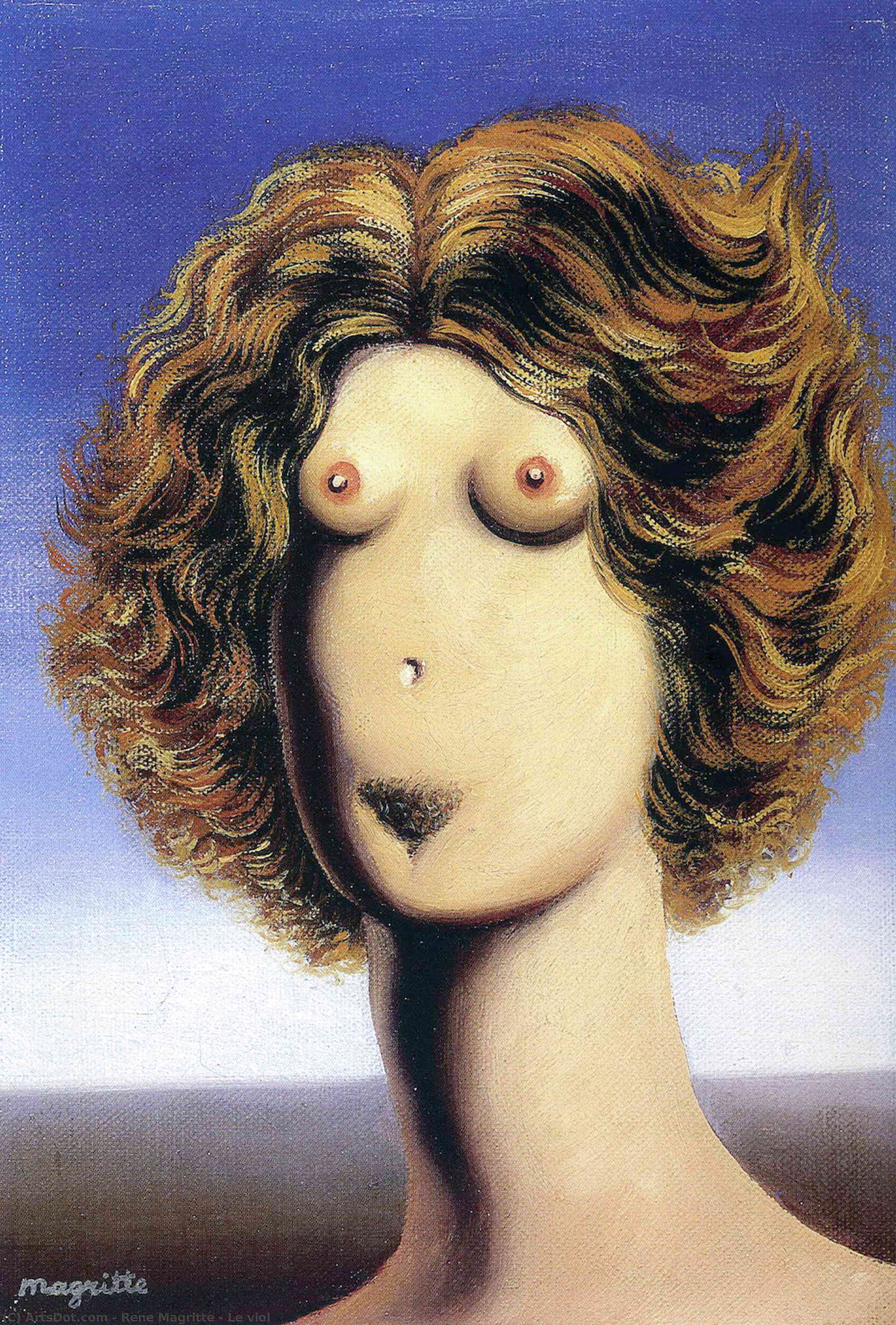
A Surrealist Riddle: Exploring René Magritte’s “Le Viol”
René Magritte's "Le Viol," painted in 1935, isn’t merely a depiction of a woman; it’s an invitation to confront the unsettling core of perception itself. This deceptively simple image—a nude female figure with two breasts—immediately arrests the viewer’s gaze and compels contemplation beyond its surface appearance. Magritte, deeply influenced by the burgeoning Surrealist movement, skillfully employs visual paradox to unsettle conventional notions of beauty and reality.The Style and Technique of Illusion
Magritte's approach aligns perfectly with Surrealism’s manifesto championed by André Breton—a deliberate rejection of rational thought in favor of accessing the subconscious mind. He achieves this effect through meticulous realism rendered in oil paint on canvas, a technique that contrasts sharply with the dreamlike distortions characteristic of other Surrealist artists. The artist employs precise shading and tonal gradations to create an illusionistic depth, grounding the fantastical element—the doubled breast—within a believable space. This careful craftsmanship underscores Magritte’s commitment to portraying the world as it *feels*, rather than simply how it looks.Historical Context: Surrealism's Challenge to Convention
The 1930s witnessed a fervent debate regarding artistic expression and societal values. Surrealism arose from disillusionment with the horrors of World War I and a desire to liberate thought from the constraints of logic. Breton argued that art should bypass conscious control, tapping into primal instincts and repressed desires—a radical departure from academic painting’s focus on idealized representations. “Le Viol” embodies this spirit, mirroring the movement's preoccupation with exploring hidden anxieties and questioning accepted standards of femininity. It reflects a broader cultural fascination with psychoanalysis and its exploration of unconscious motivations.Symbolism: Beyond Anatomy – A Meditation on Desire
The doubled breast is arguably the painting’s most potent symbol—a deliberate provocation designed to disrupt our ingrained understanding of female anatomy. While seemingly straightforward, Magritte avoids explicit eroticism; instead, he presents a visual enigma that invites interpretation. Some scholars suggest it represents fertility and motherhood, while others interpret it as a commentary on societal pressures surrounding female sexuality. The woman’s gaze is averted, furthering the sense of mystery and emphasizing the difficulty of accessing inner thoughts and emotions. Magritte's masterful use of symbolism elevates “Le Viol” beyond mere visual representation, transforming it into a profound meditation on desire and vulnerability.Emotional Resonance: Unease and Intellectual Engagement
“Le Viol” lingers in the viewer’s mind long after initial observation—a testament to its ability to evoke feelings of unease and stimulate intellectual curiosity. Magritte doesn't offer answers; he poses questions, forcing us to confront our assumptions about beauty, sexuality, and the nature of reality. Like many Surrealist artworks, it operates on multiple levels, stimulating contemplation and prompting viewers to consider alternative perspectives. Its enduring appeal lies in its refusal to succumb to easy interpretations—a characteristic that secures its place as a cornerstone of 20th-century art history.Questions & Answers
How do I preview a reproduction of "Le viol" by René Magritte?
The Preview page of "Le viol" lets you preview the artwork before ordering.
In what year was "Le viol" by René Magritte created?
"Le viol" dates from 1935. The date places the work within René Magritte's career and its era.
What is the art-historical place of "Le viol" by René Magritte?
Historically, "Le viol" is a Surrealism work of the broader Modern era.
Related Artworks


Artist Biography
The Early Life of René Magritte
Born René François Ghislain Magritte on November 21, 1898, in Lessines, Belgium, the artist entered a world defined by the quiet industry of his family. His father, Léopold Magritte, worked as a tailor and textile merchant, providing a stable, if unremarkable, upbringing. By the age of ten, René Magritte had already begun to seek out formal drawing lessons, discovering an early inclination toward visual expression that would eventually define his life's work.
A profound shadow fell over his adolescence in 1912 when his mother, Régina Bertinchamps, died by suicide. This loss left a permanent mark on his psyche, introducing a sense of mystery and concealment that would later manifest in his paintings through veiled figures and obscured faces. Such personal trauma often informs the quiet tension found in his later compositions, where the seen and the unseen exist in a state of constant friction.
His formal training began in earnest at the Académie Royale des Beaux-Arts in Brussels, where he studied from 1916 to 1918. During these years, he moved away from the simple sketches of his youth toward a more disciplined understanding of form. This period of academic study provided the technical foundation necessary for the conceptual shifts that would follow as he moved toward the avant-garde movements of the early twentieth century.
Artistic Development and Early Influences
Magritte’s early forays into painting around 1915 were marked by an Impressionistic sensibility. These initial efforts were far from the cerebral puzzles that would later define his name. During the First World War, his path took a detour into the military, where he served as a cartographer in the Belgian army. This period of service provided a structured, technical contrast to his burgeoning creative impulses. Upon returning to his studies, he began to move away from the soft edges of Impressionism, experimenting instead with the fractured planes of Cubism and the dynamic energy of Futurism. These movements offered him a way to deconstruct the visual world, though he would eventually find their formal concerns too limiting for his specific vision.
A profound shift occurred when he encountered the work of Giorgio de Chirico. The 1914 painting The Song of Love left a lasting impression on him, introducing a sense of dreamlike tension that resonated deeply. This encounter helped steer him toward a style that favored the unsettling juxtaposition of the familiar. He also drew inspiration from the paintings of William Degouve de Nuncques, whose influence contributed to the development of his unique aesthetic. These early years were a period of searching, a time when he moved through various avant-garde styles to find a language capable of expressing the strange logic of the subconscious.
The Paris Years and Surrealism
By 1927, the quietude of his Belgian life gave way to the restless energy of Paris. This move marked a significant shift in his trajectory, as he became deeply involved with the Surrealist group. In the cafes and studios of the city, he found a community of like-minded thinkers, forming friendships with figures such as André Breton, Paul Éluard, and Salvador Dalí. These connections were not merely social; they were intellectual alignments that helped define his place within the movement. He moved through this period with a sense of purpose, seeking to translate the irrational into a visual language that challenged the logic of the waking world.
His transition into this new mode of expression had already begun in 1926 with the production of Le Jockey Perdu (The Lost Jockey), a work widely recognized as his first truly surrealist painting. This early foray into the unexpected preceded his formal immersion in the Parisian scene. During his time in the city, his professional life took on a more structured, if precarious, form. In 1929, he was put under contract at the Goemans Gallery in Paris, alongside Jean Arp and Yves Tanguy. This period of formal association provided a brief window of stability before the complexities of the decade eventually drew him back toward his home country.
The Return to Brussels and Advertising
The departure from Paris in 1930 marked a period of pragmatic redirection for Magritte. Returning to Brussels, he sought stability through the commercial application of his visual skills. He and his brother, Paul, established an advertising agency, a venture that required a disciplined approach to imagery and typography. This professional life was not a departure from his creative instincts but a refinement of them, as he navigated the intersection of art and commerce.
His livelihood was often tied to the industrial and the mundane. He spent time as a draughtsman for a wallpaper factory, and his expertise was utilized by the factory Usines Peters-Lacroix (U.P.L.) as a designer. These years of commercial labor provided a steady income and a deep familiarity with the textures and patterns of everyday objects. This technical precision would later inform the clarity of his more philosophical works. He also found work in the film industry, designing posters for the German sound film distributor Tobis Klangfilm. For these assignments, he adopted the pseudonym 'Emair', a mask that allowed him to operate within the commercial sphere while maintaining a professional distance.
The Renoir Period and Sunlit Surrealism
During the mid-1940s, Magritte’s aesthetic underwent a notable shift. Between about 1943 and 1947, he moved away from the darker, more somber tones that had characterized much of his earlier surrealist output. This phase, often referred to as his Renoir Period, saw him adopting a palette of bright colors and compositions that leaned toward the optimistic. It was a departure from the heavy, psychological tension of his previous years, favoring instead a sense of clarity and light.
This stylistic evolution was not a random whim but was deeply connected to the intellectual climate of the time. His work during these years was influenced by the manifesto Surrealism in Full Sunlight. Drawing inspiration from the painter Pierre-Auguste Renoir, Magritte embraced a more luminous approach to his subjects. The shadows that once obscured his figures were replaced by a more open, sunlit quality. While this shift was met with some skepticism by his contemporaries in the surrealist movement, it represented a significant moment of personal experimentation in his long career.
Technique and Signature Visual Style
Magritte’s approach to the canvas was marked by a meticulous, almost clinical precision. He avoided the expressive, messy brushwork favored by many of his contemporaries, opting instead for a style that rendered the impossible with startling clarity. By using realistic techniques to depict illogical scenarios, he stripped away the comfort of the familiar. This clarity was essential to his method of creating visual paradoxes, where the precision of the execution made the strangeness of the subject matter even more unsettling.
His imagery relied heavily on the juxtaposition of ordinary objects within unexpected contexts. He frequently returned to a specific vocabulary of motifs: the bowler hat, the apple, and the female torso. These objects, stripped of their mundane utility, became symbols of a deeper, hidden reality. He often manipulated the relationship between an object and its representation, most notably through the use of text within his paintings to challenge the viewer's perception of language and image. This intellectual friction was further heightened by his use of veiled faces and floating objects, which disrupted the natural laws of gravity and identity.
- The Treachery of Images (1929)
- The Son of Man (1964)
- The Lovers (undated)
- The Castle of the Pyrenees (1959)
- Time Transfixed (1938)
Key Masterpieces and Iconic Works
Magritte’s canvases often functioned as visual puzzles designed to disrupt the viewer's certainty. In 1929, he produced The Treachery of Images, a work that presents a meticulously rendered pipe alongside the declaration "This is not a pipe." This paradox forces a confrontation with the gap between an object and its representation. His exploration of concealment reached a poignant peak in the 1928 series The Lovers. These four variations depict figures attempting to kiss through shrouds of white cloth, a motif that transforms intimacy into a sense of profound frustration.
The artist also possessed a talent for disrupting the logic of domestic and physical space. In 1938, Time Transfixed presented a heavy locomotive bursting through a brick wall, a scene that defies the stability of architecture. This ability to place the mundane in impossible settings became a hallmark of his mature period. In 1953, Golconda populated a sky with dozens of nearly identical men in dark overcoats and bowler hats. These figures appear in a three-dimensional lattice, suspended in mid-air as if caught in a moment of falling or rising.
Even in his later years, certain symbols remained constant. The Son of Man, created in 1964, features a man in a bowler hat whose face is partially obscured. This repetition of the bourgeois "little man" and the bowler hat helped establish a visual language that was both simple and deeply unsettling. His work remains a study in the tension between what is seen and what is known.
Where to See His Works Today
The preservation of his visual puzzles is distributed across several major institutions, ensuring his presence remains felt in both Europe and the Americas. In Brussels, the Magritte Museum in Jette offers a dedicated space for his output, situated in the very house where he lived and worked for twenty-four years. This site remains deeply connected to his personal history, as the apartment where he resided with his wife, Georgette, provided much of the inspiration for his compositions. Nearby, the Musées Royaux des Beaux-Arts also holds a significant portion of his paintings, maintaining the Belgian connection to his surrealist inquiry.
His influence extends across the Atlantic, where American collections house several of his significant canvases. The Museum of Modern Art in New York City maintains a selection of his works, while the Menil Collection in Houston, Texas, is home to the 1953 painting Golconda. These locations allow for a continued study of how he manipulated the familiar to create the unexpected.
- The Lovers (undated)
- The Son of Man (1964)
- Time Transfixed (1938)
- The Treachery of Images (1929)

René Magritte
1898 - 1967 , Belgium
Quick Facts
- Artistic Movement Or Style: Surrealism
- Artists Or Movements Influenced By This Artist:
- Pop art
- Minimalist art
- Conceptual art
- Artists Who Influenced This Artist:
- Giorgio de Chirico
- Claude Monet
- Vincent van Gogh
- Paul Cézanne
- Georges Seurat
- Pablo Picasso
- Full Name: René François Ghislain Magritte
- Nationality: Belgian
- Notable Artworks:
- The Treachery of Images
- The Lovers
- Time Transfixed
- The Human Condition
- The Son of Man
- The Castle of the Pyrenees
- Golconda
- Place Of Birth: Lesennes, Belgium
- Date Of Birth: 1898
- Date Of Death: 1967
Related Articles

The Eloquent Form: A Historical & Aesthetic Exploration of the Nude in Art
Explore the captivating history of the nude in art! From ancient Greece to modern masters, discover its evolving symbolism, techniques & enduring beauty. Expert insights for collectors and enthusiasts.

Surrealism's Greatest Hits: 10 Masterpieces for Your Home |
Journey into the dreamlike world of Surrealism! Explore 10 masterpieces by Dali, Magritte & Miró. Discover the stories behind these iconic paintings and find museum-quality art reproductions for your home at .

Surrealist Painting Masterpieces: 10 Artworks That Redefined Reality | ArtsDot
Journey into the dreamlike world of Surrealism! Explore 10 masterpieces by Dali, Magritte & Miró that redefined art. Discover their stories & find museum-quality reproductions to elevate your home decor on ArtsDot.com.

Surrealism's Visionaries: 10 Masterpieces for Your Home | ArtsDot
Journey into the dreamlike world of Surrealism! Explore 10 masterpieces by Dali, Magritte & Miró that redefined art. Discover their stories & find museum-quality reproductions to elevate your home decor on ArtsDot.com.

The Enduring Allure of the Nude: A Historical & Artistic Exploration of the Human Form
Explore the captivating history of nude art! Discover iconic paintings & artists from classical to modern eras. Uncover symbolism, techniques & find museum-quality reproductions at ArtsDot.


