

- 65.0 x 51.0 cm


The picture follows your choices: , .
Collectible Description
Experience Raphael's iconic 'Madonna della Tenda'! This Renaissance masterpiece showcases Mary and Christ with exquisite detail. Order a stunning, hand-painted reproduction today.
 Read More
Artist Biography
High Renaissance master of the School of Athens. Discover his legendary Madonnas and breathtaking Vatican frescoes today.
Hand Made Oil Reproduction
Hand-painted oil on canvas in your size and frame, made to order by our artists. ( Switch to Print Switch to Digital Image)
More about this painting
 Preview
 Send
Send Share
Share
 Details
 Guide
Guide

 Download
 Similars
 X-Ray
X-Ray Diaporama
 Q&A
Q&A Stats
StatsOrder your painting in four simple steps
Take your time. You can change any answer; the price in your order card follows each choice.
1 Step one of four
Which size would you like?
These sizes keep the proportions of the original painting. The drawing shows your choice on a wall, above a two-metre sofa.
Or give your own measurements
Pick from our preset sizes that match the artwork's original proportions.

Type the width and the height you need, to fit your frame or your wall. This is hand-painted, so for a size with a different shape the artist can paint a bit more around the picture, or cut a bit — you choose. We send you a digital mockup to approve before the painting starts. The picture shown on this page does not show the real result — only the mockup does.
2 Step two of four
How should it be prepared: rolled, stretched or framed?
The prices below are for the size you chose in step one.
Choose the edges of the stretched canvas
Choose your frame

White $1

Blurside $1

Extended $1

P118B $10

P118H $10

P118W $10

P438Z $10

P508JH $12

P508YH $12

P805H $10

P805Z $10

P919BZ $10

P919G $10

P919XJ $10

P959ZH $10

P968JZ $12

W106C $8

W218G $10

W218JH $8

W218Y $10

W307PJ $10

W316G $10

W316PJ $8

W316Y $10

W398PJ $8

W4111J $10

W500HY $15

W500JH $15

W692G $12

W849H $8

W940BG $15

W953PJ $8

H24-GOLD $30

H24-SILVER $30

H36-GOLD $45

H36-SILVER $45
Framed
Moulding: . Overall size with the frame: .
3 Step three of four
Would you like anything changed in the painting?
Most people answer no. Because each painting is made by hand, our artist can also adapt it for you.
After order, ArtsDot.com team will email client for instructions and provide a mockup preview
4 Step four of four
A few finishing options
All of them are optional. The answers already selected cost nothing extra.
Who paints it?
Worldwide Delivery () in 3/4 weeks instead of standard 5 weeks. (5 November). No compromise on quality.
A nameplate, as in a museum?
Engraved Bronze Plaque Details
This elegant plaque features the artist's name and the title of the artwork, finely engraved for a timeless presentation.
It is made from bronze with a refined, elegant finish. The text is precisely laser-engraved for a sharp and permanent result. Measuring 9x2 cm, the plaque is compact yet easy to read. It's built to be durable and scratch-resistant, offering a professional, museum-quality look. Mounting is simple thanks to the included adhesive backing.
Transparent Acrylic Plaque Details
The plaque includes essential engraved details such as the artist's name, the title of the artwork, the date it was created, the type of media used-like oil on canvas or watercolor-a brief description of the piece, and a QR code that links to the complete artwork information.
It is crafted from clear acrylic, offering a sleek, modern appearance. The text is UV-engraved in black to ensure strong visual contrast. With a size of 10x15 cm, it ensures optimal readability. It comes equipped with two metal hooks for secure wall mounting. The plaque is designed to be weather-resistant, making it suitable for various environments, and it includes interactive features that work seamlessly with smartphone scanning.
Black Acrylic Plaque Details
This elegant plaque includes engraved information such as the artist's name, the title of the artwork, the date it was created, the type of media used (like oil on canvas or watercolor), a short description of the artwork, and a QR code for quick access to more information.
The plaque itself is made from refined black acrylic with a premium finish. The text is laser-engraved in white for high contrast and readability. Its size is 10x15 cm, designed to be easy to read. It comes with two metal hooks for professional mounting. The design is sleek and fits any interior style. It is also weather-resistant and durable, with built-in digital integration for mobile compatibility.
A protective varnish?
When do you need it?
✓ Check and order
Your painting, as you ordered it

Madonna della Tenda
Reproduction Medium
Reproduction Size
-

Elite Senior Artist
More detail, finesse, and extra production time
-

Reproduction Frame
-
-
For artworks or reproductions larger than 105 cm (approximately 41 inches) on any side, the frame will be shipped as a kit, disassembled. This method ensures safe delivery and prevents damage during transport.
Professional assembly required - this is not a DIY product.
The kit must be assembled and the canvas stretched by an experienced professional framer, using wood glue (not supplied), a canvas stretching plier and clamps to hold the bars square while the glue dries. Incorrect assembly or uneven canvas tension can permanently damage the artwork and is not covered by our warranty.
 For artworks or reproductions larger than 105 cm (approximately 41 inches) on any side, the frame will be shipped as a kit, disassembled. This method ensures safe delivery and prevents damage during transport.
All solid wood bars are included, precisely cut to size.
Assembled with the screws provided, plus wood glue for the corner joints, which is not supplied and must be sourced by your framer.
Professional tools are required and not included: a canvas stretching plier (tensioner) and clamps to hold the bars square while the glue dries.
Important:
The corner joints require wood glue, the bars must be held with clamps until the glue is fully dry, and tightening the canvas on the assembled frame requires a canvas stretching plier. None of these are included in the kit. Please arrange an experienced professional framer before ordering this size.

Nameplate
-
-

Protective Varnish
Glossy Varnish (enhances colors, protects against light/moisture)
-

Customize My Artwork
Examples of what can be changed: Replace face with customer photo; Add pet (e.g., replace cat with dog); Include hidden message in background; Change background landscape or elements.
-

Urgent
Worldwide Delivery () in 3/4 weeks instead of standard 5 weeks. (5 November). No compromise on quality.
-
Express Shipping
Worldwide Delivery () in 5 weeks. (12 November).
Included
Total Price
$ 263
Glass option is only available in size under 110 CM
Included with every order
- Free Worldwide Express Shipping
- High-Quality Linen Canvas
- Full Shipping Insurance
- Customs Tax Refund Guarantee
- True Color Matching Guarantee
- 100-Day Return Policy (Defects Only)
- 100% Money-Back Guarantee
- Bulk Discount Offer


The Serene Embrace: Unveiling Raphael’s Madonna della Tenda
Raphael’s Madonna della Tenda, painted in 1512, isn’t merely a depiction of the Virgin Mary cradling her infant son; it's a profound meditation on grace, protection, and divine love. This exquisite oil-on-panel painting, measuring just 65 x 51 cm, radiates an almost palpable serenity—a testament to Raphael’s mastery of capturing not just likeness but also the very essence of human emotion within the framework of High Renaissance ideals. The work immediately draws the viewer into a scene of quiet intimacy, inviting contemplation and sparking questions about faith, family, and the timeless beauty of motherhood.
At first glance, the composition appears deceptively simple: Mary, dressed in flowing robes of rich crimson and gold, holds Jesus with an unwavering tenderness. The baby’s youthful features—a delicate hand resting on his knee—suggest a future filled with promise and destiny. However, a closer examination reveals a carefully orchestrated arrangement designed to heighten the painting's symbolic weight. Two figures flank the central scene – one on the left, partially obscured by drapery, and another on the right, gazing towards the infant. These enigmatic presences are often interpreted as representing John the Baptist, symbolizing faith and witness, and perhaps even Joseph, embodying earthly protection. Above Jesus’ head, an angel descends, offering a subtle yet powerful reinforcement of divine guardianship.
Masterful Technique: Light, Shadow, and the Language of Form
Raphael's genius lies not only in his subject matter but also in his technical execution. The painting is a prime example of chiaroscuro—the dramatic interplay of light and dark—a technique he honed from studying the works of Andrea del Sarto, another master of Venetian realism. Notice how Raphael skillfully sculpts the figures through carefully placed highlights, creating an illusion of volume and depth. The folds of Mary’s robes cascade with a luxurious softness, while the shadows subtly define her face and hands, imbuing them with a sense of warmth and humanity. This masterful manipulation of light isn't merely aesthetic; it serves to draw our attention to the central figures, emphasizing their sacredness and vulnerability.
Furthermore, Raphael’s use of color is remarkably restrained yet profoundly effective. The palette—dominated by reds, golds, and blues—evokes a sense of majesty and spirituality. These colors are not applied in a haphazard manner; instead, they are carefully blended to create harmonious transitions and subtle shifts in tone. This attention to detail extends to the rendering of textures – from the smooth fabric of Mary’s garments to the delicate skin of the infant Jesus.
A Window into the Cinquecento: Context and Influence
The Madonna della Tenda emerged during the vibrant period known as the Cinquecento Art Movement – the “Fifteenth Century” – a time of unprecedented artistic innovation and intellectual ferment in Italy. This era, spanning from 1500 to 1599, witnessed a shift away from the Gothic style towards a more classical and humanistic approach. Artists like Raphael were deeply influenced by the rediscovery of ancient Greek and Roman art and philosophy, seeking to emulate their ideals of beauty, harmony, and proportion.
The painting’s subject matter—the Virgin Mary with the Christ Child—was a popular theme during this period, but Raphael imbued it with a unique sense of grace and serenity. The work reflects the humanist values of the time, emphasizing the dignity and importance of human relationships, particularly those rooted in faith and family.
Beyond Reproduction: Capturing the Essence of a Masterpiece
ArtsDot offers meticulously crafted hand-painted reproductions of Raphael’s Madonna della Tenda, allowing you to experience the painting's beauty and emotional depth in a truly authentic way. Unlike digital prints or mass-produced copies, our reproductions are created by skilled artists who painstakingly recreate Raphael’s techniques, colors, and textures. Each reproduction is an original work of art, capturing not just the visual likeness of the original but also its spirit and atmosphere. Consider commissioning a custom reproduction to perfectly complement your interior design—a timeless addition that speaks volumes about your appreciation for artistic excellence.
To explore more of Raphael’s captivating works and discover our exquisite reproductions, visit ArtsDot today.
Questions & Answers
Can I watch "Madonna della Tenda" as a full-screen slideshow?
"Madonna della Tenda" by Raphael can be viewed as a slideshow on the artwork's Diaporama page.
Is "Madonna della Tenda" by Raphael recommended as a gift, and for whom?
"Madonna della Tenda" is suggested for wedding as a present, with statement in mind.
In which movement and which era is "Madonna della Tenda" by Raphael placed?
"Madonna della Tenda" belongs to the High Renaissance movement, and its creator worked in the Renaissance era.
Related Artworks


Raphael
1483 - 1520, Italy
Artist Biography
The Grace of Urbino
In the quiet, intellectual halls of Urbino, a young boy named Raffaello Sanzio grew up surrounded by the scent of ink and the rhythms of courtly life. His father, Giovanni Santi, was a man of letters and a painter for the Duke, ensuring that the child’s earliest memories were steeped in the humanist traditions of the Italian courts. This environment provided more than just a home; it offered a window into the advanced artistic ideas flowing through central Italy. When tragedy struck and his father passed away when Raphael was only eleven, the boy found himself managing the family workshop. He learned the weight of responsibility alongside the delicate touch of the brush.
His early training led him to the workshop of Pietro Perugino in Perugia. Under this master, he absorbed the Umbrian style, a method defined by soft modeling and serene religious scenes. By the time he was recognized as an independent master around 1500, his hand already showed a certain clarity and ease. He moved through the cities of northern Italy, gathering knowledge like a traveler collecting coins, before the pull of larger artistic centers began to reshape his vision.
The Florentine Crucible
When Raphael arrived in Florence in 1504, he entered a city pulsing with the energy of new discoveries. He did not merely observe the works of Leonardo da Vinci and Michelangelo; he studied them with an insatiable hunger. From Leonardo, he learned the subtle gradations of light and shadow known as sfumato. From Michelangelo, he drew an understanding of anatomical precision and the power of dramatic composition. This period was a transformation. His earlier, gentler Madonnas began to take on a new psychological depth and physical presence.
The Florentine influence allowed him to synthesize these diverse techniques into something uniquely his own. He possessed a rare ability to take the scientific shadows of one master and the muscular strength of another, blending them into a style characterized by balance and luminous color. His portraits from this era reflect a growing sophistication, capturing not just the likeness of his subjects but a sense of their inner dignity.
The Roman Triumph
A summons from Pope Julius II in 1508 brought Raphael to Rome, an event that changed the trajectory of his life. The Eternal City offered him the grandest stage imaginable. Tasked with decorating the papal apartments in the Vatican, he began work on the Stanze della Segnatura. It was here that he produced the School of Athens, a vast fresco where he brought together the great thinkers of antiquity—Plato, Aristotle, and Euclid—into a single, harmonious space. This work celebrated human reason through a masterful use of perspective and classical allegory.
His productivity in Rome was immense. Working for successive Popes, including Leo X, he expanded his reach from painting to architecture, even overseeing projects at St. Peter's basilica. His hands decorated the halls of the Vatican with scenes that spoke of justice, prudence, and fortitude. Even as he managed an unusually large workshop to meet these monumental demands, the clarity of his original vision remained intact. He became a central figure in the High Renaissance, a painter whose work embodied the Neoplatonic ideal of human grandeur.
A Legacy of Harmony
The sudden end of his life in 1520, at only thirty-seven years of age, left the papal court in deep mourning. Though his career was cut short, the foundation he laid was unshakable. His emphasis on order, proportion, and idealized beauty became a standard for European painting for centuries. While later movements would occasionally reject his polished grace, his influence remained a cornerstone of the academic tradition.
The impact of his work can be seen in several key areas:
- The Development of the High Renaissance: He perfected the balance between classical structure and human emotion.
- Architectural Influence: His work on papal projects helped shape the physical landscape of the Vatican.
- Artistic Lineage: His workshop trained pupils like Giulio Romano, ensuring his methods endured.


![Stanze Vaticane - The Fire in the Borgo (detail) [01]](/media/artworks/images-thumb/76/f6/76f6220ba33c4e1d9790e47ace4c7148.jpg)

Related Articles
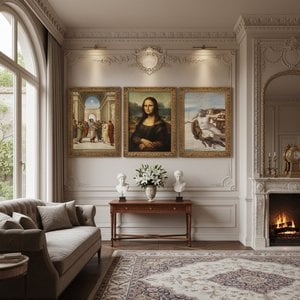
High Renaissance Masterpieces: Iconic Art for Your Home |
Journey through the High Renaissance! Explore 10 iconic masterpieces by Leonardo da Vinci, Michelangelo & Raphael. Discover art history, techniques & find museum-quality reproductions to elevate your home decor on .
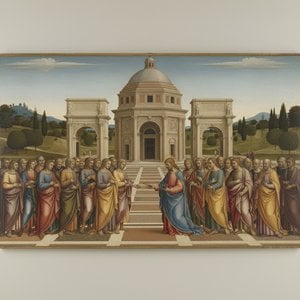
Pietro Perugino: Umbrian Master of Serenity & Precursor to Raphael's High Renaissance
Explore the life & art of Pietro Perugino, a pivotal Renaissance master and Raphael’s influential teacher. Discover his serene compositions, Sistine Chapel frescoes, and lasting legacy with ArtsDot.

25 Must-See Masterpieces at the Hermitage Museum: A Journey Through Art History
Explore 25 iconic Hermitage masterpieces, from Rembrandt to Matisse. Discover museum-quality art on ArtsDot.com.