


 Preview
 Send
Send Share
Share
 Details
 Guide
Guide

 Download
 Similars
 X-Ray
X-Ray Diaporama
 Stats
StatsComposition 1 A


 Read More
Giclée / Art Print
Museum-quality giclée or canvas print with fast production and flexible finish options. ( Buy Hand Made Painting Switch to Digital Image)




P118B $10

P118H $10

P118W $10

P438Z $10

P508JH $12

P508YH $12

P805H $10

P805Z $10

P919BZ $10

P919G $10

P919XJ $10

P959ZH $10

P968JZ $12

W106C $8

W218G $10

W218JH $8

W218Y $10

W307PJ $10

W316G $10

W316PJ $8

W316Y $10

W398PJ $8

W4111J $10

W500HY $15

W500JH $15

W692G $12

W849H $8

W940BG $15

W953PJ $8




Pick from our preset sizes that match the artwork's original proportions.

Type the width and the height you need, to fit your frame or your wall. A print can only be cut, never made bigger than the picture, so a size with a different shape loses a part of the image. We send you a digital mockup to approve before we print anything. The picture shown on this page does not show the real cut — only the mockup does.
Worldwide Delivery () in 2 weeks instead of standard 4/5 weeks. (23 October)

Free Worldwide Express Shipping

High-Quality Linen Canvas

Full Shipping Insurance

Customs Tax Refund Guarantee

True Color Matching Guarantee

100-Day Return Policy (Defects Only)

100% Money-Back Guarantee

Bulk Discount Offer
 Glass option is only available in size under 110 CM

Composition 1 A
Giclée / Art Print
Reproduction Size
-


Total Price
$ 63
The Geometry of Harmony: Exploring Piet Mondrian’s Composition 1 A
Piet Mondrian's Composition 1 A is not merely a painting; it is a visual manifesto, a distillation of artistic principles that would come to define an era. Emerging from the tumultuous currents of early 20th-century art, this work embodies the core tenets of Neoplasticism – a style Mondrian believed could express universal harmony through pure abstraction. To gaze upon its stark arrangement of black lines and rectangular planes is to encounter a world stripped bare of representational clutter, leaving only the essential elements of form and color. The painting’s power resides not in what it depicts, but in how it is depicted: a rigorous exploration of balance, tension, and the fundamental building blocks of visual experience.
A Journey Towards Abstraction
Mondrian's path to this radical simplicity was far from direct. Born Pieter Cornelis Mondriaan in Amersfoort, Netherlands, he initially trained as a teacher while simultaneously pursuing his artistic passions. His early works reveal a fascination with naturalistic landscapes, echoing the traditions of the Hague School and Dutch Impressionism. However, a restless spirit drove him to experiment – Pointillism, Fauvism – always searching for an authentic visual language. The pivotal moment arrived with his move to Paris in 1912, where exposure to Cubism ignited a transformative process. He began deconstructing forms, dismantling traditional perspective, and gradually reducing his palette. This wasn’t merely stylistic experimentation; it was a philosophical quest. Mondrian sought to transcend the subjective and represent an underlying reality – a spiritual order accessible through pure abstraction.
De Stijl and the Pursuit of Universal Beauty
Composition 1 A is deeply rooted in the principles of De Stijl (The Style), a Dutch artistic movement co-founded by Mondrian and Theo van Doesburg. This group envisioned art as a vehicle for social and spiritual renewal, believing that abstract forms could embody universal values. The painting’s limited palette – primarily black, white, and shades of gray – wasn't arbitrary. It represented a deliberate rejection of emotional expression in favor of clarity and objectivity. The bold, straight black lines aren’t simply outlines; they are dynamic forces creating structure and defining space. The asymmetrical arrangement of the rectangles introduces a subtle tension, preventing the composition from becoming static or predictable. This careful balance between order and dynamism is crucial to the work's enduring appeal. It evokes a sense of calm rationality, yet simultaneously engages the eye with its intricate interplay of shapes.
A Lasting Legacy
The impact of Composition 1 A extends far beyond the realm of painting. Mondrian’s Neoplasticism profoundly influenced graphic design, architecture, and fashion throughout the 20th century and continues to inspire contemporary artists today. His emphasis on geometric forms and primary colors became synonymous with modernism itself. The work invites contemplation – a quiet meditation on form, color, and the search for universal harmony. Owning a reproduction of this iconic piece is not simply acquiring an artwork; it’s embracing a legacy of artistic innovation and a vision of a more ordered, balanced world.
Questions & Answers
What technique and style characterize "Composition 1 A" by Piet Mondrian?
In "Composition 1 A", the acrylic on canvas technique meets the Neoplasticism movement.
Does "Composition 1 A" show strong light-dark contrasts?
"Composition 1 A" by Piet Mondrian shows a bold contrast between its light and dark areas.
How is the mood of "Composition 1 A" by Piet Mondrian described?
"Composition 1 A" has a calm atmosphere.
Related Artworks


Artist Biography
The Architecture of Order
To look at a Mondrian today is to see the blueprint of modern visual culture. We encounter his logic every time we interact with a clean graphic layout or a minimalist building facade. He stripped away the unnecessary until only the essential remained. This was not an act of destruction, but one of extreme distillation. By reducing his vocabulary to straight lines, right angles, and a strict palette of red, blue, and yellow, he removed the distraction of reality to reveal a structural truth.
His early work in the Netherlands followed much more traditional paths. He began with landscapes that captured the windmills and rivers of the Dutch countryside, heavily influenced by the Hague School and Impressionism. Pieces like The Red Mill show an artist focused on naturalistic detail and the soft light of his homeland. However, even in these early years, a drive toward simplification was present. He moved through Pointillism and Fauvism, testing how much color and form could be compressed before the subject disappeared entirely.
The Parisian Shift and Neoplasticism
The move to Paris in 1912 changed everything. Encountering Cubism forced him to deconstruct objects into geometric components. He stopped trying to depict what he saw and began exploring how he saw it. This period was deeply tied to his interest in Theosophy, a mystical philosophy that sought universal principles beneath surface appearances. He believed art could express these hidden truths through pure abstraction.
By 1917, this search resulted in Neoplasticism, or "pure plastic art." Alongside Theo van Doesburg, he co-founded the De Stijl movement to promote a rigid aesthetic of horizontal and vertical lines. The rules were absolute:
- The use of primary colors: red, blue, and yellow.
- The use of primary values: black, white, and gray.
- A focus on right angles and straight lines.
This reduction was a deliberate attempt to manifest spiritual order through visual balance. Works like Composition with Red, Blue and Yellow demonstrate this commitment to geometric purity.
New York and the Final Rhythm
The arrival of World War II forced Mondrian to flee Europe for New York City in 1940. The transition from the organic landscapes of his youth to the rigid grid of Manhattan provided a new, unexpected energy. His late works, such as Broadway Boogie Woogie, show a shift in rhythm. While he maintained his core principles, the lines began to dance with a new, syncopated movement inspired by the city's pulse and jazz music.
His death in 1944 ended a career that had fundamentally altered the trajectory of 20th-century art. He left behind a legacy that moved far beyond the canvas, influencing everything from architecture to fashion, including the famous 1965 collection by Yves Saint Laurent. His work remains a standard for anyone seeking clarity and structural integrity in a chaotic visual age.

Piet Mondrian
1872 - 1944 , Netherlands
Related Articles

Theo van Doesburg: Pioneering De Stijl & the Evolution of Neo-Plasticism
Explore the revolutionary De Stijl movement & Neo-Plasticism with our expert guide. Discover Piet Mondrian, Theo van Doesburg, and the lasting impact of this influential art style. Learn about collecting & investing in De Stijl masterpieces.

Piet Mondrian: Deconstructing Reality – A Study of Neo-Plasticism & Universal Harmony
Explore the revolutionary art of Piet Mondrian and the principles of Neo-Plasticism. Discover De Stijl's influence, iconic compositions like 'Composition with Red, Yellow and Blue,' and Mondrian’s lasting legacy on modern design.
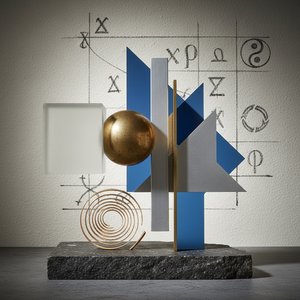
Beyond Form: Exploring the Philosophical Foundations of Geometric Abstraction
Explore the philosophical roots & artistic evolution of geometric abstraction with ArtsDot. Discover Mondrian, Malevich, De Stijl & more. Expert insights for collectors and art enthusiasts.

Beyond Form & Color: Geometric Abstraction's Evolution in 20th/21st Century Art
Explore the evolution of geometric abstraction from Cubism to contemporary art. Discover key artists like Malevich & Mondrian, investment insights, and expert collecting advice at ArtsDot.

Geometric Abstraction's 10 Defining Masterpieces | Art for Your Home - ArtsDot
Explore 10 defining masterpieces of Geometric Abstraction! Discover Kandinsky, Mondrian & Malevich’s iconic works. Find museum-quality art reproductions and curated decor ideas to elevate your home at ArtsDot.com.


