Preview
 Send
Send Share
Share
 Details
 Guide
Guide

 Download
 Similars
 X-Ray
X-Ray Diaporama
 Q&A
Q&A Stats
StatsA stable

- 47.0 x 64.0cm


 Read More
Giclée / Art Print
Museum-quality giclée or canvas print with fast production and flexible finish options. ( Buy Hand Made Painting Switch to Digital Image)




P118B $10

P118H $10

P118W $10

P438Z $10

P508JH $12

P508YH $12

P805H $10

P805Z $10

P919BZ $10

P919G $10

P919XJ $10

P959ZH $10

P968JZ $12

W106C $8

W218G $10

W218JH $8

W218Y $10

W307PJ $10

W316G $10

W316PJ $8

W316Y $10

W398PJ $8

W4111J $10

W500HY $15

W500JH $15

W692G $12

W849H $8

W940BG $15

W953PJ $8




Pick from our preset sizes that match the artwork's original proportions.

Type the width and the height you need, to fit your frame or your wall. A print can only be cut, never made bigger than the picture, so a size with a different shape loses a part of the image. We send you a digital mockup to approve before we print anything. The picture shown on this page does not show the real cut — only the mockup does.
Worldwide Delivery () in 2 weeks instead of standard 4/5 weeks. (15 November)

Free Worldwide Express Shipping

High-Quality Linen Canvas

Full Shipping Insurance

Customs Tax Refund Guarantee

True Color Matching Guarantee

100-Day Return Policy (Defects Only)

100% Money-Back Guarantee

Bulk Discount Offer
 Glass option is only available in size under 110 CM

A stable
Giclée / Art Print
Reproduction Size
-


Total Price
$ 63
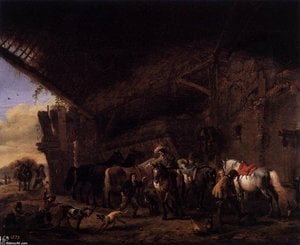
A World Within Shadows
Dust motes dance in a single, piercing beam of light that cuts through the heavy gloom of a Dutch stable. The air feels thick, weighted by the scent of hay and the warmth of breathing animals. Inside this dim enclosure, the architecture of heavy, dark wooden beams frames a scene of quiet, rhythmic labor. A large, shadowed interior occupies the upper two-thirds of the space, pressing down with a sense of enclosure that makes the central activity feel intimate and private. Light spills from an unseen opening in the background, washing over the coats of horses and the coarse fabrics of the laborers, creating a sharp contrast between the deep umbers of the corners and the bright highlights of the central group.
The scene pulses with the subtle movements of a working day:
The Art of the Everyday
Every brushstroke works to capture the specific textures of a life lived close to the earth. The technique renders the roughness of a wooden beam and the softness of a horse's mane with meticulous precision. This is a study of light and shadow, where the chiaroscuro effect does more than just illuminate; it gives weight and volume to the figures, pulling them out of the darkness. The color palette remains grounded in the soil, utilizing deep browns, ochre, and sienna to build a world that feels tangible and lived-in. There is a quiet dignity in the way the light catches a shoulder or a hoof, turning a mundane stable scene into a moment of profound observation.
The composition draws the eye inward, following the perspective from the dark foreground toward the light source in the distance. This movement creates a sense of depth that makes the stable feel like a vast, breathing entity. It is a glimpse into the 17th-century Dutch Golden Age, where the focus shifts from the grand to the granular. The painting captures a fleeting instant of rural life, frozen in oil on panel, where the simple act of tending to animals becomes a study in light, form, and the quiet rhythm of existence.
Questions & Answers
What use is suggested for "A stable" by Philips Wouwerman?
The suggested use for "A stable" by Philips Wouwerman is conversation. It can serve other purposes as well.
Where in the home does a reproduction of "A stable" fit well?
A reproduction of "A stable" fits well in a restaurant (casual).
Where can I find a guide to "A stable"?
The guide to "A stable" is the artwork's Guide page - a printable factsheet showing the artwork with its caption, credit line and identity table (artist, dates, medium, original size, collection).
Related Artworks


Artist Biography
Philips Wouwerman: A Life in the Dutch Golden Age
- Born: Haarlem, Netherlands (1619)
- Died: 1668
Philips Wouwerman (baptized May 24, 1619 – died May 19, 1668) was a highly prolific and versatile Dutch painter renowned for his depictions of hunting scenes, landscapes, and battle scenes. He stands as a significant figure within the artistic landscape of the Dutch Golden Age.
Early Life and Training
Born in Haarlem, Netherlands, Philips Wouwerman was the son of Pouwels Joostsz Wouwerman, also a painter, though less known than his son. Details regarding his early artistic training are somewhat scarce. However, it is believed that he studied under Frans Hals (1581/85–1666), a prominent Haarlem portraitist. While Hals’s distinctive style did not heavily influence Wouwerman's mature work, the foundational training likely proved invaluable. Early in his career, Wouwerman was influenced by the *bamboccianti* tradition, particularly the works of Pieter van Laer (1592/99–after 1642), adopting their focus on everyday life and genre scenes.
Artistic Development and Style
- Early Influences: Initially emulating *bamboccianti* painters, Wouwerman’s early works featured depictions of daily life.
- Emerging Style (Mid-1640s): A characteristic compositional element emerged – a diagonal slope of land often accompanied by a tree acting as a repoussoir (a device used to create depth). Figures, frequently accompanied by horses, populated these scenes.
- Mature Period (c. 1650-1660): Wouwerman developed his individual style, expanding his subject matter considerably. He painted genre scenes, landscapes with travelers, cavalry battles, military encampments, and festive gatherings of peasants.
- Mastery of the Horse: Wouwerman is particularly celebrated for his exceptional skill in depicting horses of various breeds in dynamic motion. Art historian Frederik J. Duparc has famously called him "undoubtedly the most accomplished and successful 17th-century Dutch painter of horses."
- Characteristic Features: His paintings are characterized by subdued colors, a cool atmosphere, and meticulous attention to detail, creating witty and anecdotal narratives within his scenes. He often combined imaginary southern landscapes with a distinctly Dutch ambiance.
Major Achievements and Legacy
Wouwerman’s works were highly sought after during his lifetime and continued to gain popularity in the 18th century. His paintings found their way into prominent collections across Europe, including those of princely houses in Dresden and St. Petersburg, demonstrating widespread admiration for his artistry.
- Prolific Output: Wouwerman was remarkably prolific; early catalogues listed around 800 works attributed to him, later exceeding 1200. A more recent catalogue raisonné (Schumacher, 2006) identifies approximately 570 authentic works, acknowledging the numerous followers and imitators who produced works in his style.
- Family of Artists: His brothers, Jan (1629–1666) and Pieter (1623–1682), were also painters, often initially attributed to Philips. While Pieter’s work clearly reflected Philips' influence, he developed a distinct style. Jan was recognized as a more autonomous landscape painter.
- Influence on Later Artists: Wouwerman’s style influenced numerous artists, including Jan van Huchtenburgh (1647–1733), the brothers Jan Frans and Joseph van Bredael (1688–1739), and Carel van Falens (1683–1733).
- Guild Membership & Civic Role: He was a member of the Haarlem Guild of St. Luke, holding several official positions within it. Beyond his artistic pursuits, Wouwerman also served as an estate agent in Haarlem, reflecting his involvement in civic life.
Historical Significance
Philips Wouwerman’s contribution to the Dutch Golden Age lies in his ability to capture a wide range of scenes – from bustling marketplaces and hunting expeditions to dramatic battlefields and tranquil landscapes – with remarkable detail and dynamism. His mastery of depicting horses, combined with his keen eye for anecdotal storytelling, solidified his place as one of the most celebrated and influential painters of his time. A retrospective exhibition in Kassel and The Hague (2009/2010) further highlighted his enduring legacy.

Philips Wouwerman
1619 - 1668 , Netherlands
Quick Facts
- Full Name: Philips Wouwerman
- Nationality: Dutch
- Date Of Birth: 1619
- Date Of Death: 1668
- Place Of Birth: Haarlem, Netherlands
- Notable Artworks:
- Two Horses
- Two Horsemen at a Gipsy Encampment
- Dune Landscape with a Signal Post
- A Horse Fair near an Army Camp
- Horsepond near a Boundary Stone
- Artistic Movement Or Style: Dutch Golden Age
- Artists Who Influenced This Artist:
- Pieter van Laer
- Frans Hals
- Jan Wijnants
- Artists Or Movements Influenced By This Artist:
- Jan van Huchtenburgh
- Joseph van Bredael
- Carel van Falens