


The picture follows your choices: , .
Collectible Description
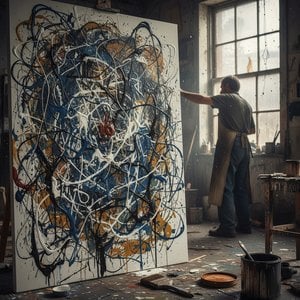
Experience Jackson Pollock’s "Number 1A," a pivotal Abstract Expressionist masterpiece. Dive into chaotic energy & textured depth – a dynamic, iconic artwork for collectors.
 Read More
Artist Biography
A pioneer of Abstract Expressionism known for his drip technique. Discover the raw energy of his iconic canvases today.
Hand Made Oil Reproduction
Hand-painted oil on canvas in your size and frame, made to order by our artists. ( Switch to Print Switch to Digital Image)
More about this painting
 Preview
 Send
Send Share
Share
 Details
 Guide
Guide

 Download
 Similars
 X-Ray
X-Ray Diaporama
 Q&A
Q&A Stats
StatsOrder your painting in four simple steps
Take your time. You can change any answer; the price in your order card follows each choice.
1 Step one of four
Which size would you like?
These sizes keep the proportions of the original painting. The drawing shows your choice on a wall, above a two-metre sofa.
Or give your own measurements
Pick from our preset sizes that match the artwork's original proportions.

Type the width and the height you need, to fit your frame or your wall. This is hand-painted, so for a size with a different shape the artist can paint a bit more around the picture, or cut a bit — you choose. We send you a digital mockup to approve before the painting starts. The picture shown on this page does not show the real result — only the mockup does.
2 Step two of four
How should it be prepared: rolled, stretched or framed?
The prices below are for the size you chose in step one.
Choose the edges of the stretched canvas
Choose your frame

White $1

Blurside $1

Extended $1

P118B $10

P118H $10

P118W $10

P438Z $10

P508JH $12

P508YH $12

P805H $10

P805Z $10

P919BZ $10

P919G $10

P919XJ $10

P959ZH $10

P968JZ $12

W106C $8

W218G $10

W218JH $8

W218Y $10

W307PJ $10

W316G $10

W316PJ $8

W316Y $10

W398PJ $8

W4111J $10

W500HY $15

W500JH $15

W692G $12

W849H $8

W940BG $15

W953PJ $8

H24-GOLD $30

H24-SILVER $30

H36-GOLD $45

H36-SILVER $45
Framed
Moulding: . Overall size with the frame: .
3 Step three of four
Would you like anything changed in the painting?
Most people answer no. Because each painting is made by hand, our artist can also adapt it for you.
After order, ArtsDot.com team will email client for instructions and provide a mockup preview
4 Step four of four
A few finishing options
All of them are optional. The answers already selected cost nothing extra.
Who paints it?
Worldwide Delivery () in 3/4 weeks instead of standard 5 weeks. (10 November). No compromise on quality.
A nameplate, as in a museum?
Engraved Bronze Plaque Details
This elegant plaque features the artist's name and the title of the artwork, finely engraved for a timeless presentation.
It is made from bronze with a refined, elegant finish. The text is precisely laser-engraved for a sharp and permanent result. Measuring 9x2 cm, the plaque is compact yet easy to read. It's built to be durable and scratch-resistant, offering a professional, museum-quality look. Mounting is simple thanks to the included adhesive backing.
Transparent Acrylic Plaque Details
The plaque includes essential engraved details such as the artist's name, the title of the artwork, the date it was created, the type of media used-like oil on canvas or watercolor-a brief description of the piece, and a QR code that links to the complete artwork information.
It is crafted from clear acrylic, offering a sleek, modern appearance. The text is UV-engraved in black to ensure strong visual contrast. With a size of 10x15 cm, it ensures optimal readability. It comes equipped with two metal hooks for secure wall mounting. The plaque is designed to be weather-resistant, making it suitable for various environments, and it includes interactive features that work seamlessly with smartphone scanning.
Black Acrylic Plaque Details
This elegant plaque includes engraved information such as the artist's name, the title of the artwork, the date it was created, the type of media used (like oil on canvas or watercolor), a short description of the artwork, and a QR code for quick access to more information.
The plaque itself is made from refined black acrylic with a premium finish. The text is laser-engraved in white for high contrast and readability. Its size is 10x15 cm, designed to be easy to read. It comes with two metal hooks for professional mounting. The design is sleek and fits any interior style. It is also weather-resistant and durable, with built-in digital integration for mobile compatibility.
A protective varnish?
When do you need it?
✓ Check and order
Your painting, as you ordered it

Number 1A
Reproduction Medium
Reproduction Size
-

Elite Senior Artist
More detail, finesse, and extra production time
-

Reproduction Frame
-
-
For artworks or reproductions larger than 105 cm (approximately 41 inches) on any side, the frame will be shipped as a kit, disassembled. This method ensures safe delivery and prevents damage during transport.
Professional assembly required - this is not a DIY product.
The kit must be assembled and the canvas stretched by an experienced professional framer, using wood glue (not supplied), a canvas stretching plier and clamps to hold the bars square while the glue dries. Incorrect assembly or uneven canvas tension can permanently damage the artwork and is not covered by our warranty.
 For artworks or reproductions larger than 105 cm (approximately 41 inches) on any side, the frame will be shipped as a kit, disassembled. This method ensures safe delivery and prevents damage during transport.
All solid wood bars are included, precisely cut to size.
Assembled with the screws provided, plus wood glue for the corner joints, which is not supplied and must be sourced by your framer.
Professional tools are required and not included: a canvas stretching plier (tensioner) and clamps to hold the bars square while the glue dries.
Important:
The corner joints require wood glue, the bars must be held with clamps until the glue is fully dry, and tightening the canvas on the assembled frame requires a canvas stretching plier. None of these are included in the kit. Please arrange an experienced professional framer before ordering this size.

Nameplate
-
-

Protective Varnish
Glossy Varnish (enhances colors, protects against light/moisture)
-

Customize My Artwork
Examples of what can be changed: Replace face with customer photo; Add pet (e.g., replace cat with dog); Include hidden message in background; Change background landscape or elements.
-

Urgent
Worldwide Delivery () in 3/4 weeks instead of standard 5 weeks. (10 November). No compromise on quality.
-
Express Shipping
Worldwide Delivery () in 5 weeks. (17 November).
Included
Total Price
$ 263
Glass option is only available in size under 110 CM
Included with every order
- Free Worldwide Express Shipping
- High-Quality Linen Canvas
- Full Shipping Insurance
- Customs Tax Refund Guarantee
- True Color Matching Guarantee
- 100-Day Return Policy (Defects Only)
- 100% Money-Back Guarantee
- Bulk Discount Offer


The Essence of Abstract Expressionism
Jackson Pollock's "Number 1A" is a quintessential example of Abstract Expressionism, a movement that redefined American art in the mid-20th century. This captivating piece embodies the raw energy and spontaneity that Pollock is renowned for, making it a must-have for any contemporary art collection or modern interior.A Dance of Chaos and Control
The artwork presents an abstract composition characterized by chaotic, energetic brushstrokes and a dense accumulation of lines and textures. Pollock's innovative technique involves pouring and splashing paint onto a horizontal canvas, allowing him to move around the painting in a dance-like motion. This method results in a dynamic interplay of colors and forms that evoke a sense of movement and spontaneity.Earthy Tones and Textured Depth
The color palette is dominated by earthy tones such as browns, blacks, and grays, with occasional flecks of other colors peeking through. These muted colors contribute to a somber yet intense atmosphere, grounding the piece in a sense of natural elements or industrial materials. The use of thick impasto techniques gives the paint a three-dimensional quality, making the surface appear rough and uneven. This tactile texture enhances the visual impact, inviting viewers to explore the intricate details of the artwork.Symbolism and Emotional Resonance
The subject matter is abstract, open to interpretation, and rich in symbolic potential. The chaotic brushstrokes might symbolize energy, movement, or even emotional turmoil. The dense accumulation of lines could represent a complex network or interconnectedness. This abstract nature invites multiple interpretations, making "Number 1A" a deeply personal piece that resonates with each viewer uniquely.Historical Context and Legacy
Created during Pollock's groundbreaking "drip period" between 1947 and 1950, "Number 1A" is a testament to the artist's revolutionary approach to painting. This period marked a significant shift in Pollock's style, as he moved away from traditional easel painting to embrace a more physical and intuitive method. The artwork's historical significance lies in its contribution to the Abstract Expressionist movement, which challenged conventional norms and paved the way for future generations of artists.Enhancing Your Space with "Number 1A"
For art lovers and collectors, owning a high-quality reproduction of "Number 1A" is an opportunity to bring a piece of art history into your home or office. The dynamic composition and earthy tones make it a versatile addition to various interior styles, from modern minimalism to eclectic bohemian spaces. Interior designers can use this artwork to create a focal point in a room, adding depth and character to the decor.Experience the Power of Abstract Art
"Number 1A" is more than just a painting; it is an experience that engages the senses and stirs the emotions. Whether you are drawn to its chaotic beauty or its historical significance, this artwork has the power to transform any space into a sanctuary of creativity and inspiration. Embrace the spirit of Abstract Expressionism and let "Number 1A" become a centerpiece in your collection.Bring Home a Masterpiece
Elevate your art collection with a hand-painted reproduction of Jackson Pollock's "Number 1A." Each reproduction is crafted with meticulous attention to detail, ensuring that the essence and energy of the original artwork are captured. Invest in a piece that not only enhances your space but also celebrates the legacy of one of the most influential artists of the 20th century.Questions & Answers
How light is "Number 1A" overall?
Overall, "Number 1A" is recorded as balanced. Perceived brightness describes how light or dark the work appears.
What is the luminance of "Number 1A" by Paul Jackson Pollock?
The luminance recorded for "Number 1A" by Paul Jackson Pollock is gentle luminance.
Is "Number 1A" by Paul Jackson Pollock a light or a dark artwork?
"Number 1A" by Paul Jackson Pollock is recorded as balanced, with a gentle luminance luminance.
Related Artworks


Paul Jackson Pollock
1912 - 1956, United States of America
Artist Biography
Early Life, Family and Training
The story of Paul Jackson Pollock begins in the rugged landscape of Cody, Wyoming, where he was born on January 28, 1912. He was the youngest of five brothers, born to Stella May McClure and LeRoy Pollock. His father worked as a land surveyor, a profession that required constant movement across the vast American West. This nomadic existence meant that the young boy's early years were defined by frequent relocations, a restlessness that seemed to mirror the shifting horizons of his father's work. These early travels through the West provided him with a direct, unmediated encounter with the natural world and the spiritual resonance of Native American art, impressions that would quietly settle into his subconscious long before he ever held a brush.
As he grew, the search for a sense of place led him toward the urban energy of the coast. He enrolled at Manual Arts High School in Los Angeles, seeking a formal structure for his burgeoning impulses. However, the true shaping of his hand occurred much later, when he moved to New York City. It was there, at the Art Students League, that he began a long and transformative period of study. From 1929 to 1942, he labored under the guidance of Thomas Hart Benton. While Benton emphasized rhythmic compositions and the narrative weight of American life, the young student was already beginning to drift toward his own, more abstract, internal truths.
The Development of a Unique Technique
By 1947, a profound shift had taken hold in the way he approached the canvas. He moved away from the traditional easel, choosing instead to lay his canvases directly upon the floor. This change allowed him to stand over his work, becoming part of the creative act itself. He did not merely apply paint; he dripped, splashed, and flung it from above, letting the liquid fall in unpredictable patterns. This method turned the act of painting into a physical performance, where gravity and gesture dictated the final form.
His tools were as unconventional as his methods. He reached for sticks, knives, and even syringes to manipulate the fluid medium. Sometimes he used trowels or dripping fluid paint to achieve specific textures. He would often scratch into the surface or use strange objects to build up a thick crust of paint, adding a tactile, sculptural quality to the work. This process was less about controlled brushwork and more about a rhythmic, almost primal release of energy onto the surface.
Key Works and Artistic Expressions
As he moved away from the constraints of the easel, his canvases began to reflect a more visceral engagement with the medium. In 1943, he produced Mural, a massive work measuring 8-by-20-foot (2.4 by 6.1 m), which demonstrated his ability to command a vast surface. During this period, his explorations into the subconscious and the act of painting itself led to works like Eyes in the Heat, created about 1946. These pieces were not merely images but records of a physical presence, where the movement of his whole body dictated the placement of every splatter and pool of color.
The years that followed saw him perfecting the rhythmic, all-over compositions that would define his reputation. He sought to create a sense of boundless space, where no single point held dominance over the rest. This approach is evident in Number 1, 1949, a work that captures a raw outpouring of energy, and in Lavender Mist, Number 1, 1950, which remains a significant piece of his output. In these works, the interplay between control and chance creates a delicate balance, as if the paint were released rather than applied.
His later experiments continued to push the boundaries of how paint could be manipulated on a horizontal surface. He often used sticks, knives, or even the cans themselves to fling pigment, resulting in complex networks of lines. This method is clearly seen in Blue Poles, Number 11, 1952 and in the energetic Convergence. Through these works, he achieved a state where the painting seemed to possess a life of its own, emerging from a deep immersion in his own imagination.
Patrons, Workshop and Commissions
The path of his career was shaped by both public necessity and the generosity of a few vital supporters. Between 1938 and 1942, he found steady work as a painter for the WPA Federal Art Project, a period that provided a necessary rhythm to his developing practice. This stability gave way to a more personal and transformative alliance when Peggy Guggenheim offered him a gallery contract in July 1943. Her support proved to be more than professional; in 1945, she provided a $2,000 down payment to help him secure a home, a gesture that deeply intertwined his personal life with his artistic survival.
His creative life eventually found its center in East Hampton, New York. There, within the Pollock-Krasner House and Studio, he lived and worked alongside his wife, Lee Krasner. The studio was a place of intense physical movement, where the boundaries between the artist and the canvas dissolved. He often moved away from the traditional easel, preferring to lay his canvases upon the floor to engage with the paint from all sides. This workspace was not merely a room for production but a site of profound, restless energy where his most radical experiments took place.
Later Years and Death
The personal life of the artist was deeply intertwined with his creative struggles. In 1945, he married the artist Lee Krasner, a union that provided a significant presence in his life during his most transformative years. Yet, beneath the surface of his professional ascent, a persistent shadow remained. He struggled with an alcohol addiction throughout his entire life, a battle that often complicated his existence and his ability to navigate the pressures of his growing fame.
This internal and external turbulence reached a tragic end in East Hampton, New York, USA. On August 11, 1956, at the age of 44, his life was cut short in a sudden, violent accident. While driving, he was involved in a single-car collision caused by alcohol. The crash proved fatal, leaving behind a legacy that was as tumultuous as the paint he flung across his canvases.
Legacy and Influence on Modern Art
The ripples of his radical methods reached far beyond the studio walls of East Hampton. By breaking the traditional bond between the brush and the easel, he became a central figure in the Abstract Expressionist movement, a shift that fundamentally altered the trajectory of American creativity. His presence helped solidify New York City's position as a global center for modern art, moving the heart of the avant-garde away from European dominance. He was among the first American painters to be recognized as a peer of the great 20th-century European masters, proving that a new, visceral language could emerge from the soil of the United States.
His influence acted as a catalyst for many subsequent art movements that followed in his wake. The way he engaged with the canvas—treating it as an arena for physical action rather than a mere surface for representation—opened doors for many who sought to express the subconscious through gesture. This emphasis on the process of creation itself left a permanent mark on the history of modern art, ensuring that the spontaneous and the unplanned would forever hold a place in the artist's toolkit.
- Number 1, 1949
- Blue Poles: Number 11, 1952
- Convergence
- Autumn Rhythm. Number 30, 1950
Where to See the Works Today
To witness the physical traces of his movement, one must travel to the great institutions that preserved his radical energy. In New York City, the Museum of Modern Art holds several of his canvases, allowing viewers to stand before the sprawling, uncentered compositions that defined his era. The National Gallery of Art in Washington D.C. also maintains his works, offering a space to observe the intricate networks of color he achieved through his unique methods. Across the Atlantic, the Tate Gallery in London keeps his presence alive within its collections, ensuring his influence reaches far beyond American shores.
For those seeking a more intimate connection to his process, the Pollock-Krasner House and Studio in East Hampton offers a profound sense of place. This site, a National Historic Landmark, was the space where he and his wife, Lee Krasner, lived and worked. The property remains a vital link to his life, preserving the environment that nurtured his transition from traditional forms to the spontaneous, floor-based methods that changed the course of modern painting. Walking through these spaces provides a sense of the scale and the physical reality of his creative struggle.
- Number 1, 1949
- Blue Poles: Number 11, 1952
- Mural (1943)
- Convergence


Related Articles
Paul Jackson Pollock: A Radical Departure – Exploring Abstract Expressionism's Pioneering Figure and His Enduring Legacy
Explore the revolutionary art of Jackson Pollock & Abstract Expressionism. Discover his iconic drip paintings, lasting impact, and considerations for collecting this pivotal American artist. Expert insights at ArtsDot.

John Jackson: A Comprehensive Exploration of Technique, Context, and the Evolution of a Modern Visionary
Explore the life & work of John Jackson, a pivotal figure in Abstract Expressionism. Discover his innovative techniques, historical context, and lasting influence on modern art. A guide for discerning collectors.

Mastering Abstraction: The 25 Most Iconic Works by Wassily Kandinsky
Explore 25 iconic Kandinsky masterpieces and the birth of abstraction. Discover the full collection online at ArtsDot.com.