


 Preview
 Send
Send Share
Share
 Details
 Guide
Guide

 Download
 Similars
 X-Ray
X-Ray Diaporama
 Stats
StatsPalomas y conejos


 Read More
Hand Made Oil Reproduction
Hand-painted oil on canvas in your size and frame, made to order by our artists. ( Switch to Print Switch to Digital Image)




P118B $10

P118H $10

P118W $10

P438Z $10

P508JH $12

P508YH $12

P805H $10

P805Z $10

P919BZ $10

P919G $10

P919XJ $10

P959ZH $10

P968JZ $12

W106C $8

W218G $10

W218JH $8

W218Y $10

W307PJ $10

W316G $10

W316PJ $8

W316Y $10

W398PJ $8

W4111J $10

W500HY $15

W500JH $15

W692G $12

W849H $8

W940BG $15

W953PJ $8




Pick from our preset sizes that match the artwork's original proportions.

You may enter your own dimensions to fit a specific frame or space. If your selected size does not match the original image's proportions, we will either crop the artwork or extend the painting with additional hand-painted elements. A digital mockup will be sent for your approval before production begins.
Please note that the on-screen preview does not reflect the actual cropping or extension. Only the mockup will accurately show the final composition.
While custom sizes are available, we recommend selecting a dimension from the predefined list to preserve the original proportions.
After order, ArtsDot.com team will email client for instructions and provide a mockup preview
Worldwide Delivery () in 3/4 weeks instead of standard 5 weeks. (23 September). No compromise on quality.

Free Worldwide Express Shipping

High-Quality Linen Canvas

Full Shipping Insurance

Customs Tax Refund Guarantee

True Color Matching Guarantee

100-Day Return Policy (Defects Only)

100% Money-Back Guarantee

Bulk Discount Offer
 Glass option is only available in size under 110 CM

Palomas y conejos
Reproduction Medium
Reproduction Size
-


Total Price
$ 288
A Fragmented Vision of Peace: The Soul of Picasso’s Palomas y Conejos
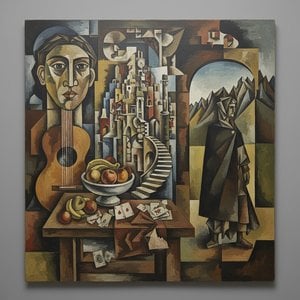
In the vast, revolutionary canon of Pablo Picasso, few works capture the delicate tension between tranquility and structural complexity quite like "Palomas y Conejos". Completed in 1957, this masterpiece serves as a profound testament to the artist’s enduring fascination with Cubism and his ability to infuse symbolic representation with a modern, fractured lens. At its heart, the painting is far more than a simple depiction of nature; it is an invitation into a contemplative dialogue about duality, transformation, and the very way we perceive the living world. Through the interplay of doves and rabbits, Picasso weaves a narrative that transcends the canvas, offering a glimpse into a universe where peace and fertility dance amidst geometric shadows.
The composition unfolds with a deceptive simplicity that masks a sophisticated architectural depth. Utilizing the hallmarks of his mature Cubist style, Picasso abandons the traditional illusion of three-dimensional space in favor of a dynamic, interlocking arrangement of planes. The viewer is not merely looking at animals on a branch; they are witnessing a geometric dance where forms overlap and intersect from multiple viewpoints simultaneously. Bold, decisive lines delineate the contours of the subjects, creating a rhythmic energy that defies conventional spatial logic. While the rabbit sits with a grounded, upright presence, the doves are rendered with elongated necks and flattened bodies, a deliberate disruption of naturalistic proportions that forces the eye to reconstruct the scene through an intellectual, rather than purely literal, lens.
Symbolism and the Echo of History
To gaze upon "Palomas y Conejos" is to engage with a rich tapestry of ancient symbols reimagined for the twentieth century. The dove, an eternal emblem of peace and love, finds itself integrated into a fractured landscape, perhaps suggesting that peace is not a static state but something that must be navigated through complexity and change. Paired with the rabbit—a creature often synonymous with fertility, vulnerability, and the cycles of life—the artwork achieves a poignant balance between the ethereal and the earthly. This duality creates an emotional resonance that speaks to both the fragility of existence and the enduring strength of nature.
Beyond its immediate subjects, the work carries the historical weight of Picasso’s era. While deeply rooted in the Cubist foundations he established alongside Georges Braque, this piece also whispers of Surrealist influences. The dreamlike, almost ethereal quality of the composition reflects a period where artists sought to explore the irrational and the subconscious. For the discerning collector or interior designer, this painting offers more than mere decoration; it provides a focal point of intellectual depth. Its monochromatic essence—captured in the stark, evocative tones of graphite and charcoal—allows it to integrate seamlessly into sophisticated modern interiors, acting as a window into a moment where art history was being rewritten through the lens of abstraction.
An Essential Addition for the Discerning Collector
For those seeking to curate a space defined by elegance and profound meaning, a high-quality reproduction of "Palomas y Conejos" offers an unparalleled opportunity. The artwork’s ability to command attention through its structural integrity and emotional nuance makes it a versatile masterpiece for any high-end collection. Whether placed in a minimalist gallery setting or as a conversation piece within a luxurious residential study, the painting brings with it the transformative energy of Picasso himself. It is a piece that does not merely occupy space but actively shapes the atmosphere of a room, inviting every observer to pause, reflect, and rediscover the beauty found within the fragments of our world.
Related Artworks


Artist Biography
The Enduring Legacy of Pablo Picasso
Pablo Ruiz y Picasso, a name synonymous with artistic revolution, was born in Málaga, Spain, on October 25, 1881. His very existence seemed destined for creative expression; legend has it his first uttered words were “piz, piz,” an attempt to say ‘pencil’. This early inclination was nurtured by his father, José Ruiz y Blasco, a painter and art teacher who provided young Pablo with foundational training. However, the student quickly surpassed the instructor, demonstrating a remarkable aptitude for naturalistic depiction that hinted at the prodigious talent within. The family’s subsequent moves – first to A Coruña, then Barcelona – were punctuated by personal tragedy, notably the loss of Picasso's sister, experiences which would subtly infuse his later work with themes of melancholy and mortality. Even during formal studies at the School of Fine Arts in Barcelona and a brief stint at the Royal Academy of San Fernando in Madrid, Picasso chafed against rigid academic constraints, preferring instead to immerse himself in the works of masters like Velázquez and Goya, forging his own path toward artistic innovation.
From Melancholy Blues to Rose-Tinted Hues
The early years of the 20th century witnessed the emergence of two distinct periods in Picasso’s oeuvre: the Blue Period (roughly 1901-1904) and the Rose Period (1904-1906). The Blue Period, born from personal hardship and a keen awareness of social suffering, is characterized by paintings steeped in somber shades of blue and blue-green. These works are populated by marginalized figures – beggars, the blind, prostitutes – rendered with a haunting empathy that speaks to themes of isolation and despair. La Vie (1903) and The Old Guitarist (1903-1904) stand as poignant examples of this emotionally charged phase. A shift in Picasso’s personal life, coupled with a move to Paris, heralded the arrival of the Rose Period. The palette warmed considerably, embracing pinks, oranges, and reds, reflecting a more optimistic outlook. This period saw a fascination with circus performers – harlequins, acrobats, and family troupes – figures who embodied both fragility and resilience. Family of Saltimbanques (1905) beautifully encapsulates this transition, hinting at the stylistic explorations that lay ahead.
The Shattering of Perspective: Cubism and Beyond
The year 1907 marked a pivotal moment in art history with the creation of Les Demoiselles d'Avignon. Influenced by Iberian sculpture and African masks, this groundbreaking painting shattered traditional notions of perspective and representation. It was a radical departure, a deliberate rejection of centuries-old conventions that paved the way for Cubism. Working in close collaboration with Georges Braque, Picasso co-founded this revolutionary movement, fundamentally altering how artists perceived and depicted reality. Analytical Cubism (1909-1912) involved the fragmentation of objects into geometric shapes, rendered in muted colors, as if dissecting form itself. This evolved into Synthetic Cubism (1912-1919), which incorporated collage elements – newspaper clippings, fabric scraps – adding texture and new layers of visual complexity. Picasso wasn’t content to simply represent the world; he sought to deconstruct it and reconstruct it on his own terms.
A Restless Experimenter: Neoclassicism, Surrealism, and War
The 1920s saw Picasso briefly explore Neoclassical styles, creating monumental figures that echoed classical forms while retaining a distinctly modern sensibility. Simultaneously, he engaged with the burgeoning Surrealist movement, though never fully aligning himself with its principles. His work during this period blended earlier stylistic influences with surreal imagery and distorted perspectives, demonstrating his relentless experimentation. The horrors of the Spanish Civil War profoundly impacted Picasso, culminating in the creation of Guernica (1937), a visceral and emotionally devastating response to the bombing of Guernica. This monumental work became an enduring symbol of the atrocities of war, solidifying Picasso’s role as not just an artist but also a powerful voice for peace and social justice. Throughout the 1950s and 60s, he continued to push boundaries, exploring ceramics, sculpture, and printmaking with unwavering curiosity and skill. His marriage to Jacqueline Roque in 1961 brought a new dimension to his personal life and artistic expression.
An Immeasurable Impact
Pablo Picasso died on April 8, 1973, in Mougins, France, leaving behind an astonishing body of work – estimated at over 50,000 pieces – that continues to captivate and inspire. His artistic development was shaped by a diverse range of influences, from Spanish masters like Velázquez and Goya to Iberian sculpture, African art, and the vibrant color palettes of Henri Matisse. His impact on 20th-century art is immeasurable. He co-founded Cubism, pioneered collage and constructed sculpture, and consistently challenged artistic conventions. Picasso’s relentless experimentation redefined modern art, leaving an indelible mark on generations of artists and solidifying his position as one of the most important and influential figures in history. His legacy extends beyond the canvas, resonating in countless aspects of contemporary culture and reminding us of the transformative power of artistic vision.

Pablo Picasso
1881 - 1973 , Spain
Quick Facts
- Artistic Movement Or Style: Cubism, Surrealism
- Artists Or Movements Influenced By This Artist:
- Cubism
- Modern art
- Artists Who Influenced This Artist:
- Velázquez
- Goya
- Matisse
- Date Of Birth: October 25, 1881
- Date Of Death: April 8, 1973
- Full Name: Pablo Diego José Ruiz Picasso
- Nationality: Spanish
- Notable Artworks:
- Les Demoiselles d'Avignon
- Guernica
- The Old Guitarist
- La Vie
- Family of Saltimbanques
- Place Of Birth: Malaga, Spain
Related Articles
Cubist Expression: 10 Masterpieces That Revolutionized Modern Art | ArtsDot
Explore 10 Cubist masterpieces by Picasso, Braque & more! Discover the stories behind these revolutionary paintings and their impact on modern art. Find museum-quality reproductions for your home at ArtsDot.com – where art comes to life.

Cubism's Revolution: 10 Masterpieces That Redefined Modern Art | ArtsDot
Explore 10 Cubist masterpieces by Picasso, Braque & more! Delve into the history of this revolutionary art movement. Find museum-quality reproductions and elevate your home decor with ArtsDot. Discover all masterpieces on ArtsDot.com

Cubist Portraits: 10 Masterpieces That Revolutionized Art | ArtsDot
Explore 10 revolutionary Cubist portraits by Picasso, Braque & more! Discover the stories behind these iconic paintings and how they shaped modern art. Find museum-quality reproductions to elevate your home decor on ArtsDot.com.

Pablo Picasso: A Revolutionary Vision – Cubism, Symbolism & Enduring Legacy
Explore the revolutionary art of Pablo Picasso with ArtsDot.com. Discover Cubism's origins, symbolism in his masterpieces & investment insights for collectors. Expert appraisal & custom reproductions available.

Bronze Sculptures That Defined Art History | ArtsDot
Journey through art history with our Top 10 bronze sculptures! Explore masterpieces by Rodin, Michelangelo & more. Discover stories behind iconic statues and find museum-quality reproductions for your home decor at ArtsDot.com.


