


The picture follows your choices: , .
Collectible Description
Pablo Picasso's 'Mandolin' is a Cubist masterpiece blending bicycle and guitar forms—a dynamic exploration of perspective, sound, and disruption. Witness the artist’s revolutionary vision in this unique pencil drawing.
 Read More
Artist Biography
Co-founder of Cubism and creator of Guernica. Discover the revolutionary works of Pablo Picasso today.
Hand Made Oil Reproduction
Hand-painted oil on canvas in your size and frame, made to order by our artists. ( Switch to Print Switch to Digital Image)
This Artwork Is Under Copyright Protection
The artwork displayed on this page is protected by copyright law, which means we cannot legally create or sell an identical reproduction. This protection is enforced under international agreements such as the Berne Convention and by national laws, including those outlined by the U.S. Copyright Law - Title 17.
As a respectful and legal alternative, we offer custom, hand-painted artworks inspired by the original. Our skilled and professional artists carefully study the original's style, mood, and artistic essence to create a new, unique piece that evokes the same feeling - while remaining an original creation in its own right.
This method fully complies with copyright regulations because it does not involve copying or duplicating the protected artwork. Instead, it is a creative reinterpretation - a new painting that is influenced by the original but not identical to it.
More about this painting
 Preview
 Send
Send Share
Share
 Details
 Guide
Guide

 Download
 Similars
 X-Ray
X-Ray Diaporama
 Q&A
Q&A Stats
StatsOrder your painting in four simple steps
Take your time. You can change any answer; the price in your order card follows each choice.
1 Step one of four
Which size would you like?
These sizes keep the proportions of the original painting. The drawing shows your choice on a wall, above a two-metre sofa.
Or give your own measurements
Pick from our preset sizes that match the artwork's original proportions.

Type the width and the height you need, to fit your frame or your wall. This is hand-painted, so for a size with a different shape the artist can paint a bit more around the picture, or cut a bit — you choose. We send you a digital mockup to approve before the painting starts. The picture shown on this page does not show the real result — only the mockup does.
2 Step two of four
How should it be prepared: rolled, stretched or framed?
The prices below are for the size you chose in step one.
Choose the edges of the stretched canvas
Choose your frame

White $1

Blurside $1

Extended $1

P118B $10

P118H $10

P118W $10

P438Z $10

P508JH $12

P508YH $12

P805H $10

P805Z $10

P919BZ $10

P919G $10

P919XJ $10

P959ZH $10

P968JZ $12

W106C $8

W218G $10

W218JH $8

W218Y $10

W307PJ $10

W316G $10

W316PJ $8

W316Y $10

W398PJ $8

W4111J $10

W500HY $15

W500JH $15

W692G $12

W849H $8

W940BG $15

W953PJ $8

H24-GOLD $30

H24-SILVER $30

H36-GOLD $45

H36-SILVER $45
Framed
Moulding: . Overall size with the frame: .
3 Step three of four
Would you like anything changed in the painting?
Most people answer no. Because each painting is made by hand, our artist can also adapt it for you.
After order, ArtsDot.com team will email client for instructions and provide a mockup preview
4 Step four of four
A few finishing options
All of them are optional. The answers already selected cost nothing extra.
Who paints it?
Worldwide Delivery () in 3/4 weeks instead of standard 5 weeks. (5 November). No compromise on quality.
A nameplate, as in a museum?
Engraved Bronze Plaque Details
This elegant plaque features the artist's name and the title of the artwork, finely engraved for a timeless presentation.
It is made from bronze with a refined, elegant finish. The text is precisely laser-engraved for a sharp and permanent result. Measuring 9x2 cm, the plaque is compact yet easy to read. It's built to be durable and scratch-resistant, offering a professional, museum-quality look. Mounting is simple thanks to the included adhesive backing.
Transparent Acrylic Plaque Details
The plaque includes essential engraved details such as the artist's name, the title of the artwork, the date it was created, the type of media used-like oil on canvas or watercolor-a brief description of the piece, and a QR code that links to the complete artwork information.
It is crafted from clear acrylic, offering a sleek, modern appearance. The text is UV-engraved in black to ensure strong visual contrast. With a size of 10x15 cm, it ensures optimal readability. It comes equipped with two metal hooks for secure wall mounting. The plaque is designed to be weather-resistant, making it suitable for various environments, and it includes interactive features that work seamlessly with smartphone scanning.
Black Acrylic Plaque Details
This elegant plaque includes engraved information such as the artist's name, the title of the artwork, the date it was created, the type of media used (like oil on canvas or watercolor), a short description of the artwork, and a QR code for quick access to more information.
The plaque itself is made from refined black acrylic with a premium finish. The text is laser-engraved in white for high contrast and readability. Its size is 10x15 cm, designed to be easy to read. It comes with two metal hooks for professional mounting. The design is sleek and fits any interior style. It is also weather-resistant and durable, with built-in digital integration for mobile compatibility.
A protective varnish?
When do you need it?
✓ Check and order
Your painting, as you ordered it

Mandolin
Reproduction Medium
Reproduction Size
-

Elite Senior Artist
More detail, finesse, and extra production time
-

Reproduction Frame
-
-
For artworks or reproductions larger than 105 cm (approximately 41 inches) on any side, the frame will be shipped as a kit, disassembled. This method ensures safe delivery and prevents damage during transport.
Professional assembly required - this is not a DIY product.
The kit must be assembled and the canvas stretched by an experienced professional framer, using wood glue (not supplied), a canvas stretching plier and clamps to hold the bars square while the glue dries. Incorrect assembly or uneven canvas tension can permanently damage the artwork and is not covered by our warranty.
 For artworks or reproductions larger than 105 cm (approximately 41 inches) on any side, the frame will be shipped as a kit, disassembled. This method ensures safe delivery and prevents damage during transport.
All solid wood bars are included, precisely cut to size.
Assembled with the screws provided, plus wood glue for the corner joints, which is not supplied and must be sourced by your framer.
Professional tools are required and not included: a canvas stretching plier (tensioner) and clamps to hold the bars square while the glue dries.
Important:
The corner joints require wood glue, the bars must be held with clamps until the glue is fully dry, and tightening the canvas on the assembled frame requires a canvas stretching plier. None of these are included in the kit. Please arrange an experienced professional framer before ordering this size.

Nameplate
-
-

Protective Varnish
Glossy Varnish (enhances colors, protects against light/moisture)
-

Customize My Artwork
Examples of what can be changed: Replace face with customer photo; Add pet (e.g., replace cat with dog); Include hidden message in background; Change background landscape or elements.
-

Urgent
Worldwide Delivery () in 3/4 weeks instead of standard 5 weeks. (5 November). No compromise on quality.
-
Express Shipping
Worldwide Delivery () in 5 weeks. (12 November).
Included
Total Price
$ 263
Glass option is only available in size under 110 CM
Included with every order
- Free Worldwide Express Shipping
- High-Quality Linen Canvas
- Full Shipping Insurance
- Customs Tax Refund Guarantee
- True Color Matching Guarantee
- 100-Day Return Policy (Defects Only)
- 100% Money-Back Guarantee
- Bulk Discount Offer


A Fragmented Melody – The Enigmatic Mandolin
Pablo Picasso’s 1911 drawing, “Mandolin,” isn't merely a depiction of an instrument; it’s a fractured exploration of perception itself. At first glance, the image presents a startling juxtaposition: a bicycle, rendered in the sharp angles and geometric precision characteristic of his early Cubist work, interwoven with a stylized guitar form—a suggestion of musicality emerging from the mechanical. This isn't a straightforward representation; it’s an invitation to question how we see, how we understand, and ultimately, what constitutes reality. The drawing immediately commands attention, pulling the viewer into its dynamic asymmetry and challenging conventional notions of spatial harmony.
The artwork’s monochromatic palette—a carefully orchestrated dance between black, white, and grey—amplifies this sense of disruption. Lines aren't simply delineating shapes; they are actively constructing a new visual language. Angular lines dominate, creating a feeling of restless energy, while meticulous hatching and cross-hatching build up tonal values with remarkable subtlety, suggesting both the solidity of form and the ephemeral nature of light. The visible pencil strokes themselves contribute to an immediate intimacy, as if we’ve stumbled upon a fleeting moment captured on paper – a sketch brimming with intellectual curiosity.
Cubism Unbound: Deconstructing the Familiar
Picasso's masterful manipulation of geometric shapes—triangles, rectangles, and curves—is central to the artwork’s impact. The bicycle frame, composed of sharply defined segments, embodies the Cubist principle of breaking down objects into their constituent parts and reassembling them from multiple viewpoints simultaneously. The guitar element, with its more rounded forms, offers a counterpoint, hinting at organic qualities within this otherwise rigorously constructed composition. This deliberate juxtaposition—the rigid mechanics of the bicycle against the implied warmth of music – speaks to the artist’s desire to dismantle established modes of representation and forge new ways of seeing.
The distortion of perspective is particularly striking. Rather than striving for realistic depth, Picasso flattens the image, creating a two-dimensional effect that emphasizes the interplay between planes and forms. Overlapping shapes contribute to this sense of ambiguity, blurring the boundaries between object and background, foreground and distance. This flattening isn’t simply an aesthetic choice; it mirrors the Cubist exploration of simultaneity – presenting multiple perspectives within a single frame, forcing the viewer to actively engage in the process of interpretation.
Symbolism and Emotional Resonance
Beyond its formal innovations, “Mandolin” carries a potent symbolic weight. The combination of transportation and musical instruments—the bicycle representing movement and the guitar embodying creativity – suggests an exploration of human potential and the relationship between action and expression. The fragmented forms evoke a sense of dynamism and disruption, mirroring the turbulent period in which Picasso was working, grappling with the social and political upheavals of his time. There’s a subtle undercurrent of melancholy, perhaps referencing the loss of his sister Conchita, a recurring theme in his oeuvre.
Ultimately, “Mandolin” is more than just a drawing; it's a meditation on perception, representation, and the very nature of reality. It invites us to reconsider our assumptions about how things ‘should’ look and encourages us to embrace the beauty and complexity of fragmented perspectives. It stands as a testament to Picasso’s revolutionary spirit and his enduring legacy as one of art history’s most influential figures.
Questions & Answers
What stage of Pablo Picasso's development does "Mandolin" represent?
"Mandolin" belongs to the Analytical Cubism of Pablo Picasso's career. This classification relates the work to the artist's development.
Who sells hand-painted copies of "Mandolin" by Pablo Picasso?
Hand-painted copies of "Mandolin" by Pablo Picasso are sold on this website: a hand-painted oil reproduction on linen canvas, ordered from its Hand-Painted Reproduction page.
What color saturation does "Mandolin" by Pablo Picasso have?
"Mandolin" by Pablo Picasso is recorded with a muted saturation.
Related Artworks


Pablo Picasso
1881 - 1973, Spain
Artist Biography
The boy from Málaga
A child's first words in Málaga were “piz, piz,” a small attempt at saying pencil. This early pull toward the lead and paper was nurtured by his father, José Ruiz y Blasco, who taught him the basics of figure drawing and oil painting. The boy learned to copy the masters and draw from plaster casts under a disciplined eye. As he grew, the family moved through A Coruña and Barcelona. These years were marked by the quiet weight of loss, particularly the death of his sister, Conchita, from diphtheria when she was only seven. Such shadows would later find their way into the heavy, blue-green tones of his early work.
By thirteen, he was already taking entrance exams for advanced classes in Barcelona, finishing in a week what took others a month. His hands moved with a precision that even his father noticed, once seeing him paint over an unfinished sketch of a pigeon with such accuracy that the instructor realized the student had surpassed him. He eventually moved to Paris, a city where he would spend much of his adult life, constantly shifting his focus from one way of seeing to another.
Shifting palettes and fractured forms
The early twentieth century saw his work move through distinct phases of color and mood. There was the Blue Period, where the canvases were filled with beggars, the blind, and the lonely, rendered in somber shades of blue. This gave way to the Rose Period, a time when pinks, oranges, and reds appeared, often featuring the figures of circus performers like harlequins and acrobats. These years showed a man reacting to his own life and the world around him through the temperature of his palette.
In 1907, the way he handled space changed fundamentally with Les Demoiselles d'Avignon. Influenced by African masks and Iberian sculpture, he began to break objects into geometric shapes. Alongside Georges Braque, he developed Cubism. This involved two main stages:
- Analytic Cubism: A method of fragmenting objects into muted, geometric pieces as if dissecting the form itself.
- Synthetic Cubism: An approach that brought in collage elements like newspaper clippings and fabric scraps to add texture and new layers.
A life of constant change
His work never settled into a single way of being. He explored Neoclassicism with large, monumental figures and later engaged with the imagery of Surrealism, using distorted perspectives to tap into the subconscious. The violence of the Spanish Civil War left its mark on his canvas in 1937 through Guernica. This large oil painting used a stark palette of black, white, and grey to show the suffering of a bombed town, featuring a gored horse, a bull, and screaming women. It remains a heavy, monochromatic response to the chaos of war.
In his later years, he continued to experiment with ceramics, sculpture, and printmaking. He even created large-scale public works, such as the 1967 steel sculpture in Chicago, which was inspired by the head of his Afghan Hound, Kabul. He died in Mougins, France, leaving behind a massive collection of work that spans over seventy-six years of experimentation.


Related Articles
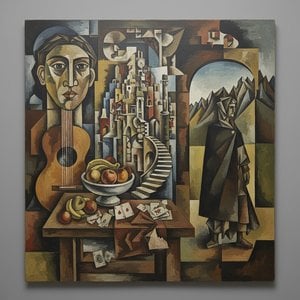
Cubist Expression: 10 Masterpieces That Revolutionized Modern Art | ArtsDot
Explore 10 Cubist masterpieces by Picasso, Braque & more! Discover the stories behind these revolutionary paintings and their impact on modern art. Find museum-quality reproductions for your home at ArtsDot.com – where art comes to life.

Dark Masterpieces: 10 Iconic Paintings Dominated by Black Tones |
Explore 10 iconic paintings dominated by black tones, from Rembrandt’s chiaroscuro to Goya's dark expressions. Discover the stories behind these masterpieces & find museum-quality art reproductions for your home at .

Cubism's Revolution: 10 Masterpieces That Redefined Modern Art | ArtsDot
Explore 10 Cubist masterpieces by Picasso, Braque & more! Delve into the history of this revolutionary art movement. Find museum-quality reproductions and elevate your home decor with ArtsDot. Discover all masterpieces on ArtsDot.com