

 Preview
 Send
Send Share
Share
 Details
 Guide
Guide

 Download
 Similars
 X-Ray
X-Ray Diaporama
 Q&A
Q&A Stats
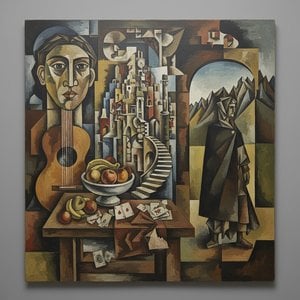
StatsFlute Player and Watermelon Eater


 Read More
The artwork displayed on this page is protected by copyright law, which means we cannot legally create or sell an identical reproduction. This protection is enforced under international agreements such as the Berne Convention and by national laws, including those outlined by the U.S. Copyright Law - Title 17.
This method fully complies with copyright regulations because it does not involve copying or duplicating the protected artwork. Instead, it is a creative reinterpretation - a new painting that is influenced by the original but not identical to it.
Giclée / Art Print
Museum-quality giclée or canvas print with fast production and flexible finish options. ( Buy Hand Made Painting Switch to Digital Image)




P118B $10

P118H $10

P118W $10

P438Z $10

P508JH $12

P508YH $12

P805H $10

P805Z $10

P919BZ $10

P919G $10

P919XJ $10

P959ZH $10

P968JZ $12

W106C $8

W218G $10

W218JH $8

W218Y $10

W307PJ $10

W316G $10

W316PJ $8

W316Y $10

W398PJ $8

W4111J $10

W500HY $15

W500JH $15

W692G $12

W849H $8

W940BG $15

W953PJ $8




Pick from our preset sizes that match the artwork's original proportions.

Type the width and the height you need, to fit your frame or your wall. A print can only be cut, never made bigger than the picture, so a size with a different shape loses a part of the image. We send you a digital mockup to approve before we print anything. The picture shown on this page does not show the real cut — only the mockup does.
Worldwide Delivery () in 2 weeks instead of standard 4/5 weeks. (4 November)

Free Worldwide Express Shipping

High-Quality Linen Canvas

Full Shipping Insurance

Customs Tax Refund Guarantee

True Color Matching Guarantee

100-Day Return Policy (Defects Only)

100% Money-Back Guarantee

Bulk Discount Offer
 Glass option is only available in size under 110 CM

Flute Player and Watermelon Eater
Giclée / Art Print
Reproduction Size
-


Total Price
$ 63
Flute Player and Watermelon Eater: A Pioneering Vision of Cubism
Pablo Picasso’s *Flute Player and Watermelon Eater*, painted in 1908 during his formative years as a Cubist artist, stands as an emblem of this revolutionary movement—a testament to its audacious challenge of traditional artistic conventions. Measuring 65 x 54 cm, the oil on canvas embodies Picasso's innovative approach to representing reality through fragmented forms and multiple perspectives, reflecting the intellectual fervor of the era and cementing his place among the titans of modern art.Style and Composition: Geometric Harmony
The painting’s aesthetic is characterized by a deliberate embrace of geometric shapes—circles dominating the heads of both figures, while triangles delineate their bodies—a stylistic hallmark directly influenced by African sculpture that Picasso had encountered during his travels to Africa in 1906-1907. This simplification of form isn't merely decorative; it’s fundamental to Cubism’s core principle: dismantling objects into constituent planes and presenting them simultaneously from various viewpoints. The muted color palette—primarily ochre, brown, and pale blues—contributes to the painting’s solemn mood, mirroring the contemplative stillness of the scene.Influence on Cubism: Breaking Free From Perspective
As one of the founding fathers of Cubism alongside Georges Braque, Picasso actively sought to liberate art from the constraints of linear perspective—a technique that had dominated Western painting for centuries. Instead of depicting objects as seen from a single vantage point, Cubists aimed to convey their totality by juxtaposing multiple viewpoints on a single canvas, forcing viewers to actively engage in reconstructing the image mentally. This radical departure from convention signaled a profound shift in artistic thought and practice, establishing Cubism as a cornerstone of 20th-century art history.A Mythological Echo: Symbolism and Artistic Inspiration
The subject matter itself—a man playing the flute alongside a woman consuming watermelon—holds symbolic resonance. The flute represents musicality and contemplation, while the watermelon embodies fertility and abundance—themes frequently explored in mythology and folklore. Picasso’s artistic inspiration stemmed from diverse sources, including Cézanne's explorations of form and volume, as well as the expressive power of African art, which profoundly impacted his visual vocabulary. *Flute Player and Watermelon Eater* exemplifies this fusion of influences, demonstrating Picasso’s masterful ability to synthesize disparate traditions into a cohesive and emotionally evocative artwork.Concluding Remarks: Legacy of Innovation
Ultimately, *Flute Player and Watermelon Eater* transcends its formal elements—the geometric shapes, muted colors, and fractured perspective—to convey a deeper message about the human condition. It captures a moment of serene stillness amidst an increasingly turbulent world, inviting contemplation on themes of beauty, harmony, and artistic experimentation. Picasso’s enduring legacy lies not only in his groundbreaking contribution to Cubism but also in his unwavering commitment to pushing the boundaries of artistic expression—a spirit that continues to inspire artists today.Questions & Answers
What color palette is used in "Flute Player and Watermelon Eater" by Pablo Picasso?
The palette of "Flute Player and Watermelon Eater" by Pablo Picasso is described as earthy. It is a compact description of the work's colors.
Is "Flute Player and Watermelon Eater" by Pablo Picasso a well-known artwork?
"Flute Player and Watermelon Eater" is classified as iconic.
How do movement and era meet in "Flute Player and Watermelon Eater" by Pablo Picasso?
In "Flute Player and Watermelon Eater" by Pablo Picasso, the Cubism movement meets the Modern era.
Related Artworks


Artist Biography
The boy from Málaga
A child's first words in Málaga were “piz, piz,” a small attempt at saying pencil. This early pull toward the lead and paper was nurtured by his father, José Ruiz y Blasco, who taught him the basics of figure drawing and oil painting. The boy learned to copy the masters and draw from plaster casts under a disciplined eye. As he grew, the family moved through A Coruña and Barcelona. These years were marked by the quiet weight of loss, particularly the death of his sister, Conchita, from diphtheria when she was only seven. Such shadows would later find their way into the heavy, blue-green tones of his early work.
By thirteen, he was already taking entrance exams for advanced classes in Barcelona, finishing in a week what took others a month. His hands moved with a precision that even his father noticed, once seeing him paint over an unfinished sketch of a pigeon with such accuracy that the instructor realized the student had surpassed him. He eventually moved to Paris, a city where he would spend much of his adult life, constantly shifting his focus from one way of seeing to another.
Shifting palettes and fractured forms
The early twentieth century saw his work move through distinct phases of color and mood. There was the Blue Period, where the canvases were filled with beggars, the blind, and the lonely, rendered in somber shades of blue. This gave way to the Rose Period, a time when pinks, oranges, and reds appeared, often featuring the figures of circus performers like harlequins and acrobats. These years showed a man reacting to his own life and the world around him through the temperature of his palette.
In 1907, the way he handled space changed fundamentally with Les Demoiselles d'Avignon. Influenced by African masks and Iberian sculpture, he began to break objects into geometric shapes. Alongside Georges Braque, he developed Cubism. This involved two main stages:
- Analytic Cubism: A method of fragmenting objects into muted, geometric pieces as if dissecting the form itself.
- Synthetic Cubism: An approach that brought in collage elements like newspaper clippings and fabric scraps to add texture and new layers.
A life of constant change
His work never settled into a single way of being. He explored Neoclassicism with large, monumental figures and later engaged with the imagery of Surrealism, using distorted perspectives to tap into the subconscious. The violence of the Spanish Civil War left its mark on his canvas in 1937 through Guernica. This large oil painting used a stark palette of black, white, and grey to show the suffering of a bombed town, featuring a gored horse, a bull, and screaming women. It remains a heavy, monochromatic response to the chaos of war.
In his later years, he continued to experiment with ceramics, sculpture, and printmaking. He even created large-scale public works, such as the 1967 steel sculpture in Chicago, which was inspired by the head of his Afghan Hound, Kabul. He died in Mougins, France, leaving behind a massive collection of work that spans over seventy-six years of experimentation.

Pablo Picasso
1881 - 1973 , Spain
Quick Facts
- Full Name: Pablo Diego José Ruiz Picasso
- Nationality: Spanish
- Date Of Birth: 1881
- Date Of Death: 1973
- Place Of Birth: Malaga, Spain
- Notable Artworks:
- Les Demoiselles d'Avignon
- Guernica
- The Old Guitarist
- La Vie
- Family of Saltimbanques
- Artistic Movement Or Style: Cubism, Surrealism
- Artists Who Influenced This Artist:
- Velázquez
- Goya
- Matisse
- Artists Or Movements Influenced By This Artist:
- Cubism
- Modern art
Related Articles
Cubist Expression: 10 Masterpieces That Revolutionized Modern Art | ArtsDot
Explore 10 Cubist masterpieces by Picasso, Braque & more! Discover the stories behind these revolutionary paintings and their impact on modern art. Find museum-quality reproductions for your home at ArtsDot.com – where art comes to life.

Cubist Portraits: 10 Masterpieces That Revolutionized Art | ArtsDot
Explore 10 revolutionary Cubist portraits by Picasso, Braque & more! Discover the stories behind these iconic paintings and how they shaped modern art. Find museum-quality reproductions to elevate your home decor on ArtsDot.com.

Pablo Picasso: A Revolutionary Vision – Cubism, Symbolism & Enduring Legacy
Explore the revolutionary art of Pablo Picasso with ArtsDot.com. Discover Cubism's origins, symbolism in his masterpieces & investment insights for collectors. Expert appraisal & custom reproductions available.

Cubism's Revolution: 10 Masterpieces That Redefined Modern Art | ArtsDot
Explore 10 Cubist masterpieces by Picasso, Braque & more! Delve into the history of this revolutionary art movement. Find museum-quality reproductions and elevate your home decor with ArtsDot. Discover all masterpieces on ArtsDot.com

Deconstructing Reality: Cubism's Revolutionary Impact on 20th-Century Art
Explore the revolutionary world of Cubism with ArtsDot. Discover Picasso & Braque's groundbreaking techniques, its philosophical roots, and lasting impact on modern art. Expert insights for collectors.


