

 Preview
 Send
Send Share
Share
 Details
 Guide
Guide

 Download
 Similars
 X-Ray
X-Ray Diaporama
 Q&A
Q&A Stats
StatsFemale bust


 Read More
The artwork displayed on this page is protected by copyright law, which means we cannot legally create or sell an identical reproduction. This protection is enforced under international agreements such as the Berne Convention and by national laws, including those outlined by the U.S. Copyright Law - Title 17.
This method fully complies with copyright regulations because it does not involve copying or duplicating the protected artwork. Instead, it is a creative reinterpretation - a new painting that is influenced by the original but not identical to it.
Giclée / Art Print
Museum-quality giclée or canvas print with fast production and flexible finish options. ( Buy Hand Made Painting Switch to Digital Image)




P118B $10

P118H $10

P118W $10

P438Z $10

P508JH $12

P508YH $12

P805H $10

P805Z $10

P919BZ $10

P919G $10

P919XJ $10

P959ZH $10

P968JZ $12

W106C $8

W218G $10

W218JH $8

W218Y $10

W307PJ $10

W316G $10

W316PJ $8

W316Y $10

W398PJ $8

W4111J $10

W500HY $15

W500JH $15

W692G $12

W849H $8

W940BG $15

W953PJ $8




Pick from our preset sizes that match the artwork's original proportions.

Type the width and the height you need, to fit your frame or your wall. A print can only be cut, never made bigger than the picture, so a size with a different shape loses a part of the image. We send you a digital mockup to approve before we print anything. The picture shown on this page does not show the real cut — only the mockup does.
Worldwide Delivery () in 2 weeks instead of standard 4/5 weeks. (9 November)

Free Worldwide Express Shipping

High-Quality Linen Canvas

Full Shipping Insurance

Customs Tax Refund Guarantee

True Color Matching Guarantee

100-Day Return Policy (Defects Only)

100% Money-Back Guarantee

Bulk Discount Offer
 Glass option is only available in size under 110 CM

Female bust
Giclée / Art Print
Reproduction Size
-


Total Price
$ 63
A Window into Naive Art’s Bold Simplicity
Pablo Picasso's "Female Bust," painted in 1907, stands as a pivotal work within the burgeoning movement of Naive Art—also known as Primitivism. This style wasn’t born from formal academic training but rather from an innate artistic impulse, mirroring the raw talent found in artists who eschewed traditional conventions and sought inspiration in non-Western cultures. Picasso's embrace of Naive Art represents a conscious rebellion against established artistic norms, marking a significant step in his evolving artistic journey.The Essence of Primitivism: Form Meets Emotion
Naive Art distinguishes itself through its deliberate rejection of illusionistic representation. Instead, artists prioritize direct observation and emotional expression—often conveying feelings rather than meticulously recreating reality. Picasso’s “Female Bust” exemplifies this ethos perfectly. The composition is strikingly simple: a woman's face dominates the canvas, rendered in bold lines and vibrant hues against a muted blue backdrop. This deliberate reduction of visual elements amplifies the painting’s impact, forcing viewers to confront its core message—a portrait imbued with palpable emotion.Cubist Influences Shaping Visual Language
While firmly rooted in Naive Art principles, “Female Bust” subtly incorporates elements characteristic of Picasso's developing Cubist style. The fractured planes and geometric shapes that define Cubism are present here, albeit restrained, contributing to the painting’s dynamic visual language. This fusion of stylistic approaches underscores Picasso’s intellectual curiosity and his willingness to experiment with innovative techniques—a hallmark of his groundbreaking career.Symbolic Resonance: Face and Necklace – Vessels of Identity
The depiction of a woman's face is laden with symbolic significance within Naive Art, representing not merely physical appearance but also inner character and psychological depth. Picasso’s focus on the prominent nose—a feature often interpreted as embodying strength and resilience—further reinforces this notion. Similarly, the necklace encircling her neck symbolizes adornment and perhaps a connection to tradition or heritage. These carefully chosen elements invite contemplation about the subject's identity and emotional state.A Legacy of Artistic Innovation
“Female Bust” remains an enduring testament to Picasso’s artistic vision—a courageous assertion of stylistic freedom and a profound exploration of human emotion. Its simplicity belies its intellectual complexity, captivating audiences across generations with its raw beauty and unwavering sincerity. For those seeking to immerse themselves in the spirit of modern art history, ArtsDot offers exceptional reproductions that bring this masterpiece to life, allowing you to experience Picasso’s groundbreaking style firsthand.- Pablo Picasso: Female bust
- Pablo Picasso: Nude (Bust)
- Pablo Picasso: Painter and his model
- Pablo Picasso: Matador
ArtsDot.com - The Naive Art (Primitivism) Art Movement: /art/list/?Filter=A@D3CQBV-The-Naive-Art-(Primitivism)-Art-Movement
Wikipedia.org - Pablo Picasso: https://en.wikipedia.org/wiki/Pablo_Picasso
ArtsDot.com - Pablo Picasso: https://ArtsDot.com/@/Pablo-Picasso
Questions & Answers
Can I examine "Female bust" in more detail?
The X-Ray page of "Female bust" by Pablo Picasso is an interactive viewer that lets you slide through eleven optical layers of the artwork's image, including an X-ray style view.
What print size of "Female bust" by Pablo Picasso fits the recommended room?
The recommended pairing for "Female bust" by Pablo Picasso: a large print in a living room.
Where do the visitors of "Female bust" by Pablo Picasso come from?
The Stats page of "Female bust" by Pablo Picasso presents public visit statistics: monthly visits of this artwork, a comparison with the artist's most viewed works, and where its visitors come from.
Related Artworks


Artist Biography
Early Life, Family and Training
In the city of Málaga, Spain, a boy named Pablo Picasso entered the world on October 25, 1881. He was born to María Picasso y López and José Ruiz Blasco, a man who understood the weight of a brush and the discipline of the canvas. From his earliest years, the child displayed a restless pull toward drawing, a talent that seemed to manifest in his very first attempts at speech. His father, a painter himself, recognized the spark in his son and took it upon himself to nurture that budding skill. Under his father's watchful and disciplined eye, the boy learned the fundamentals of figure drawing and the complexities of oil painting, mastering the ability to copy the old masters and study the forms of plaster casts.
The family's path eventually led them through A Coruña and into Barcelona, but these years of growth were shadowed by a quiet, heavy grief. When Pablo was only seven, his sister Conchita was taken by diphtheria. This early encounter with loss left a mark on the household, a somberness that would eventually find its way into the tones of his later work. Despite the weight of such sorrows, his technical progress remained startlingly rapid. By the age of thirteen, he was already facing the rigorous entrance exams for advanced classes in Barcelona. While other students labored for weeks to prove their worth, he completed the requirements in a single week, demonstrating a precision that left even his instructors in awe of his natural aptitude.
The Formative Years in Spain
The boy’s path led away from the warmth of Málaga as his family moved to A Coruña in 1891. It was a time of shifting landscapes and growing skill, as he began to navigate the formal structures of artistic training. His hands, already showing a remarkable aptitude for the lead and paper, moved with a precision that often left his instructors astonished. He was a student of the School of Fine Arts in Barcelona, where his talent began to outpace the traditional lessons of the academy. He sought more, eventually finding himself at the Royal Academy of San Fernando in Madrid, testing his limits against the rigid expectations of the masters.
Shadows fell over the family during these years, specifically when the loss of his sister, Conchita, to diphtheria cast a heavy weight upon their lives. This grief prompted the family to move to Barcelona, a city that would become a central part of his early development. In these streets, the young artist was already moving beyond the simple imitation of his father’s work. He was a restless spirit, often chafing against the strict academic constraints of his studies. He preferred to immerse himself in the works of the old masters, seeking a way to see the world that was entirely his own.
- First Communion (1896)
- Science and Charity (1897)
The Blue and Rose Periods
As the young man moved through his early years, a profound melancholy began to seep into his brushstrokes. Between 1901 and 1904, he entered what is known as the Blue Period. This era was born from the heavy weight of personal hardship and a keen awareness of the social suffering surrounding him. He turned his gaze toward the marginalized, painting the lonely, the blind, and the beggars in somber, monochromatic shades of indigo and azure. These canvases did not merely depict people; they captured a sense of isolation that seemed to echo his own internal landscape. The colors were cold, mirroring a world that felt distant and unforgiving.
By 1904, the shadows began to retreat, replaced by a shift in both temperament and palette. This transition led into the Rose Period, which lasted until about 1906. The heavy blues gave way to warmer, more optimistic hues of pink, orange, and red. During these years, his subjects changed as well, often focusing on the figures of the circus, such as acrobats and harlequins. This period showed a man reacting to the world through the changing temperature of his colors, moving from the depths of sorrow toward a more nuanced, colorful reality.
- 1901: Sabartes
- 1905: Saltimbanques (The Family of Saltimbanques)
The Development of Cubism
By the time he settled in Paris in 1904, the restless spirit of the artist was already seeking a way to dismantle the traditional rules of sight. He did not work in isolation; instead, he co-founded the Cubist movement, a radical departure from the way a canvas had been understood for centuries. This was a period of profound experimentation where the solid world began to shatter into a mosaic of geometric shapes. He sought to capture the essence of an object by showing it from many different angles at once, breaking the illusion of a single, fixed perspective.
The first phase of this revolution was known as Analytic Cubism. In this stage, he worked with a muted palette, dissecting forms into fragmented, overlapping planes as if he were performing a visual autopsy on the subject. The colors were often somber, focusing the viewer's attention on the structure and the complex geometry of the composition rather than on the warmth of the hue. It was a cerebral, disciplined approach to the act of seeing.
As his ideas evolved, he moved toward Synthetic Cubism, a phase also referred to as the Crystal period. This approach brought a new kind of texture to his work, as he began to incorporate collage elements like fabric scraps and newspaper clippings directly onto the surface. This method allowed him to build up layers of meaning and material, moving away from the purely analytical dissection of the earlier years toward a more constructive way of assembling reality. His work during these years reflected a constant, driving need to reinvent the very language of art.
- Les Demoiselles d'Avignon (1907)
- Three Musicians (1921)
Key Works and Artistic Milestones
The year 1907 brought a profound shift in how the world was perceived through his brush. With the creation of Les Demoiselles d'Avignon, he began to dismantle the traditional rules of space and form. This work signaled a departure from the naturalism of his youth, moving toward a fractured reality that would soon define a new era of visual thought. He was no longer merely observing the world; he was breaking it apart to understand its underlying structure.
The chaos of human conflict often found its way into his most powerful responses to tragedy. In 1937, the news of the bombing of Guernica reached him, a devastating attack on a town in the Basque Country. This event prompted the creation of Guernica, a large oil painting that captured the suffering of the victims. Through a stark palette of black, white, and grey, he rendered the agony of the gored horse, the screaming women, and the fallen soldier. It remains a heavy, monochromatic response to the violence of war.
Even in his later years, his reach extended into the public squares of distant cities. In 1967, he gifted the city of Chicago an untitled monumental sculpture made of COR-TEN steel. This massive, fifty-foot structure, which he suggested represented the head of his Afghan Hound, Kabul, transformed the urban landscape of Daley Plaza. It stood as a bold, abstract presence in the heart of the city, proving that his restless spirit could find form in heavy metal just as easily as in oil and canvas.
Technique and Stylistic Evolution
His hands were never content with a single method, constantly seeking new ways to dismantle the world he saw. He moved through the years with a restless energy, shifting from the disciplined oil painting of his youth to the more tactile experiments of his maturity. He embraced the art of collage, pulling newspaper clippings and scraps of fabric into his compositions to build layers of texture that challenged the flat surface of the canvas. This hunger for new forms led him toward constructed sculpture, where he moved beyond the traditional carving of stone to build figures from diverse materials. He was a man of many tools, finding expression in the soft touch of pastels and the quick, decisive lines of pencils.
As his vision expanded, he often looked backward to move forward. He returned to the weight of Neoclassicism, crafting large, monumental figures that possessed a heavy, sculptural presence. This was not a retreat into the past, but a way to explore the gravity of the human form. Later, he found himself drawn to the distorted perspectives of Surrealism, using the imagery of the subconscious to pull the viewer into a dreamlike state. He did not merely paint a subject; he interrogated it, often breaking it into geometric shapes to show how we perceive reality from multiple angles at once. His work was a constant struggle between the order of structure and the chaos of emotion.
- Guernica (1937)
- Les Demoiselles d'Avignon (1907)
- The Young Ladies of Avignon (1907)
Legacy and Influence
The ripples of his creative life reached far beyond the walls of his studios in Paris and the South of France. By co-founding the Cubist movement, he fundamentally altered how the eye perceives the world, breaking the traditional rules of perspective to reveal a new, fragmented reality. This shift did more than change the canvas; it redirected the entire course of twentieth-century art, encouraging generations to look past the surface of things. He possessed a restless spirit that refused to be tethered by tradition, constantly seeking new visual languages to express the complexities of human existence.
His impact also extended into the realm of social conscience and global symbols. Through his profound commitment to peace, he helped transform the dove into a universal symbol, a gesture that linked his personal convictions to the collective hope of humanity. He lived through the most violent upheavals of his century, from the Spanish Civil War to the World Wars, and his ability to translate such chaos into a visual language ensured that his work remained a mirror to the human condition. His influence was not a single event but a continuous, evolving presence that shaped the very fabric of modern culture.
- Guernica (1937)
- Les Demoiselles d'Avignon (1907)
- The Chicago Picasso (1967)
Where to See the Works Today
To walk through the halls of the Musée Picasso in Paris is to enter a sanctuary where the artist's restless spirit remains palpable. This Parisian institution offers a deep look into the evolution of his thought, tracing the path from his early, somber experiments to the radical shifts that redefined modern sight. For those seeking to trace his origins, the Museo Picasso Málaga in Spain provides a connection to his beginnings, situated in the very land that shaped his early training and formative years.
In Madrid, the Museo Reina Sofía holds the heavy, monochromatic weight of his response to the chaos of war. This is where his massive, grey and black oil painting, Guernica, resides, offering a stark confrontation with the suffering of a bombed town. Across the Atlantic, the Metropolitan Museum of Art in New York City preserves a significant portion of his output, allowing viewers to encounter his diverse styles within a vast, international collection. These institutions act as the primary keepers of his visual language, preserving the fragments of a life spent in constant reinvention.
- Guernica (1937)
- Les Demoiselles d'Avignon (1907)
- Three Musicians (1921)
- Portrait of Ambroise Vollard (1910)
- The Young Ladies of Avignon (1907)

Pablo Picasso
1881 - 1973 , Spain
Quick Facts
- Full Name: Pablo Diego José Ruiz Picasso
- Nationality: Spanish
- Date Of Birth: 1881
- Date Of Death: 1973
- Place Of Birth: Malaga, Spain
- Notable Artworks:
- Les Demoiselles d'Avignon
- Guernica
- The Old Guitarist
- La Vie
- Family of Saltimbanques
- Artistic Movement Or Style: Cubism, Surrealism
- Artists Who Influenced This Artist:
- Velázquez
- Goya
- Matisse
- Artists Or Movements Influenced By This Artist:
- Cubism
- Modern art
Related Articles

Cubist Portraits: 10 Masterpieces That Revolutionized Art | ArtsDot
Explore 10 revolutionary Cubist portraits by Picasso, Braque & more! Discover the stories behind these iconic paintings and how they shaped modern art. Find museum-quality reproductions to elevate your home decor on ArtsDot.com.

Cubism's Revolution: 10 Masterpieces That Redefined Modern Art | ArtsDot
Explore 10 Cubist masterpieces by Picasso, Braque & more! Delve into the history of this revolutionary art movement. Find museum-quality reproductions and elevate your home decor with ArtsDot. Discover all masterpieces on ArtsDot.com

Deconstructing Reality: Cubism's Revolutionary Impact on 20th-Century Art
Explore the revolutionary world of Cubism with ArtsDot. Discover Picasso & Braque's groundbreaking techniques, its philosophical roots, and lasting impact on modern art. Expert insights for collectors.
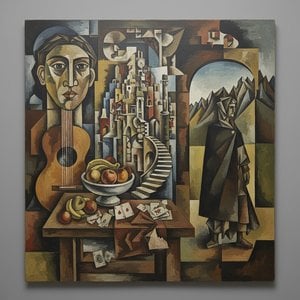
Cubist Expression: 10 Masterpieces That Revolutionized Modern Art | ArtsDot
Explore 10 Cubist masterpieces by Picasso, Braque & more! Discover the stories behind these revolutionary paintings and their impact on modern art. Find museum-quality reproductions for your home at ArtsDot.com – where art comes to life.

Pablo Picasso: A Revolutionary Vision – Cubism, Symbolism & Enduring Legacy
Explore the revolutionary art of Pablo Picasso with ArtsDot.com. Discover Cubism's origins, symbolism in his masterpieces & investment insights for collectors. Expert appraisal & custom reproductions available.


