

- 44.0 x 36.0 cm


The picture follows your choices: , .
Collectible Description
Intriguing Odilon Redon painting "Closed Eyes" captures a woman in deep introspection against a serene blue backdrop with scattered flowers, showcasing the artist's evocative style from 1890. Discover this captivating artwork and bring its dreamlike beauty into your space.
 Read More
Artist Biography
A Symbolist master known for his dreamlike Cyclops. Discover the enigmatic visions of Odilon Redon today.
Hand Made Oil Reproduction
Hand-painted oil on canvas in your size and frame, made to order by our artists. ( Switch to Print Switch to Digital Image)
More about this painting
 Preview
 Send
Send Share
Share
 Details
 Guide
Guide

 Download
 Similars
 X-Ray
X-Ray Diaporama
 Q&A
Q&A Stats
StatsOrder your painting in four simple steps
Take your time. You can change any answer; the price in your order card follows each choice.
1 Step one of four
Which size would you like?
These sizes keep the proportions of the original painting. The drawing shows your choice on a wall, above a two-metre sofa.
Or give your own measurements
Pick from our preset sizes that match the artwork's original proportions.

Type the width and the height you need, to fit your frame or your wall. This is hand-painted, so for a size with a different shape the artist can paint a bit more around the picture, or cut a bit — you choose. We send you a digital mockup to approve before the painting starts. The picture shown on this page does not show the real result — only the mockup does.
2 Step two of four
How should it be prepared: rolled, stretched or framed?
The prices below are for the size you chose in step one.
Choose the edges of the stretched canvas
Choose your frame

White $1

Blurside $1

Extended $1

P118B $10

P118H $10

P118W $10

P438Z $10

P508JH $12

P508YH $12

P805H $10

P805Z $10

P919BZ $10

P919G $10

P919XJ $10

P959ZH $10

P968JZ $12

W106C $8

W218G $10

W218JH $8

W218Y $10

W307PJ $10

W316G $10

W316PJ $8

W316Y $10

W398PJ $8

W4111J $10

W500HY $15

W500JH $15

W692G $12

W849H $8

W940BG $15

W953PJ $8

H24-GOLD $30

H24-SILVER $30

H36-GOLD $45

H36-SILVER $45
Framed
Moulding: . Overall size with the frame: .
3 Step three of four
Would you like anything changed in the painting?
Most people answer no. Because each painting is made by hand, our artist can also adapt it for you.
After order, ArtsDot.com team will email client for instructions and provide a mockup preview
4 Step four of four
A few finishing options
All of them are optional. The answers already selected cost nothing extra.
Who paints it?
Worldwide Delivery () in 3/4 weeks instead of standard 5 weeks. (10 November). No compromise on quality.
A nameplate, as in a museum?
Engraved Bronze Plaque Details
This elegant plaque features the artist's name and the title of the artwork, finely engraved for a timeless presentation.
It is made from bronze with a refined, elegant finish. The text is precisely laser-engraved for a sharp and permanent result. Measuring 9x2 cm, the plaque is compact yet easy to read. It's built to be durable and scratch-resistant, offering a professional, museum-quality look. Mounting is simple thanks to the included adhesive backing.
Transparent Acrylic Plaque Details
The plaque includes essential engraved details such as the artist's name, the title of the artwork, the date it was created, the type of media used-like oil on canvas or watercolor-a brief description of the piece, and a QR code that links to the complete artwork information.
It is crafted from clear acrylic, offering a sleek, modern appearance. The text is UV-engraved in black to ensure strong visual contrast. With a size of 10x15 cm, it ensures optimal readability. It comes equipped with two metal hooks for secure wall mounting. The plaque is designed to be weather-resistant, making it suitable for various environments, and it includes interactive features that work seamlessly with smartphone scanning.
Black Acrylic Plaque Details
This elegant plaque includes engraved information such as the artist's name, the title of the artwork, the date it was created, the type of media used (like oil on canvas or watercolor), a short description of the artwork, and a QR code for quick access to more information.
The plaque itself is made from refined black acrylic with a premium finish. The text is laser-engraved in white for high contrast and readability. Its size is 10x15 cm, designed to be easy to read. It comes with two metal hooks for professional mounting. The design is sleek and fits any interior style. It is also weather-resistant and durable, with built-in digital integration for mobile compatibility.
A protective varnish?
When do you need it?
✓ Check and order
Your painting, as you ordered it

Closed Eyes
Reproduction Medium
Reproduction Size
-

Elite Senior Artist
More detail, finesse, and extra production time
-

Reproduction Frame
-
-
For artworks or reproductions larger than 105 cm (approximately 41 inches) on any side, the frame will be shipped as a kit, disassembled. This method ensures safe delivery and prevents damage during transport.
Professional assembly required - this is not a DIY product.
The kit must be assembled and the canvas stretched by an experienced professional framer, using wood glue (not supplied), a canvas stretching plier and clamps to hold the bars square while the glue dries. Incorrect assembly or uneven canvas tension can permanently damage the artwork and is not covered by our warranty.
 For artworks or reproductions larger than 105 cm (approximately 41 inches) on any side, the frame will be shipped as a kit, disassembled. This method ensures safe delivery and prevents damage during transport.
All solid wood bars are included, precisely cut to size.
Assembled with the screws provided, plus wood glue for the corner joints, which is not supplied and must be sourced by your framer.
Professional tools are required and not included: a canvas stretching plier (tensioner) and clamps to hold the bars square while the glue dries.
Important:
The corner joints require wood glue, the bars must be held with clamps until the glue is fully dry, and tightening the canvas on the assembled frame requires a canvas stretching plier. None of these are included in the kit. Please arrange an experienced professional framer before ordering this size.

Nameplate
-
-

Protective Varnish
Glossy Varnish (enhances colors, protects against light/moisture)
-

Customize My Artwork
Examples of what can be changed: Replace face with customer photo; Add pet (e.g., replace cat with dog); Include hidden message in background; Change background landscape or elements.
-

Urgent
Worldwide Delivery () in 3/4 weeks instead of standard 5 weeks. (10 November). No compromise on quality.
-
Express Shipping
Worldwide Delivery () in 5 weeks. (17 November).
Included
Total Price
$ 263
Glass option is only available in size under 110 CM
Included with every order
- Free Worldwide Express Shipping
- High-Quality Linen Canvas
- Full Shipping Insurance
- Customs Tax Refund Guarantee
- True Color Matching Guarantee
- 100-Day Return Policy (Defects Only)
- 100% Money-Back Guarantee
- Bulk Discount Offer


A Portrait of Introspection: Odilon Redon’s “Closed Eyes”
Odilon Redon's "Closed Eyes," painted in 1890, is more than just a depiction of a woman; it’s a profound meditation on the subconscious and the elusive nature of perception. Executed during a pivotal period in Redon’s career – a time when he was increasingly concerned with exploring the realms of dreams and nightmares – this work exemplifies his signature style: a haunting blend of realism and Symbolism, rendered with meticulous detail and imbued with an unsettling atmosphere.
- Subject & Composition: The central figure, a woman seated with her eyes closed, immediately draws the viewer into a state of quiet contemplation. Her posture is relaxed yet alert, suggesting a vulnerability and openness to inner experience. The scattering of flowers – likely lilies or poppies given Redon’s penchant for floral motifs – adds a layer of delicate beauty that contrasts sharply with the overall mood of melancholy.
- Technique & Materials: Redon's mastery of etching and lithography, honed during his early training, is evident in the subtle gradations of tone and the precise rendering of form. The painting likely employs oil paints on canvas, applied with a delicate brushwork that builds up layers of color to create depth and luminosity. The use of blue as the dominant background color contributes significantly to the artwork's somber and dreamlike quality.
The Symbolism of Silence
“Closed Eyes” is rich in symbolic meaning, reflecting Redon’s fascination with the hidden aspects of human psychology. The closed eyes represent a retreat from the external world, an immersion in the realm of dreams and fantasies. This motif was particularly prevalent in late 19th-century Symbolism, where artists sought to express subjective experience rather than objective reality. The flowers, often associated with mourning or remembrance, could symbolize lost innocence or the fragility of beauty. Redon frequently used floral imagery to evoke a sense of decay and transience – themes that resonate powerfully within this piece.
- Historical Context: Painted in 1890, “Closed Eyes” sits firmly within the Symbolist movement, which was reacting against the perceived materialism and rationalism of the Victorian era. Redon’s work aligns with a broader artistic trend toward exploring psychological states and spiritual themes.
- Redon's Vision: Redon believed in accessing visions beyond the visible world, often depicting figures that seemed to exist on the periphery of reality – spectral, ambiguous, and deeply evocative.
A Masterpiece of Mood and Atmosphere
The emotional impact of “Closed Eyes” is undeniable. The painting evokes a sense of quiet sadness, mystery, and introspection. It’s a work that invites the viewer to engage in their own contemplation, prompting questions about identity, perception, and the nature of consciousness. Redon's ability to capture such profound emotion through seemingly simple imagery is a testament to his artistic genius.
- Size & Presentation: This edition, measuring 44 x 36 cm, offers an intimate scale that allows for a deeply personal connection with the artwork.
- ArtsDot Reproduction: ArtsDot is proud to offer a meticulously crafted hand-painted reproduction of “Closed Eyes,” ensuring the highest level of quality and authenticity. Each reproduction captures the nuances of Redon’s original technique, bringing this evocative masterpiece into your home or office.
Perfect for Interior Design & Art Collection
"Closed Eyes" would be a stunning addition to any art collection or interior design scheme. Its melancholic beauty and symbolic depth make it ideal for spaces where contemplation and reflection are valued. Consider displaying this piece in a study, bedroom, or living room – wherever you wish to create an atmosphere of quiet serenity and artistic intrigue.
Questions & Answers
Is a high-resolution download of "Closed Eyes" available?
To get a digital file of "Closed Eyes" by Odilon Redon, order a high-resolution digital image download on its Digital Image page.
How does "Closed Eyes" balance light and dark?
"Closed Eyes" by Odilon Redon is recorded as balanced, with a soft shadow luminance.
How do I preview a reproduction of "Closed Eyes" by Odilon Redon?
A preview of "Closed Eyes" by Odilon Redon is available on the artwork's Preview page.
Related Artworks


Odilon Redon
1840 - 1916, France
Artist Biography
Early Life, Family and Training
Born Bertrand-Jean Redon on 20 April 1840 in Bordeaux, Aquitaine, France, the boy who would become known as Odilon Redon entered a world shaped by his family's origins. His mother, Marie Guérin, was a French Creole from Île Bourbon, and it was from her name that he eventually acquired his chosen moniker. Even in his youth, a certain visual aptitude was evident; at the age of ten, he was awarded a drawing prize at school, a small triumph that hinted at the sensitivity he would later apply to his craft.
The path toward an artistic life was not a straight one. Though he began formal study of drawing at fifteen, his father’s wishes initially pulled him toward the structured world of architecture. This pursuit led him to Paris, where in 1864 he briefly studied painting under Jean-Léon Gérôme. However, the rigid requirements of architectural training did not suit his temperament. After failing to pass the entrance exams for the École des Beaux-Arts, he returned to his native Bordeaux to seek a different way of seeing.
In the quiet of his home region, his hands found new textures. He took up sculpture and began to master the intricate, shadowy arts of etching and lithography. It was under the guidance of Rodolphe Bresdin that these technical skills took root, providing him with the tools to explore the darker, more ambiguous realms of the human psyche. These early years of experimentation with line and stone laid the foundation for everything that followed.
The Monochromatic Noirs Period
The course of Redon's life took an unexpected turn in 1870 when the Franco-Prussian War called him to serve in the army. This period of military duty interrupted his developing artistic path, yet it could not extinguish the visions that stirred within him. Upon his return, he turned his focus toward the shadows, working almost exclusively in black and white until he reached his fifties. He began to call these visionary works his noirs, a term that captured the intense, dark nature of his explorations. Through these monochromatic studies, he sought to give form to the unseen, moving away from the literal world to find a language of pure light and darkness.
His method was as varied as the creatures he conjured. He mastered the art of lithography and used charcoal to build his compositions, often layering different materials to achieve a specific depth. He would combine vine and oiled charcoal with touches of compressed charcoal and black crayon to create his effects. These tools allowed him to render nocturnal scenes and strange, fantastical creatures that seemed to emerge from a swirling mist. His hands worked with a deliberate intensity, using the hardness of black chalk to outline forms against the softer, more atmospheric passages of charcoal. The results were not mere drawings but windows into a private, shadowy realm.
- Guardian Spirit of the Waters, about 1878
- The Crying Spider, 1881
Evolution into Color and Symbolism
As the 1890s arrived, a new light began to touch Redon's studio. The heavy, monochromatic shadows of his earlier years gave way to a sudden embrace of color. He turned his hand to pastels and oils, finding in these mediums a way to express the shifting moods of the soul. This was no mere change in technique, but a profound expansion of his vision. He moved away from the starkness of his charcoal studies toward a dreamlike abstraction, where forms seemed to dissolve into light and hue. This transition marked his place at the heart of the Symbolist movement, as he sought to give shape to the intangible through the language of color.
This newfound luminosity was deeply influenced by the arrival of Japanese art in France. Redon found himself drawn to the aesthetic of Japanese prints, finding much to admire in their flattened perspective and the boldness of their colors. This fascination allowed him to move further into a realm of suggestion rather than literal depiction. His compositions began to reflect this Eastern influence, blending a sense of mystery with a more decorative, ethereal quality. The world he painted was no longer a place of solid objects, but a space of spiritual and emotional resonance.
- The Death of Buddha (1899)
- The Green Horseman (about 1904)
- The Yellow Sail (about 1905)
- The Birth of Venus (about 1910)
Key Works and Notable Commissions
As Redon moved away from the shadows of his early years, his brush found new purpose through the patronage of those who shared his fascination with the unseen. Baron Robert de Domecy became a significant figure in this period, commissioning the artist to capture the likenesses of his family. These portraits of the Baroness and her daughter, Jeanne, allowed Redon to apply his evolving sense of light to the human form, seeking to reveal an inner life beneath the surface of the skin.
His imagination often turned toward the myths of old, reimagining them through a lens of dreamlike abstraction. In one notable oil painting, he depicted the myth of Polyphemus and the nymph Galatea, known as The Cyclops. This work captures the giant as he turns a single eye toward the sleeping maiden, a composition that reflects his ability to blend classical subject matter with a sense of psychological mystery. Similarly, his 1900 pastel work, Portrait of Marie Botkine, invites a closer look at the quiet, introspective depths of the subject, rendered with a soft, luminous touch that defines his later style.
In his final years, the influence of Eastern aesthetics became even more pronounced, leading to works that embraced a more decorative and flattened perspective. Toward the end of his life, around 1916, he produced Large Bouquet in a Japanese Vase, a piece that demonstrates how the principles of Japanese art had become deeply woven into his visual language. This late work shows an artist who had fully embraced the power of color to express the intangible.
Technique and Artistic Style
Redon moved through the world of art as a draughtsman, printmaker, and painter, always seeking to place the logic of the visible at the service of the invisible. In his early years, he found a profound language in the shadows, working primarily in black and white. He mastered the art of lithography, using the medium to achieve subtle tonal gradations that allowed light to emerge from deep darkness. To achieve greater precision, he often applied fabricated black chalk to outline specific compositional elements over broad, soft passages of charcoal. These works were often described as a synthesis of nightmares and dreams, where the boundaries between the physical and the imagined became blurred.
As his hand grew more confident, his approach to texture and light shifted. He moved away from the heavy, monochromatic depths of his early charcoal studies toward the use of pastels and oils. This transition allowed him to explore a different kind of luminosity, though he never lost his preoccupation with the subconscious. Even when working with color, his compositions often retained a sense of mystery, as if the subjects were emerging from a dream rather than a physical landscape. His ability to manipulate different media allowed him to translate the most elusive parts of the human psyche into tangible forms.
- The Cyclops, about 1914
- Portrait of Marie Botkine, 1900
- The Death of Ophelia, 1905
Legacy and Influence on Modern Art
The ripples of Redon’s vision reached far beyond the quiet rooms of the Symbolist circle, touching the very foundations of the coming century. By turning his gaze inward to map the strange, irrational territories of the subconscious, he prepared the ground for the Surrealists. His ability to give form to the logic of dreams provided a blueprint for later artists like Marcel Duchamp and Max Ernst, who sought to liberate the mind from the constraints of reason. He did not merely paint scenes; he visualized the unseen currents of human thought, creating a bridge between the visible world and the internal psyche.
This preoccupation with subjective experience and the emotional weight of the unseen also found a deep resonance with the Expressionist painters. His work suggested that the true essence of a subject lay in how it was felt rather than how it was measured by the eye. Beyond his canvases and pastels, his graphic art remains a profound achievement. His lithographs and charcoal drawings, those shadowy explorations of the dark and the mysterious, are regarded as some of the most innovative achievements in nineteenth-century printmaking. He mastered the subtle gradations of tone to suggest worlds that felt both ancient and entirely new.
- The Cyclops, about 1914
- The Death of Ophelia, 1905
- The Birth of Venus, 1910
Where to See His Works Today
To encounter the traces of his imagination, one must travel to the great repositories of European art. In Paris, the Musée d'Orsay holds several of his works, offering a glimpse into the evolution of his vision. Those who seek his more colorful, later explorations might find themselves in New York City, where the Museum of Modern Art preserves several pieces that reflect his shift toward a more luminous aesthetic.
The reach of his influence extends across borders, finding homes in diverse collections. In the Netherlands, the Kröller-Müller Museum houses The Cyclops, a work that captures the mythological and dreamlike qualities of his mid-to-late career. Meanwhile, across the Atlantic, the J. Paul Getty Museum in Los Angeles maintains the portrait of Baronne de Domecy, a piece that speaks to the personal connections and commissions that shaped his life.
- The Cyclops, Kröller-Müller Museum, Otterlo
- Portrait of Baronne de Domecy, J. Paul Getty Museum, Los Angeles


Related Articles

Giclée Prints: Archival Quality & Aesthetic Nuances for the Discerning Collector
Explore the world of giclée prints with ArtsDot. Learn about archival quality, aesthetic nuances & investment potential. Expert guidance for discerning art collectors seeking museum-quality reproductions and lasting value.
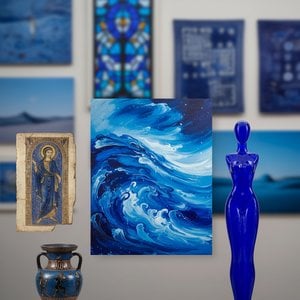
The Allure of Azure: Exploring the Symbolic & Aesthetic Depths of Blue in Art History
Explore the rich history of blue in art! Discover its symbolism, from ancient pigments to modern masterpieces by Kandinsky & Seurat. Uncover the psychological impact and cultural meanings behind this captivating hue.

Slate Blue Masterpieces: 10 Iconic Paintings & Timeless Home Decor Ideas
Immerse yourself in the captivating world of slate blue! Explore 10 iconic paintings by Monet, Van Gogh & Renoir. Discover their stories, techniques & find museum-quality art reproductions for your home at .