


 Preview
 Send
Send Share
Share
 Details
 Guide
Guide

 Download
 Similars
 X-Ray
X-Ray Diaporama
 Stats
StatsRabbit
 Graphite Pencil
- Bay Area Figurative Movement
 1964
1964- Modern
 49.0 x 50.0 cm
 Read More
The artwork displayed on this page is protected by copyright law, which means we cannot legally create or sell an identical reproduction. This protection is enforced under international agreements such as the Berne Convention and by national laws, including those outlined by the U.S. Copyright Law - Title 17.
This method fully complies with copyright regulations because it does not involve copying or duplicating the protected artwork. Instead, it is a creative reinterpretation - a new painting that is influenced by the original but not identical to it.
Giclée / Art Print
Museum-quality giclée or canvas print with fast production and flexible finish options. ( Buy Hand Made Painting Switch to Digital Image)




P118B $10

P118H $10

P118W $10

P438Z $10

P508JH $12

P508YH $12

P805H $10

P805Z $10

P919BZ $10

P919G $10

P919XJ $10

P959ZH $10

P968JZ $12

W106C $8

W218G $10

W218JH $8

W218Y $10

W307PJ $10

W316G $10

W316PJ $8

W316Y $10

W398PJ $8

W4111J $10

W500HY $15

W500JH $15

W692G $12

W849H $8

W940BG $15

W953PJ $8




Pick from our preset sizes that match the artwork's original proportions.

Type the width and the height you need, to fit your frame or your wall. A print can only be cut, never made bigger than the picture, so a size with a different shape loses a part of the image. We send you a digital mockup to approve before we print anything. The picture shown on this page does not show the real cut — only the mockup does.
Worldwide Delivery () in 2 weeks instead of standard 4/5 weeks. (18 October)

Free Worldwide Express Shipping

High-Quality Linen Canvas

Full Shipping Insurance

Customs Tax Refund Guarantee

True Color Matching Guarantee

100-Day Return Policy (Defects Only)

100% Money-Back Guarantee

Bulk Discount Offer
 Glass option is only available in size under 110 CM

Rabbit
Giclée / Art Print
Reproduction Size
-


Total Price
$ 63
A Quiet Encounter with Nature
In the delicate interplay of light and shadow, Nathan Oliveira’s 1964 drawing, Rabbit, invites the viewer into a moment of profound stillness. This monochromatic masterpiece captures a solitary rabbit resting upon a weathered wooden beam, presenting a scene that feels both intimately close and timelessly distant. The composition is anchored by the reclining form of the animal, which dominates the frame with a heavy, tactile presence. Through the masterful use of graphite, Oliveira transforms a simple observation of nature into an evocative study of existence. There is a palpable sense of quietude in the rabbit’s posture—a vulnerability that resonates deeply with anyone who has paused to witness the silent rhythms of the natural world.
The technique employed in this work is nothing short of virtuosic, showcasing Oliveira's ability to breathe life into dry media. Using graphite pencils on paper, the artist utilizes thick, gestural lines and varying degrees of pressure to build a sense of immense volume and texture. The surface of the drawing feels almost sculptural; one can trace the rhythmic layering of strokes that define the soft contours of the rabbit against the rugged, irregular grain of the wooden beam. This interplay between the organic softness of the subject and the coarse, structural elements of its environment creates a dynamic tension. The lighting, appearing to descend from the upper left, casts dramatic shadows that carve out the forms, lending the piece a three-dimensional depth that pulls the viewer into the very heart of the scene.
The Soul of Expressionism in Graphite
To understand Rabbit, one must look toward the artistic lineage of Nathan Oliveira. Influenced heavily by the emotional weight of European Expressionists such as Max Beckmann and Edvard Munch, Oliveira possessed a unique ability to infuse figurative subjects with psychological depth. While the subject matter here is straightforward, the execution is far from mere documentation. The loose, expressive rendering and the heavy, textured application of graphite suggest an internal emotional landscape. The piece transcends a simple biological study to become a meditation on solitude and the quiet strength found in repose.
For the discerning collector or interior designer, this artwork offers a sophisticated focal point that marries raw emotion with refined technique. Its monochromatic palette ensures a seamless integration into diverse decor styles, from contemporary minimalist galleries to more traditional, textured spaces. The piece does not merely decorate a wall; it commands attention through its atmospheric intensity and its ability to evoke a sense of peace and introspection. Owning a reproduction of such a significant work allows one to bring the profound, contemplative spirit of Oliveira’s mid-century mastery into the modern home, serving as a constant reminder of the beauty found in life's most silent moments.
Questions & Answers
What are the dimensions of the original "Rabbit" by Nathan Oliveira?
"Rabbit" measures 49 x 50 cm in its original form. Original dimensions are a useful reference when choosing a reproduction size.
What was Nathan Oliveira's age when "Rabbit" was created?
Nathan Oliveira made "Rabbit" at the age of 36. The artist was born in 1928 and the work is dated 1964.
Where does "Rabbit" fall in Nathan Oliveira's career?
"Rabbit" represents the Mature Period of Nathan Oliveira.
Related Artworks


Artist Biography
A Life Forged in Form: The World of Nathan Oliveira
Nathan Oliveira, a name synonymous with evocative figuration and profound emotional depth, emerged as a pivotal figure in American art during the latter half of the 20th century. Born in Oakland, California, in 1928 to Portuguese immigrant parents, his artistic journey was one of constant exploration, a synthesis of diverse influences tempered by an unwavering commitment to personal expression. Oliveira’s early exposure to the works of European Expressionists – artists like Oskar Kokoschka, Edvard Munch, and Max Beckmann encountered during formative visits to the M.H. de Young Memorial Museum – ignited within him a passion for conveying psychological states through distorted forms and emotive brushwork. This initial spark was further fanned by his formal training at the California College of Arts and Crafts, culminating in both a BFA (1951) and an MFA (1952). A particularly transformative experience was a summer course with Max Beckmann himself at Mills College, where Oliveira absorbed the German master’s emphasis on symbolic content and dramatic composition.Evolving Visions: From Figures to ‘Sites’
Oliveira's artistic reputation initially blossomed through his compelling depictions of isolated figures, rendered in a style that felt both improvisational and deeply considered. These early works hinted at the themes of alienation and introspection that would continue to resonate throughout his career. However, Oliveira was not an artist content with stylistic stagnation. His creative path led him on a remarkable journey of exploration, encompassing animals – particularly birds of prey imbued with symbolic weight – human heads often masked or fragmented, nudes conveying vulnerability, and still lifes populated by what he termed “fetish objects,” items charged with personal meaning. A significant turning point arrived with the creation of his celebrated "Sites" series. These weren’t depictions of physical locations but rather imagined landscapes representing the story of an invented culture, steeped in shamanic traditions and imbued with a sense of ancient ritual. The ‘Sites’ became a vehicle for exploring themes of cultural identity, memory, and the enduring power of myth. While often associated with the Bay Area Figurative Movement, Oliveira consciously maintained his aesthetic independence, acknowledging influences from giants like Willem de Kooning, Alberto Giacometti, and Francis Bacon, yet forging a path distinctly his own. He famously described himself as belonging to “the garde that comes afterward, assimilates, consolidates, refines,” a testament to his ability to absorb and transform artistic precedents into something wholly original.A Master of Many Mediums
Oliveira’s versatility extended far beyond the canvas. Throughout his prolific career, he fearlessly embraced a wide range of media. Oil paintings remained central to his practice, but he also worked extensively with acrylics on paper, creating dynamic and expressive compositions. His drawings – executed in ink, charcoal, and pencil – revealed a remarkable sensitivity to line and texture. He was a gifted printmaker, mastering the techniques of lithography and etching, and even venturing into poster design. Furthermore, Oliveira explored three-dimensional forms through sculpture, working with clay, wax, and bronze. Perhaps most notably, he became renowned for his monotype work – a unique printing process that allowed for spontaneous mark-making and atmospheric effects. This willingness to experiment across different mediums underscores his relentless curiosity and his commitment to finding the most effective means of expressing his artistic vision.Recognition and Legacy
The impact of Nathan Oliveira’s art was widely recognized during his lifetime, and continues to grow in appreciation today. His work has been showcased in nearly one hundred solo exhibitions and countless group shows around the globe, solidifying his position as a major force in American art. A landmark moment came in 2002 with “The Art of Nathan Oliveira,” a comprehensive traveling retrospective organized by the San Jose Museum of Art and curated by Peter Selz. This exhibition, accompanied by a significant monograph published by the University of California Press, offered a sweeping overview of his career and cemented his place in art historical scholarship. In 1999, he received a prestigious honor from his ancestral homeland – the degree of “Commander” in "the Order of the Infante D. Henrique," bestowed upon him by the President of Portugal in recognition of his artistic and cultural contributions. Perhaps one of the most enduring testaments to Oliveira’s vision is the “Windhover Contemplative Center” at Stanford University, inspired by Gerard Manley Hopkins’ poem of the same name. Designed as a space for quiet reflection and meditation, the center embodies Oliveira's belief in the power of art to foster spiritual awareness. His 1960 oil painting, "Seated Figure with Pink Background," achieved $317,500 at Sotheby's New York in 2002, demonstrating his market recognition.An Enduring Influence
Nathan Oliveira’s legacy lies not only in the beauty and power of his individual artworks but also in his ability to synthesize diverse influences into a uniquely personal style. His exploration of universal themes – isolation, cultural identity, emotion, and spirituality – through both figurative representation and abstract expressionism established him as a significant figure within the Bay Area Figurative Movement and beyond. He possessed an uncommon capacity for conveying complex psychological states with remarkable economy of means. The Windhover Contemplative Center stands as a lasting monument to his artistic vision and his commitment to fostering contemplation, ensuring that his influence will continue to inspire generations of artists and viewers alike. His work remains a powerful reminder of the enduring human need to find meaning and connection in a world often marked by uncertainty.
Nathan Oliveira
1928 - 2010 , United States of America
Quick Facts
- Full Name: Nathan Oliveira
- Nationality: American
- Date Of Birth: 1928
- Date Of Death: 2010
- Place Of Birth: Oakland, United States of America
- Notable Artworks:
- Conversation
- Rabbit
- Untitled (Interior Site)
- Artistic Movement Or Style: Bay Area Figurative
- Artists Who Influenced This Artist:
- Oskar Kokoschka
- Max Beckmann
- Willem de Kooning
- Artists Or Movements Influenced By This Artist: Bay Area Figurative Movement
Related Articles

The Nuances of Graphite: Exploring Emotional Depth & Technical Mastery in Pencil Drawing
Explore the captivating world of graphite drawing! Discover its rich history, master essential techniques like chiaroscuro, and learn how artists evoke emotion through this timeless medium. Expert insights for art enthusiasts.

The Enduring Power of Line: Exploring Themes & Techniques in Drawing Across Art History
Explore the rich history of drawing! Discover key techniques like linear perspective & iconic artists from the Renaissance to modern times. Enhance your art appreciation with ArtsDot.
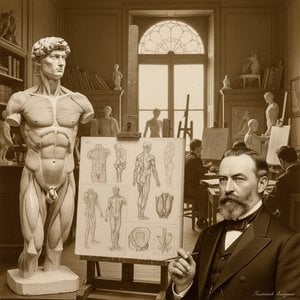
Frederick Bridgman: Anatomical Mastery & the Evolution of Figure Drawing Instruction
Explore the anatomical mastery of George B. Bridgman & his revolutionary figure drawing techniques. Discover how his methods transformed art instruction and continue to inspire artists today. Learn more at ArtsDot.

The Eloquent Line: Exploring the Artistic Significance of Sketches Across Movements and Media
Explore the profound artistic significance of sketches throughout history. From Renaissance masters to modern innovators like Van Gogh & Guston, discover how these foundational works reveal technique, emotion, and vision. Learn more at ArtsDot.

British Museum Masterpieces: Explore 25 Iconic Artworks & Decor Inspiration
Journey through 25 iconic artworks at the British Museum, London! Explore masterpieces from Egyptian sculptures to Renaissance paintings & uncover their stories. Find museum-quality art reproductions and curated decor ideas on ArtsDot.com.


