


The picture follows your choices: , .
Collectible Description
 Read More
Artist Biography
High Renaissance master of the Sistine Chapel. Discover his legendary sculptures and frescoes today.
Hand Made Oil Reproduction
Hand-painted oil on canvas in your size and frame, made to order by our artists. ( Switch to Print Switch to Digital Image)
More about this painting
 Preview
 Send
Send Share
Share
 Details
 Guide
Guide

 Download
 Similars
 X-Ray
X-Ray Diaporama
 Q&A
Q&A Stats
StatsOrder your painting in four simple steps
Take your time. You can change any answer; the price in your order card follows each choice.
1 Step one of four
Which size would you like?
These sizes keep the proportions of the original painting. The drawing shows your choice on a wall, above a two-metre sofa.
Or give your own measurements
Pick from our preset sizes that match the artwork's original proportions.

Type the width and the height you need, to fit your frame or your wall. This is hand-painted, so for a size with a different shape the artist can paint a bit more around the picture, or cut a bit — you choose. We send you a digital mockup to approve before the painting starts. The picture shown on this page does not show the real result — only the mockup does.
2 Step two of four
How should it be prepared: rolled, stretched or framed?
The prices below are for the size you chose in step one.
Choose the edges of the stretched canvas
Choose your frame

White $1

Blurside $1

Extended $1

P118B $10

P118H $10

P118W $10

P438Z $10

P508JH $12

P508YH $12

P805H $10

P805Z $10

P919BZ $10

P919G $10

P919XJ $10

P959ZH $10

P968JZ $12

W106C $8

W218G $10

W218JH $8

W218Y $10

W307PJ $10

W316G $10

W316PJ $8

W316Y $10

W398PJ $8

W4111J $10

W500HY $15

W500JH $15

W692G $12

W849H $8

W940BG $15

W953PJ $8

H24-GOLD $30

H24-SILVER $30

H36-GOLD $45

H36-SILVER $45
Framed
Moulding: . Overall size with the frame: .
3 Step three of four
Would you like anything changed in the painting?
Most people answer no. Because each painting is made by hand, our artist can also adapt it for you.
After order, ArtsDot.com team will email client for instructions and provide a mockup preview
4 Step four of four
A few finishing options
All of them are optional. The answers already selected cost nothing extra.
Who paints it?
Worldwide Delivery () in 3/4 weeks instead of standard 5 weeks. (4 November). No compromise on quality.
A nameplate, as in a museum?
Engraved Bronze Plaque Details
This elegant plaque features the artist's name and the title of the artwork, finely engraved for a timeless presentation.
It is made from bronze with a refined, elegant finish. The text is precisely laser-engraved for a sharp and permanent result. Measuring 9x2 cm, the plaque is compact yet easy to read. It's built to be durable and scratch-resistant, offering a professional, museum-quality look. Mounting is simple thanks to the included adhesive backing.
Transparent Acrylic Plaque Details
The plaque includes essential engraved details such as the artist's name, the title of the artwork, the date it was created, the type of media used-like oil on canvas or watercolor-a brief description of the piece, and a QR code that links to the complete artwork information.
It is crafted from clear acrylic, offering a sleek, modern appearance. The text is UV-engraved in black to ensure strong visual contrast. With a size of 10x15 cm, it ensures optimal readability. It comes equipped with two metal hooks for secure wall mounting. The plaque is designed to be weather-resistant, making it suitable for various environments, and it includes interactive features that work seamlessly with smartphone scanning.
Black Acrylic Plaque Details
This elegant plaque includes engraved information such as the artist's name, the title of the artwork, the date it was created, the type of media used (like oil on canvas or watercolor), a short description of the artwork, and a QR code for quick access to more information.
The plaque itself is made from refined black acrylic with a premium finish. The text is laser-engraved in white for high contrast and readability. Its size is 10x15 cm, designed to be easy to read. It comes with two metal hooks for professional mounting. The design is sleek and fits any interior style. It is also weather-resistant and durable, with built-in digital integration for mobile compatibility.
A protective varnish?
When do you need it?
✓ Check and order
Your painting, as you ordered it

Pietà
Reproduction Medium
Reproduction Size
-

Elite Senior Artist
More detail, finesse, and extra production time
-

Reproduction Frame
-
-
For artworks or reproductions larger than 105 cm (approximately 41 inches) on any side, the frame will be shipped as a kit, disassembled. This method ensures safe delivery and prevents damage during transport.
Professional assembly required - this is not a DIY product.
The kit must be assembled and the canvas stretched by an experienced professional framer, using wood glue (not supplied), a canvas stretching plier and clamps to hold the bars square while the glue dries. Incorrect assembly or uneven canvas tension can permanently damage the artwork and is not covered by our warranty.
 For artworks or reproductions larger than 105 cm (approximately 41 inches) on any side, the frame will be shipped as a kit, disassembled. This method ensures safe delivery and prevents damage during transport.
All solid wood bars are included, precisely cut to size.
Assembled with the screws provided, plus wood glue for the corner joints, which is not supplied and must be sourced by your framer.
Professional tools are required and not included: a canvas stretching plier (tensioner) and clamps to hold the bars square while the glue dries.
Important:
The corner joints require wood glue, the bars must be held with clamps until the glue is fully dry, and tightening the canvas on the assembled frame requires a canvas stretching plier. None of these are included in the kit. Please arrange an experienced professional framer before ordering this size.

Nameplate
-
-

Protective Varnish
Glossy Varnish (enhances colors, protects against light/moisture)
-

Customize My Artwork
Examples of what can be changed: Replace face with customer photo; Add pet (e.g., replace cat with dog); Include hidden message in background; Change background landscape or elements.
-

Urgent
Worldwide Delivery () in 3/4 weeks instead of standard 5 weeks. (4 November). No compromise on quality.
-
Express Shipping
Worldwide Delivery () in 5 weeks. (11 November).
Included
Total Price
$ 263
Glass option is only available in size under 110 CM
Included with every order
- Free Worldwide Express Shipping
- High-Quality Linen Canvas
- Full Shipping Insurance
- Customs Tax Refund Guarantee
- True Color Matching Guarantee
- 100-Day Return Policy (Defects Only)
- 100% Money-Back Guarantee
- Bulk Discount Offer


Michelangelo’s Pietà: A Symphony of Sorrow and Divine Beauty
Michelangelo Buonarroti's Pietà, completed in 1499 and currently residing within the Museo dell’Opera del Duomo in Florence, stands as a monumental achievement—a testament not only to the artist’s unparalleled technical skill but also to his profound understanding of human emotion. More than just a sculpture, it's an experience; a deeply moving meditation on grief, loss, and ultimately, divine grace. The work immediately captivates with its serene beauty, yet beneath the polished marble lies a complex tapestry of symbolism and artistic innovation that continues to fascinate art historians and viewers alike.
At first glance, the sculpture depicts the Virgin Mary cradling the lifeless body of Jesus Christ after his crucifixion. However, Michelangelo’s genius transcends mere representation. He masterfully captures the moment *between* sorrow and acceptance—Mary's face a delicate balance of grief and profound love, her youthful appearance defying the expected age of a mother mourning her son. The composition itself is meticulously crafted, employing the principles of classical geometry to create a sense of perfect harmony and stability. Notice how Mary’s drapery, cascading around her like a protective veil, not only serves as a visual anchor but also subtly directs the viewer's eye towards Jesus’s serene face, offering a poignant contrast between life and death.
The Artistic Vision: Non-Finito Technique and Emotional Depth
Michelangelo’s approach to this demanding subject is revolutionary. He employed his signature “non-finito” technique—leaving portions of the marble deliberately rough and unpolished—to create a dynamic, almost breathing quality within the sculpture. This wasn't simply an aesthetic choice; it was a deliberate attempt to convey the raw emotion of the scene. The unfinished surfaces suggest the vulnerability and fragility of both Mary and Jesus, inviting viewers to contemplate their shared suffering. The contrast between the smooth, polished areas—particularly around the faces—and the textured, exposed marble highlights the emotional intensity of the moment.
Furthermore, Michelangelo’s understanding of anatomy is breathtakingly evident. The musculature of Christ's body, rendered with exquisite detail despite his lifeless state, speaks to a deep knowledge of human form. Mary’s pose, too, is remarkably naturalistic—a subtle curve of her spine, the delicate placement of her hand—reflecting Michelangelo’s commitment to portraying realistic emotions and gestures.
Historical Context: Renaissance Innovation and Florentine Ideals
The Pietà emerged during a pivotal period in Florentine art history – the High Renaissance. Michelangelo, already establishing himself as a prodigious talent, was deeply influenced by classical sculpture, particularly the works of ancient Greek and Roman masters. He sought to emulate their ideals of beauty, proportion, and anatomical accuracy while simultaneously imbuing his work with a distinctly Christian sensibility. The commission itself reflects the patronage system prevalent in Renaissance Florence, where wealthy families like the Medici commissioned artists to create works that glorified both God and themselves.
Interestingly, the sculpture was initially intended for a private chapel within St. Peter's Basilica in Rome, but it ultimately found its home in Florence, becoming one of the most iconic pieces within the Museo dell’Opera del Duomo. This relocation underscores the importance of Florentine artistic identity and the city’s role as a cradle of Renaissance innovation.
Preservation, Reproduction, and Enduring Appreciation
Today, the Pietà remains a powerful symbol of faith, grief, and maternal love. Its beauty continues to inspire awe and reflection in viewers around the world. For those unable to witness this masterpiece firsthand, ArtsDot.com offers a meticulously crafted oil painting reproduction that captures the essence of Michelangelo’s vision. This hand-painted rendition allows art enthusiasts to bring the emotional depth and artistic brilliance of the Pietà into their own homes, fostering a deeper appreciation for this timeless work of art.
To explore more of Michelangelo's extraordinary body of work, we invite you to visit Michelangelo Buonarroti: Pietà (detail) and List of works by Michelangelo on Wikipedia for further insights into the life and legacy of this Renaissance titan.
Questions & Answers
Are the colors of "Pietà" by Michelangelo Buonarroti saturated or muted?
The colors of "Pietà" by Michelangelo Buonarroti have a muted saturation. Saturation describes how vivid or muted the colors are.
How is the mood of "Pietà" by Michelangelo Buonarroti described?
"Pietà" has a dramatic atmosphere.
Can I order an oil reproduction of "Pietà"?
Hand-painted copies of "Pietà" by Michelangelo Buonarroti are sold on this website: a hand-painted oil reproduction on linen canvas, ordered from its Hand-Painted Reproduction page.
Related Artworks


Michelangelo Buonarroti
1475 - 1564, Italy
Artist Biography
The Hands of Caprese
In the hills of Caprese, a boy learned the weight of stone and the grit of marble dust. Born in 1475, Michelangelo di Lodovico Buonarroti Simoni spent his early years near Settignano, where his father owned a quarry. The smell of damp earth and the sound of hammers against rock were part of his childhood. He did not start with brushes but with the chisel. His apprenticeship under Domenico Ghirlandaio in Florence brought him into contact with the city's growing interest in the human form, yet it was the Medici gardens that truly shaped his eyes. There, among the ancient Greek and Roman fragments, he studied how light falls across muscle and bone.
His work began to take shape through a deep study of anatomy. He looked at the way a limb carries weight and how skin stretches over a joint. This focus on the physical reality of the body became his primary language. By the time he reached Rome in 1496, he was already carving figures that possessed a heavy, palpable presence. The Pietà, completed in 1499, shows this early ability to make marble appear as soft as flesh, even as it carries the weight of a dead man.
The Weight of the Sistine Ceiling
The task of the Sistine Chapel ceiling was not something he sought. He saw himself as a sculptor, someone who pulls life out of stone rather than spreading pigment on plaster. Yet, for four years, he worked in the high reaches of the chapel, painting over 300 figures from the Book of Genesis. The physical toll was visible in his daily life. He spent hours in difficult positions, his body strained by the reach and the heavy application of fresco technique. In panels like The Creation of Adam, the tension is found in the small gap between two fingers, a moment of near-contact that holds the viewer's attention through pure composition.
As time passed, his style moved away from the balanced ideals of the High Renaissance toward something more restless. His later works, such as The Last Judgment on the altar wall, show a shift toward Mannerism. The figures became more elongated and the compositions more crowded and dramatic. This change reflected a shifting spiritual climate in Rome. He continued to work with an intensity that many found overwhelming, often leaving projects unfinished as his mind moved toward new architectural or sculptural problems.
Architecture and Final Years
In his later decades, Michelangelo turned much of his attention to the structure of buildings. At age 71, he took over the work on St. Peter's Basilica, altering the plans to create a more massive, imposing design. He also designed the Laurentian Library, where his use of architectural elements broke from tradition, creating a sense of movement within the stone itself. His work on the Piazza del Campidoglio in Rome showed how he could organize a public space using symmetry and classical motifs to guide the eye through the square.
He died in Rome in 1564, leaving behind a legacy written in marble, fresco, and stone. His life was defined by several key roles:
- Sculptor: Carving works like David from single blocks of Carrara marble.
- Painter: Executing the vast narrative cycles of the Sistine Chapel.
- Architect: Redesigning the foundations of St. Peter's Basilica and the Laurentian Library.
- Poet: Expressing his inner thoughts through verse.


Related Articles

Bronze Sculptures That Defined Art History | ArtsDot
Journey through art history with our Top 10 bronze sculptures! Explore masterpieces by Rodin, Michelangelo & more. Discover stories behind iconic statues and find museum-quality reproductions for your home decor at ArtsDot.com.

Bronze Age to Modern Masters: 10 Sculptures That Redefined Art | ArtsDot
Journey through art history with 10 legendary bronze sculptures – from Michelangelo's David to Rodin’s Thinker. Explore the stories, techniques & timeless beauty of these masterpieces. Find museum-quality reproductions & elevate your home decor on ArtsDot.com.
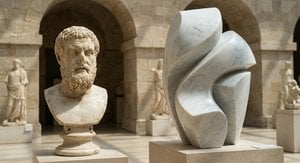
The Enduring Allure of Marble in Art History: From Classical Sculpture to Modern Abstraction
Explore the captivating history of marble sculpture from ancient Greece to modern art. Discover renowned artists like Canova & Michelangelo, carving techniques, and investment insights at ArtsDot.