

 Preview
 Send
Send Share
Share
 Details
 Guide
Guide

 Download
 Similars
 X-Ray
X-Ray Diaporama
 Q&A
Q&A Stats
StatsDavid (rear view)


 Read More
Giclée / Art Print
Museum-quality giclée or canvas print with fast production and flexible finish options. ( Buy Hand Made Painting Switch to Digital Image)




P118B $10

P118H $10

P118W $10

P438Z $10

P508JH $12

P508YH $12

P805H $10

P805Z $10

P919BZ $10

P919G $10

P919XJ $10

P959ZH $10

P968JZ $12

W106C $8

W218G $10

W218JH $8

W218Y $10

W307PJ $10

W316G $10

W316PJ $8

W316Y $10

W398PJ $8

W4111J $10

W500HY $15

W500JH $15

W692G $12

W849H $8

W940BG $15

W953PJ $8




Pick from our preset sizes that match the artwork's original proportions.

Type the width and the height you need, to fit your frame or your wall. A print can only be cut, never made bigger than the picture, so a size with a different shape loses a part of the image. We send you a digital mockup to approve before we print anything. The picture shown on this page does not show the real cut — only the mockup does.
Worldwide Delivery () in 2 weeks instead of standard 4/5 weeks. (4 November)

Free Worldwide Express Shipping

High-Quality Linen Canvas

Full Shipping Insurance

Customs Tax Refund Guarantee

True Color Matching Guarantee

100-Day Return Policy (Defects Only)

100% Money-Back Guarantee

Bulk Discount Offer
 Glass option is only available in size under 110 CM

David (rear view)
Giclée / Art Print
Reproduction Size
-


Total Price
$ 63
David (Rear View): A Masterpiece of Proportion and Tension
The sculpture David by Michelangelo Buonarroti stands as an enduring testament to Renaissance artistic genius—a figure whose rear view offers a profound glimpse into the sculptor’s meticulous craft and unwavering dedication to anatomical precision. Created in 1504 during his illustrious tenure in Rome, this monumental marble statue resides within the Galleria dell'Accademia, Florence, captivating visitors with its serene stillness juxtaposed against an underlying dynamism that speaks volumes about Michelangelo’s artistic vision.Michelangelo Buonarroti: The Renaissance Forge
Michelangelo di Lodovico Buonarroti Simoni (1475-1564) wasn’t merely a sculptor; he was the embodiment of the Renaissance ideal—a polymath who excelled in painting, architecture, and poetry. His unparalleled skill stemmed from an unwavering belief in classical ideals combined with an innate understanding of human anatomy. As Giorgio Vasari eloquently stated, Michelangelo “was the most accomplished artist of his era,” surpassing even Leonardo da Vinci in mastery and innovation. This conviction solidified during his formative years under Domenico Ghirlandaio’s tutelage, where he honed foundational drafting skills before immersing himself in the study of Greek sculptures within the Medici Gardens—a crucible for shaping his distinctive style.The Anatomy of Perfection: Detail and Proportion
The rear view of David is particularly remarkable for its meticulous depiction of human musculature. Michelangelo painstakingly recreated the subtle contours of muscles like the sternocleidomastoid and abductor digiti minimi, achieving an astonishing level of realism that defied conventional artistic standards of the time. Furthermore, he deliberately manipulated proportions—slightly elongating the torso and exaggerating the musculature of the upper body—to convey a sense of tension and readiness for action. This technique wasn’t merely stylistic; it reflected Michelangelo's profound understanding of human anatomy and his desire to capture the essence of movement within static form. As Vasari noted, Michelangelo “was able to express the most subtle emotions.”Symbolism and Context: Triumph Over Fear
Beyond its technical brilliance, David embodies a powerful symbolic narrative rooted in biblical tradition—the tale of David slaying Goliath. The statue’s posture conveys unwavering confidence and determination, mirroring the heroic spirit of the Old Testament hero. Michelangelo's deliberate choice to depict David facing away from the viewer reinforces this message, emphasizing his inner resolve and focusing attention on the musculature of his torso and upper limbs. This visual strategy underscores the sculpture’s significance as a celebration of courage and resilience—themes central to Renaissance humanist thought.A Legacy Enduring Through Time
David's placement in Piazza della Signoria, Florence, served as a deliberate assertion of Florentine republican ideals during a period fraught with political instability. Michelangelo’s masterpiece continues to inspire awe and admiration worldwide, cementing his place among the greatest artists of all time—a figure whose enduring legacy transcends centuries and speaks to the timeless beauty of human form and artistic expression. Its presence in the Galleria dell'Accademia ensures that future generations can appreciate the sublime achievement of Buonarroti’s genius.Questions & Answers
What is "David (rear view)" about, and what atmosphere does it have?
"David (rear view)" by Michelangelo Buonarroti depicts michelangelo buonarroti, sculpture, renaissance art, david statue, anatomy, proportion, florentine culture, in a dramatic mood. Subject and atmosphere together describe the work.
What subjects appear in "David (rear view)" by Michelangelo Buonarroti?
The themes present in "David (rear view)" by Michelangelo Buonarroti include michelangelo buonarroti, sculpture, renaissance art, david statue, anatomy, proportion, florentine culture. Together they summarize the artwork's subject matter.
Where in Michelangelo Buonarroti's career does "David (rear view)" fall, given its date?
The 1504 date places "David (rear view)" in the High Renaissance of Michelangelo Buonarroti's development.
Related Artworks


Artist Biography
The Hands of Caprese
In the hills of Caprese, a boy learned the weight of stone and the grit of marble dust. Born in 1475, Michelangelo di Lodovico Buonarroti Simoni spent his early years near Settignano, where his father owned a quarry. The smell of damp earth and the sound of hammers against rock were part of his childhood. He did not start with brushes but with the chisel. His apprenticeship under Domenico Ghirlandaio in Florence brought him into contact with the city's growing interest in the human form, yet it was the Medici gardens that truly shaped his eyes. There, among the ancient Greek and Roman fragments, he studied how light falls across muscle and bone.
His work began to take shape through a deep study of anatomy. He looked at the way a limb carries weight and how skin stretches over a joint. This focus on the physical reality of the body became his primary language. By the time he reached Rome in 1496, he was already carving figures that possessed a heavy, palpable presence. The Pietà, completed in 1499, shows this early ability to make marble appear as soft as flesh, even as it carries the weight of a dead man.
The Weight of the Sistine Ceiling
The task of the Sistine Chapel ceiling was not something he sought. He saw himself as a sculptor, someone who pulls life out of stone rather than spreading pigment on plaster. Yet, for four years, he worked in the high reaches of the chapel, painting over 300 figures from the Book of Genesis. The physical toll was visible in his daily life. He spent hours in difficult positions, his body strained by the reach and the heavy application of fresco technique. In panels like The Creation of Adam, the tension is found in the small gap between two fingers, a moment of near-contact that holds the viewer's attention through pure composition.
As time passed, his style moved away from the balanced ideals of the High Renaissance toward something more restless. His later works, such as The Last Judgment on the altar wall, show a shift toward Mannerism. The figures became more elongated and the compositions more crowded and dramatic. This change reflected a shifting spiritual climate in Rome. He continued to work with an intensity that many found overwhelming, often leaving projects unfinished as his mind moved toward new architectural or sculptural problems.
Architecture and Final Years
In his later decades, Michelangelo turned much of his attention to the structure of buildings. At age 71, he took over the work on St. Peter's Basilica, altering the plans to create a more massive, imposing design. He also designed the Laurentian Library, where his use of architectural elements broke from tradition, creating a sense of movement within the stone itself. His work on the Piazza del Campidoglio in Rome showed how he could organize a public space using symmetry and classical motifs to guide the eye through the square.
He died in Rome in 1564, leaving behind a legacy written in marble, fresco, and stone. His life was defined by several key roles:
- Sculptor: Carving works like David from single blocks of Carrara marble.
- Painter: Executing the vast narrative cycles of the Sistine Chapel.
- Architect: Redesigning the foundations of St. Peter's Basilica and the Laurentian Library.
- Poet: Expressing his inner thoughts through verse.

Michelangelo Buonarroti
1475 - 1564 , Italy
Quick Facts
- Artistic Movement Or Style:
- High Renaissance
- Mannerism
- Artists Or Movements Influenced By This Artist: ['Mannerism']
- Artists Who Influenced This Artist:
- Domenico Ghirlandaio
- Donatello
- Masaccio
- Full Name: Michelangelo di Lodovico Buonarroti Simoni
- Nationality: Italian
- Notable Artworks:
- Pietà
- David
- The Creation of Adam
- The Last Judgment
- Moses
- Place Of Birth: Caprese Michelangelo, Italy
- Date Of Birth: 1475
- Date Of Death: 1564
Related Articles

Bronze Sculptures That Defined Art History | ArtsDot
Journey through art history with our Top 10 bronze sculptures! Explore masterpieces by Rodin, Michelangelo & more. Discover stories behind iconic statues and find museum-quality reproductions for your home decor at ArtsDot.com.

25 Must-See Masterpieces at the Uffizi Gallery, Florence
Explore 25 iconic Renaissance masterpieces from the Uffizi Gallery. Discover timeless art legends on ArtsDot.com.

Bronze Age to Modern Masters: 10 Sculptures That Redefined Art | ArtsDot
Journey through art history with 10 legendary bronze sculptures – from Michelangelo's David to Rodin’s Thinker. Explore the stories, techniques & timeless beauty of these masterpieces. Find museum-quality reproductions & elevate your home decor on ArtsDot.com.
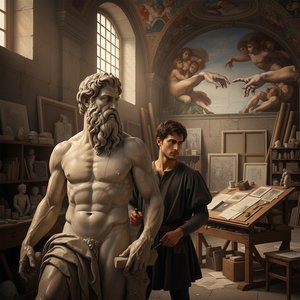
Michelangelo Buonarroti: A Renaissance Titan – Life, Works & Enduring Legacy
Explore the life, works & enduring legacy of Michelangelo Buonarroti, a Renaissance titan. Discover his iconic sculptures, frescoes, and architectural achievements. Expert art consultation & high-quality reproductions at ArtsDot.

Masterpieces of Michelangelo: The Top 25 Greatest Works of the Renaissance Legend
Explore 25 iconic Michelangelo masterpieces from the Renaissance. Discover museum-quality art legends on ArtsDot.com.


