


The picture follows your choices: , .
Collectible Description
Experience the Renaissance perspective of Melozzo da Forlì's Annunciation fresco; discover this masterpiece of early Italian art today.
 Read More
Artist Biography
Discover Melozzo da Forlì (1438-1494), Renaissance master of perspective & foreshortening! Explore his frescoes, influence on Raphael & Mantegna, and innovative style.
Hand Made Oil Reproduction
Hand-painted oil on canvas in your size and frame, made to order by our artists. ( Switch to Print Switch to Digital Image)
More about this painting
 Send
Send Share
Share
 Details
 Guide
Guide

 Download
 Similars
 Diaporama
 Q&A
Q&A Stats
StatsOrder your painting in four simple steps
Take your time. You can change any answer; the price in your order card follows each choice.
1 Step one of four
Which size would you like?
These sizes keep the proportions of the original painting. The drawing shows your choice on a wall, above a two-metre sofa.
Or give your own measurements
Pick from our preset sizes that match the artwork's original proportions.

Type the width and the height you need, to fit your frame or your wall. This is hand-painted, so for a size with a different shape the artist can paint a bit more around the picture, or cut a bit — you choose. We send you a digital mockup to approve before the painting starts. The picture shown on this page does not show the real result — only the mockup does.
2 Step two of four
How should it be prepared: rolled, stretched or framed?
The prices below are for the size you chose in step one.
Choose the edges of the stretched canvas
Choose your frame

White $1

Blurside $1

Extended $1

P118B $10

P118H $10

P118W $10

P438Z $10

P508JH $12

P508YH $12

P805H $10

P805Z $10

P919BZ $10

P919G $10

P919XJ $10

P959ZH $10

P968JZ $12

W106C $8

W218G $10

W218JH $8

W218Y $10

W307PJ $10

W316G $10

W316PJ $8

W316Y $10

W398PJ $8

W4111J $10

W500HY $15

W500JH $15

W692G $12

W849H $8

W940BG $15

W953PJ $8

H24-GOLD $30

H24-SILVER $30

H36-GOLD $45

H36-SILVER $45
Framed
Moulding: . Overall size with the frame: .
3 Step three of four
Would you like anything changed in the painting?
Most people answer no. Because each painting is made by hand, our artist can also adapt it for you.
After order, ArtsDot.com team will email client for instructions and provide a mockup preview
4 Step four of four
A few finishing options
All of them are optional. The answers already selected cost nothing extra.
Who paints it?
Worldwide Delivery () in 3/4 weeks instead of standard 5 weeks. (2 November). No compromise on quality.
A nameplate, as in a museum?
Engraved Bronze Plaque Details
This elegant plaque features the artist's name and the title of the artwork, finely engraved for a timeless presentation.
It is made from bronze with a refined, elegant finish. The text is precisely laser-engraved for a sharp and permanent result. Measuring 9x2 cm, the plaque is compact yet easy to read. It's built to be durable and scratch-resistant, offering a professional, museum-quality look. Mounting is simple thanks to the included adhesive backing.
Transparent Acrylic Plaque Details
The plaque includes essential engraved details such as the artist's name, the title of the artwork, the date it was created, the type of media used-like oil on canvas or watercolor-a brief description of the piece, and a QR code that links to the complete artwork information.
It is crafted from clear acrylic, offering a sleek, modern appearance. The text is UV-engraved in black to ensure strong visual contrast. With a size of 10x15 cm, it ensures optimal readability. It comes equipped with two metal hooks for secure wall mounting. The plaque is designed to be weather-resistant, making it suitable for various environments, and it includes interactive features that work seamlessly with smartphone scanning.
Black Acrylic Plaque Details
This elegant plaque includes engraved information such as the artist's name, the title of the artwork, the date it was created, the type of media used (like oil on canvas or watercolor), a short description of the artwork, and a QR code for quick access to more information.
The plaque itself is made from refined black acrylic with a premium finish. The text is laser-engraved in white for high contrast and readability. Its size is 10x15 cm, designed to be easy to read. It comes with two metal hooks for professional mounting. The design is sleek and fits any interior style. It is also weather-resistant and durable, with built-in digital integration for mobile compatibility.
A protective varnish?
When do you need it?
✓ Check and order
Your painting, as you ordered it

Annunciation
Reproduction Medium
Reproduction Size
-

Elite Senior Artist
More detail, finesse, and extra production time
-

Reproduction Frame
-
-
For artworks or reproductions larger than 105 cm (approximately 41 inches) on any side, the frame will be shipped as a kit, disassembled. This method ensures safe delivery and prevents damage during transport.
Professional assembly required - this is not a DIY product.
The kit must be assembled and the canvas stretched by an experienced professional framer, using wood glue (not supplied), a canvas stretching plier and clamps to hold the bars square while the glue dries. Incorrect assembly or uneven canvas tension can permanently damage the artwork and is not covered by our warranty.
 For artworks or reproductions larger than 105 cm (approximately 41 inches) on any side, the frame will be shipped as a kit, disassembled. This method ensures safe delivery and prevents damage during transport.
All solid wood bars are included, precisely cut to size.
Assembled with the screws provided, plus wood glue for the corner joints, which is not supplied and must be sourced by your framer.
Professional tools are required and not included: a canvas stretching plier (tensioner) and clamps to hold the bars square while the glue dries.
Important:
The corner joints require wood glue, the bars must be held with clamps until the glue is fully dry, and tightening the canvas on the assembled frame requires a canvas stretching plier. None of these are included in the kit. Please arrange an experienced professional framer before ordering this size.

Nameplate
-
-

Protective Varnish
Glossy Varnish (enhances colors, protects against light/moisture)
-

Customize My Artwork
Examples of what can be changed: Replace face with customer photo; Add pet (e.g., replace cat with dog); Include hidden message in background; Change background landscape or elements.
-

Urgent
Worldwide Delivery () in 3/4 weeks instead of standard 5 weeks. (2 November). No compromise on quality.
-
Express Shipping
Worldwide Delivery () in 5 weeks. (9 November).
Included
Total Price
$ 263
Glass option is only available in size under 110 CM
Included with every order
- Free Worldwide Express Shipping
- High-Quality Linen Canvas
- Full Shipping Insurance
- Customs Tax Refund Guarantee
- True Color Matching Guarantee
- 100-Day Return Policy (Defects Only)
- 100% Money-Back Guarantee
- Bulk Discount Offer


The Enigmatic Visionary of Forlì: Melozzo da Forlì and the Dawn of Renaissance Perspective
Melozzo da Forlì (c. 1438 – 8 November 1494) remains a figure shrouded in mystery within the annals of Renaissance art, yet his contribution to artistic innovation—particularly the masterful application of perspective—is undeniable. Born around 1438 in Forlì, Italy, he ascended from humble beginnings as a journeyman and color-grinder to become one of the foremost fresco painters of his era, profoundly influencing artists like Raphael and Andrea Mantegna.
Details surrounding Melozzo’s early life are scarce; it is believed he hailed from a prosperous family named Ambrosi, and likely received his initial artistic training within the Forlivese school, absorbing stylistic currents shaped by masters such as Ansuino da Forlì—himself deeply impacted by Andrea Mantegna's groundbreaking explorations of spatial illusion. Some accounts even suggest a formative period spent mastering techniques alongside Antoniazzo Romano, fostering a collaborative spirit that propelled artistic experimentation.
His career blossomed in Urbino between 1465 and 1474, where he encountered Piero della Francesca—a pivotal encounter that cemented Melozzo’s stylistic allegiance to linear perspective and imbued his work with an unwavering commitment to realism. Furthermore, he studied architecture alongside Bramante and the Flemish painters working for Federico da Montefeltro, broadening his artistic horizons and enriching his understanding of visual representation.
A Master of Fresco Technique
Melozzo’s genius lay primarily in his unparalleled skill at fresco painting—a technique demanding meticulous planning and execution. Unlike tempera or oil paint, fresco utilizes pigments mixed with lime plaster applied directly onto wet masonry walls, resulting in durable, luminous images that withstand the test of time. Melozzo's mastery extended beyond mere replication; he skillfully manipulated tonal gradations and shading to create astonishingly convincing three-dimensional effects—a feat unheard of at the time.
His most celebrated achievement is undoubtedly his monumental decoration of the Pantheon in Rome, where he undertook a commission that would solidify his reputation as one of the foremost artists of his generation. The fresco cycle depicts scenes from biblical narratives with remarkable detail and psychological depth, showcasing Melozzo’s ability to convey emotion and narrative complexity within a constrained spatial framework.
Symbolism and Artistic Innovation
Melozzo's artistic vision was characterized by an unwavering dedication to observation and anatomical accuracy—traits that mirrored the humanist ideals prevalent during the Renaissance. He meticulously studied human anatomy, striving to depict figures with lifelike realism, reflecting a burgeoning interest in scientific inquiry alongside aesthetic beauty.
Perhaps his most significant contribution was the pioneering use of foreshortening—a technique that dramatically alters perspective to create an illusion of depth and space. This innovation revolutionized painting practice, influencing subsequent generations of artists and establishing Melozzo da Forlì as a cornerstone of Renaissance artistic achievement. His frescoes stand as enduring testament to his genius and the transformative power of visual representation.
Legacy and Influence
Melozzo’s influence extended far beyond his immediate contemporaries. Raphael, Andrea Mantegna, and countless other artists acknowledged his profound impact on their own stylistic development—a legacy that continues to inspire admiration and scholarly study today. Melozzo da Forlì's unwavering pursuit of artistic excellence cemented his place as a pivotal figure in the history of art, ensuring that his groundbreaking techniques and visionary aesthetic would resonate through centuries.
Questions & Answers
What space is suggested for "Annunciation" by Melozzo da Forlì?
The recommended space for "Annunciation" by Melozzo da Forlì is a living room. The suggestion can of course be adapted to your interior.
What use is suggested for "Annunciation" by Melozzo da Forlì?
The suggested use for "Annunciation" by Melozzo da Forlì is accent. It can serve other purposes as well.
Is a download available for "Annunciation"?
"Annunciation" by Melozzo da Forlì can be downloaded from the artwork's Download page, as a high-resolution digital image download.
Related Artworks


![Scrovegni - Last Judgment (detail) [01] — Giotto Di Bondone, Proto-renaissance](/media/artworks/images-thumb/71/cd/71cdd4c7aa3759a909cb446d05af5e14.jpg)


Melozzo da Forlì
1438 - 1494, Italy
Artist Biography
The Enigmatic Visionary of Forlì: Melozzo da Forlì and the Dawn of Renaissance Perspective
Melozzo da Forlì, born around 1438 in the vibrant Italian city of Forlì, remains a somewhat elusive figure within the pantheon of Renaissance masters. Though his life spanned only fifty-six years, ending in November 1494, his impact on the development of perspective and fresco technique was profound, influencing generations of artists including Raphael and Andrea Mantegna. Details surrounding his early life are scarce; it is believed he hailed from a prosperous family named Ambrosi, and likely received his initial artistic training within the Forlivese school, absorbing the stylistic currents shaped by figures like Ansuino da Forlì—himself touched by the powerful influence of Andrea Mantegna. Some accounts even suggest humble beginnings as a journeyman and color-grinder, honing his craft through practical experience before ascending to prominence. Documented appearances in Forlì in 1460 and 1464 mark the earliest traces of his artistic activity, hinting at a gradual emergence onto the burgeoning Renaissance scene.Rome, Urbino, and the Mastery of Illusion
Around 1472-1474, Melozzo’s career took him to Rome, where he collaborated with Antoniazzo Romano on the frescoes within the Bessarione Chapel in the Basilica dei Santi Apostoli. This commission proved pivotal, exposing him to the artistic ferment of the papal city and solidifying his reputation. However, it was a sojourn to Urbino, likely between 1465 and 1474, that truly ignited his artistic evolution. There, under the patronage of Duke Federico da Montefeltro—a renowned humanist and art collector—Melozzo encountered the groundbreaking work of Piero della Francesca. The meticulous perspective, serene compositions, and luminous color palettes of Piero left an indelible mark on Melozzo’s style. He also immersed himself in architectural studies alongside Bramante, and observed the techniques employed by Flemish painters working for the Duke, broadening his artistic horizons. This period saw a blossoming of his talent, culminating in key Roman works such as *Sixtus IV Appointing Platina as Librarian* (c. 1477), now housed in the Pinacoteca Vaticana, and designs for the Palazzo Altemps, commissioned by Girolamo Riario. His participation in the newly founded Academy of St Luke in 1478 further cemented his position within Rome’s artistic elite. It was during this time that Melozzo began to demonstrate a remarkable mastery of *foreshortening*, a technique that would become his signature, most notably showcased in the now fragmented Ascension of Christ fresco at the Basilica dei Santi Apostoli—a work that captivated contemporaries and profoundly influenced subsequent generations.Loreto, Influence, and Late Roman Commissions
Following the death of Sixtus IV in 1484, Melozzo relocated to Loreto, where he undertook a commission for the cupola of the sacristy of San Marco within the Basilica della Santa Casa. This work is arguably his most celebrated achievement—a breathtaking display of illusionistic perspective and architectural detail that significantly impacted artists like Pietro da Cortona and even Andrea Mantegna’s famed *Camera degli Sposi* in Mantua. The dynamic composition, with its soaring figures and convincing spatial depth, demonstrated a level of technical skill rarely seen at the time. In 1489, Melozzo returned to Rome, engaged in creating cartoons for mosaics within the Chapel of St Helena. His artistic versatility extended beyond religious subjects; his only known secular work, the “Pestapepe” fresco in Forlì—depicting a grocer—reveals a keen eye for realism and characterization. During his final years, he returned to Forlì, collaborating with Marco Palmezzano on the decoration of the Feo Chapel before his untimely death in November 1494.A Legacy Defined by Perspective and Innovation
Melozzo da Forlì’s artistic significance lies primarily in his pioneering use of perspective, particularly foreshortening, which imbued his frescoes with an unprecedented sense of depth and realism. He wasn't merely replicating reality; he was constructing it anew on the wall, drawing the viewer into the scene with masterful illusionism. His influence extended to some of the most celebrated artists of the High Renaissance—Raphael and Donato Bramante both studied his work intently, absorbing his techniques and incorporating them into their own masterpieces. The stylistic connections between Melozzo and Andrea Mantegna are also undeniable, reflecting a shared artistic lineage within the Italian Renaissance. Furthermore, as a mentor to Marco Palmezzano, he ensured that his innovative style continued to flourish after his death. Melozzo’s contributions to fresco painting were not simply technical; they were transformative, pushing the boundaries of what was possible and paving the way for the artistic achievements of the coming centuries. He remains a testament to the power of observation, innovation, and the enduring legacy of Renaissance artistry—a visionary whose work continues to captivate and inspire.


Related Articles

The Enduring Legacy of Fresco: Technique, History & Artistic Expression Across Cultures
Explore the rich history & enduring legacy of fresco painting! Discover ancient techniques, Giotto's masterpieces, and modern applications. Expert insights for art lovers & professionals.
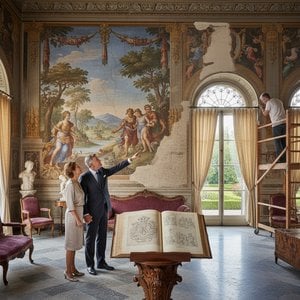
The Fresco as Family Legacy: Preserving Heritage Through Wall Art
Explore the rich history & enduring legacy of fresco painting. Discover how to preserve family heritage through stunning wall art. Expert insights & restoration guidance.

Masterpieces of Genius: The Top 25 Leonardo da Vinci Artworks
Explore 25 legendary Renaissance masterpieces by Leonardo da Vinci. Discover the stories behind each icon on ArtsDot.com.