

The picture follows your choices: , .
Artist Biography
A Post-Impressionist master of Parisian cityscapes like Montmartre. Discover stunning hand-painted reproductions of his iconic works today.
 Read More
Hand Made Oil Reproduction
Hand-painted oil on canvas in your size and frame, made to order by our artists. ( Switch to Print Switch to Digital Image)
More about this painting
 Preview
 Send
Send Share
Share
 Details
 Guide
Guide

 Download
 Similars
 X-Ray
X-Ray Diaporama
 Q&A
Q&A Stats
StatsOrder your painting in four simple steps
Take your time. You can change any answer; the price in your order card follows each choice.
1 Step one of four
Which size would you like?
These sizes keep the proportions of the original painting. The drawing shows your choice on a wall, above a two-metre sofa.
Or give your own measurements
Pick from our preset sizes that match the artwork's original proportions.

Type the width and the height you need, to fit your frame or your wall. This is hand-painted, so for a size with a different shape the artist can paint a bit more around the picture, or cut a bit — you choose. We send you a digital mockup to approve before the painting starts. The picture shown on this page does not show the real result — only the mockup does.
2 Step two of four
How should it be prepared: rolled, stretched or framed?
The prices below are for the size you chose in step one.
Choose the edges of the stretched canvas
Choose your frame

White $1

Blurside $1

Extended $1

P118B $10

P118H $10

P118W $10

P438Z $10

P508JH $12

P508YH $12

P805H $10

P805Z $10

P919BZ $10

P919G $10

P919XJ $10

P959ZH $10

P968JZ $12

W106C $8

W218G $10

W218JH $8

W218Y $10

W307PJ $10

W316G $10

W316PJ $8

W316Y $10

W398PJ $8

W4111J $10

W500HY $15

W500JH $15

W692G $12

W849H $8

W940BG $15

W953PJ $8

H24-GOLD $30

H24-SILVER $30

H36-GOLD $45

H36-SILVER $45
Framed
Moulding: . Overall size with the frame: .
3 Step three of four
Would you like anything changed in the painting?
Most people answer no. Because each painting is made by hand, our artist can also adapt it for you.
After order, ArtsDot.com team will email client for instructions and provide a mockup preview
4 Step four of four
A few finishing options
All of them are optional. The answers already selected cost nothing extra.
Who paints it?
Worldwide Delivery () in 3/4 weeks instead of standard 5 weeks. (12 November). No compromise on quality.
A nameplate, as in a museum?
Engraved Bronze Plaque Details
This elegant plaque features the artist's name and the title of the artwork, finely engraved for a timeless presentation.
It is made from bronze with a refined, elegant finish. The text is precisely laser-engraved for a sharp and permanent result. Measuring 9x2 cm, the plaque is compact yet easy to read. It's built to be durable and scratch-resistant, offering a professional, museum-quality look. Mounting is simple thanks to the included adhesive backing.
Transparent Acrylic Plaque Details
The plaque includes essential engraved details such as the artist's name, the title of the artwork, the date it was created, the type of media used-like oil on canvas or watercolor-a brief description of the piece, and a QR code that links to the complete artwork information.
It is crafted from clear acrylic, offering a sleek, modern appearance. The text is UV-engraved in black to ensure strong visual contrast. With a size of 10x15 cm, it ensures optimal readability. It comes equipped with two metal hooks for secure wall mounting. The plaque is designed to be weather-resistant, making it suitable for various environments, and it includes interactive features that work seamlessly with smartphone scanning.
Black Acrylic Plaque Details
This elegant plaque includes engraved information such as the artist's name, the title of the artwork, the date it was created, the type of media used (like oil on canvas or watercolor), a short description of the artwork, and a QR code for quick access to more information.
The plaque itself is made from refined black acrylic with a premium finish. The text is laser-engraved in white for high contrast and readability. Its size is 10x15 cm, designed to be easy to read. It comes with two metal hooks for professional mounting. The design is sleek and fits any interior style. It is also weather-resistant and durable, with built-in digital integration for mobile compatibility.
A protective varnish?
When do you need it?
✓ Check and order
Your painting, as you ordered it

Buis chapell
Reproduction Medium
Reproduction Size
-

Elite Senior Artist
More detail, finesse, and extra production time
-

Reproduction Frame
-
-
For artworks or reproductions larger than 105 cm (approximately 41 inches) on any side, the frame will be shipped as a kit, disassembled. This method ensures safe delivery and prevents damage during transport.
Professional assembly required - this is not a DIY product.
The kit must be assembled and the canvas stretched by an experienced professional framer, using wood glue (not supplied), a canvas stretching plier and clamps to hold the bars square while the glue dries. Incorrect assembly or uneven canvas tension can permanently damage the artwork and is not covered by our warranty.
 For artworks or reproductions larger than 105 cm (approximately 41 inches) on any side, the frame will be shipped as a kit, disassembled. This method ensures safe delivery and prevents damage during transport.
All solid wood bars are included, precisely cut to size.
Assembled with the screws provided, plus wood glue for the corner joints, which is not supplied and must be sourced by your framer.
Professional tools are required and not included: a canvas stretching plier (tensioner) and clamps to hold the bars square while the glue dries.
Important:
The corner joints require wood glue, the bars must be held with clamps until the glue is fully dry, and tightening the canvas on the assembled frame requires a canvas stretching plier. None of these are included in the kit. Please arrange an experienced professional framer before ordering this size.

Nameplate
-
-

Protective Varnish
Glossy Varnish (enhances colors, protects against light/moisture)
-

Customize My Artwork
Examples of what can be changed: Replace face with customer photo; Add pet (e.g., replace cat with dog); Include hidden message in background; Change background landscape or elements.
-

Urgent
Worldwide Delivery () in 3/4 weeks instead of standard 5 weeks. (12 November). No compromise on quality.
-
Express Shipping
Worldwide Delivery () in 5 weeks. (19 November).
Included
Total Price
$ 263
Glass option is only available in size under 110 CM
Included with every order
- Free Worldwide Express Shipping
- High-Quality Linen Canvas
- Full Shipping Insurance
- Customs Tax Refund Guarantee
- True Color Matching Guarantee
- 100-Day Return Policy (Defects Only)
- 100% Money-Back Guarantee
- Bulk Discount Offer


Related Artworks


Maurice Utrillo
1883 - 1955, France
Artist Biography
Early Life, Family and Training
Maurice Utrillo was born Maurice Valadon on 26 December 1883 in the Montmartre district of Paris, France. His arrival into the world was marked by a certain ambiguity, as his mother, Suzanne Valadon, never revealed the identity of his father. Suzanne was a woman of many lives, having transitioned from a circus acrobat to a sought-after artist's model. Growing up in the bohemian atmosphere of Montmartre, Maurice was surrounded by the creative energy of the neighborhood, yet his own path was shaped more by personal hardship than by formal instruction. He received no formal art school training, learning instead through the direct, unpolished guidance of his mother.
His youth was a difficult period defined by struggles with alcoholism and mental illness. As he faced bouts of illness and a growing sense of isolation, Suzanne encouraged him to take up painting. She saw it as a form of therapy, a way to find stability amidst his internal turbulence. Around 1904 to 1905, he began to paint under her watchful eye. This early period was less about academic technique and more about finding a way to navigate his own reality. The streets and buildings of his home district became his first teachers, providing a sense of structure when his personal life felt uncertain.
The White Period and Artistic Style
Around 1909, Utrillo entered a distinctive phase of his work known as the "White Period." During these years, his approach to the canvas became deeply physical. He often chose to work on cardboard rather than traditional canvas, a choice that influenced the weight and presence of his compositions. His technique involved a heavy impasto, where he applied paint with a thickness that gave the surface a tangible, sculptural quality. To achieve this, he mixed zinc white with plaster, creating textured layers that mimicked the very surfaces he sought to depict.
This method allowed him to capture the weathered walls and timeworn facades of the Montmartre streets he knew so well. His palette during this time was restrained, favoring muted tones of ochres, browns, and grays. These colors, combined with the chalky, cracked textures of the plaster, reflected the aging architecture of the district. He was not interested in the bright colors of a bustling city, but rather in the quiet, pale light that settled on the stone and mortar of the buildings.
- 1910: place pigalle
- 1913: The Lapin Agile [Le Lapin Agile]
- 1917: Rue Saint-Vincent and the Lapin Agile
Key Works and Subject Matter
Utrillo focused his gaze on the physical bones of the city, specializing in cityscapes and landscapes. His most frequent subjects were the houses and streets of the Montmartre district in Paris. He had a particular affinity for the quiet, weathered facades and the winding alleys that defined the neighborhood. Many of his paintings captured the Sacré-Coeur or various Parisian street scenes, often focusing on the way light hit the stone and plaster of the buildings.
He often returned to the same corners of his world, finding deep familiarity in the local landmarks. One such place was the Lapin Agile, a cabaret in Montmartre that served as a gathering point for many artists and writers. His work frequently depicted these social hubs and the surrounding architecture. As his health changed in later years, his perspective shifted. No longer able to wander the streets freely, he began to paint landscapes viewed from his windows, often using postcards or his own memory to reconstruct the scenes he could no longer reach.
- Montmartre Street Corner or Lapin Agile (1936)
Later Years and Death
By the late 1920s, Utrillo had achieved a level of stability and respect that had long eluded him. In 1928, the French government awarded him the Cross of the Légion d'honneur, recognizing the unique way he had captured the spirit of the streets. His personal life also saw a significant change in 1935 when he married Lucie Valore. Following their marriage, the couple moved to Le Vésinet, a quiet area located just outside the edges of Paris.
As his health began to decline, his ability to paint changed. He could no longer work in the open air, so he turned his attention to the views from his windows. He often relied on postcards or his own memory to recreate the scenes of Montmartre that had defined his earlier years. Even in these later stages, his connection to the city remained a constant thread in his life.
His life came to an end on 5 November 1955. He passed away at the Hotel Splendid in Dax, France. Though his final years were spent away from the bustling center of the capital, his roots remained firmly planted in the district of his birth. He was eventually buried in the Cimetière Saint-Vincent in Montmartre.
Legacy and Influence
Utrillo remains a singular figure in the history of the School of Paris, largely because he was one of the few notable painters of Montmartre who was actually born and raised within the district. While many artists traveled to the neighborhood to find inspiration in its bohemian lifestyle, his work grew from a lived experience of its winding streets and weathered facades. His canvases offer an invaluable insight into the atmosphere of early 20th-century Paris, capturing a version of the city that was rapidly changing even as he painted it.
The reach of his work extends far beyond the hills of Montmartre. His paintings are held in numerous museums worldwide, ensuring that his specific vision of urban solitude remains accessible to those studying the era. His presence in major international collections, such as the Hermitage Museum and the Musée d'Orsay, confirms the lasting importance of his perspective on the built environment. He did not seek to paint grand historical events, but instead focused on the quiet, everyday reality of the streets and buildings that defined his home.
Where to See the Works Today
To experience the quiet, textured streets of Montmartre through his eyes, one can travel to several major institutions. In New York, his paintings are part of the collections at the Metropolitan Museum of Art and the Museum of Modern Art. These works offer a way to see the heavy impasto and the pale, chalky facades he favored, even when he was painting from memory in his later years.
In Europe, his presence is felt in many significant galleries. The Musée National d'Art Moderne and the Tate Museum both hold his pieces, preserving the specific atmosphere of the Parisian neighborhoods he loved. For a more intimate connection to the district that shaped him, his art is featured in the Musée de Montmartre, a place that feels deeply connected to the life he lived.
- The Lapin Agile (1913)
- Montmartre Street Corner or Lapin Agile (about 1936)
![The Lapin Agile [Le Lapin Agile]](/media/artworks/images-thumb/20/3c/203c4998e280a55c7a438575d77714a5.jpg)


Related Articles
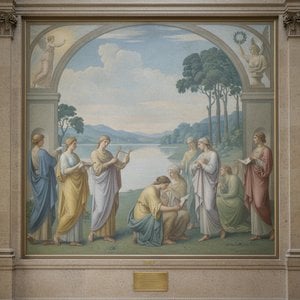
Pierre Puvis de Chavannes: Symbolism, Mural Painting, and the Pursuit of Ideal Beauty
Explore the life & work of Pierre Puvis de Chavannes, a pivotal Symbolist painter renowned for his monumental murals. Discover his aesthetic principles, key artworks like 'Hope,' and lasting influence on modern art. A deep dive into 19th-century French painting.

The Bountiful Still Life: Symbolism & Artistic Representation of Fruit Across Art History
Explore the rich history of still life painting & the symbolism of fruit across art movements. Discover masterpieces from Caravaggio to Cézanne with ArtsDot – expert guidance & museum-quality reproductions.

Maurice Utrillo: A Poetic Vision of Parisian Solitude – Life, Style & Legacy
Explore the poignant world of Maurice Utrillo, the master of Parisian cityscapes. Discover his life, distinctive style, and enduring legacy with ArtsDot – handmade oil reproductions & expert art insights.