


 Preview
 Send
Send Share
Share
 Details
 Guide
Guide

 Download
 Similars
 X-Ray
X-Ray Diaporama
 Stats
StatsUntitled
 Oil On Canvas
- WallArt
- Abstract Expressionism
 1946
1946- Modern
 70.0 x 80.0 cm
 Read More
The artwork displayed on this page is protected by copyright law, which means we cannot legally create or sell an identical reproduction. This protection is enforced under international agreements such as the Berne Convention and by national laws, including those outlined by the U.S. Copyright Law - Title 17.
This method fully complies with copyright regulations because it does not involve copying or duplicating the protected artwork. Instead, it is a creative reinterpretation - a new painting that is influenced by the original but not identical to it.
Giclée / Art Print
Museum-quality giclée or canvas print with fast production and flexible finish options. ( Buy Hand Made Painting Switch to Digital Image)




P118B $10

P118H $10

P118W $10

P438Z $10

P508JH $12

P508YH $12

P805H $10

P805Z $10

P919BZ $10

P919G $10

P919XJ $10

P959ZH $10

P968JZ $12

W106C $8

W218G $10

W218JH $8

W218Y $10

W307PJ $10

W316G $10

W316PJ $8

W316Y $10

W398PJ $8

W4111J $10

W500HY $15

W500JH $15

W692G $12

W849H $8

W940BG $15

W953PJ $8




Pick from our preset sizes that match the artwork's original proportions.

You may enter your own dimensions to fit a specific frame or space. If your selected size does not match the original image's proportions, we will either crop the artwork or extend the image with a mirrored or solid-fill edge. A digital mockup will be sent for your approval before production begins.
Please note that the on-screen preview does not reflect the actual cropping or extension. Only the mockup will accurately show the final composition.
While custom sizes are available, we recommend selecting a dimension from the predefined list to preserve the original proportions.
Worldwide Delivery () in 2 weeks instead of standard 4/5 weeks. (8 October)

Free Worldwide Express Shipping

High-Quality Linen Canvas

Full Shipping Insurance

Customs Tax Refund Guarantee

True Color Matching Guarantee

100-Day Return Policy (Defects Only)

100% Money-Back Guarantee

Bulk Discount Offer
 Glass option is only available in size under 110 CM

Untitled
Giclée / Art Print
Reproduction Size
-


Total Price
$ 63
A Window into Rothko’s Inner World: Exploring ‘Untitled’ (1946)
This captivating work by Mark Rothko, created in 1946, exemplifies a pivotal moment in the artist's transition towards his signature Color Field style. Measuring 70 x 80 cm, ‘Untitled’ is not merely a painting; it’s an immersive experience—a visual poem rendered in layered hues and gestural abstraction.Deconstructing the Abstract Form
The composition eschews traditional representation, instead presenting a dynamic interplay of overlapping rectangles and amorphous shapes. Dominant shades of yellow, gray, black, and red coalesce on the canvas, creating a sense of both chaos and balance. There is no single focal point; rather, the eye wanders through the textured surface, drawn in by the visible brushstrokes and drips that speak to the physicality of its creation. Lines are implied, edges dissolving into one another, fostering a feeling of depth despite the painting’s inherent flatness. The forms range from sharply defined rectangles to softer, rounded shapes, adding to the visual complexity.Technique & Materials: A Layered Approach
Rothko's technique in ‘Untitled’ is characterized by a meticulous layering of oil paint on canvas. This isn’t about precise application; it’s about building up surfaces, allowing previous layers to peek through and influence the final effect. The rough, uneven texture—a direct result of thick impasto and expressive brushwork—is integral to the painting's emotional resonance. This tactile quality invites close inspection and a deeper connection with the artwork.Historical Context: Post-War Expressionism
Created in the aftermath of World War II, ‘Untitled’ reflects the anxieties and existential questioning prevalent during that era. Rothko, having immigrated to the United States from Latvia as a child, channeled his personal experiences and the collective trauma of the time into his art. He was deeply involved with the burgeoning Abstract Expressionist movement, which rejected traditional artistic conventions in favor of subjective emotional expression. This painting stands as an early example of his move away from figurative work towards the pure exploration of color and form that would define his later career.Symbolism & Emotional Impact
While Rothko resisted prescriptive interpretations of his work, ‘Untitled’ undeniably evokes a range of emotions—contemplation, anxiety, even a sense of the sublime. The interplay of dark and light hues can be interpreted as representing opposing forces, while the ambiguous forms suggest hidden depths within the human psyche. Rothko aimed to create paintings that were not *about* something, but *were* something—direct conduits for emotional experience. The painting’s power lies in its ability to resonate with viewers on a deeply personal level, prompting introspection and self-discovery.Integrating ‘Untitled’ into Your Space
This piece would serve as a striking focal point in a modern or minimalist interior. Its rich color palette complements neutral tones while adding depth and sophistication. Consider placing it in a quiet space—a study, living room, or bedroom—where its contemplative energy can be fully appreciated. A high-quality reproduction of ‘Untitled’ allows you to bring the emotional power of Rothko's vision into your home or office.- Style: Abstract Expressionism, Color Field Painting
- Materials: Oil on Canvas
- Dimensions: 70 x 80 cm
- Year: 1946
Questions & Answers
Who is the artist behind "Untitled"?
"Untitled" is attributed to Mark Rothko.
How old was Mark Rothko when creating "Untitled" in 1946?
Mark Rothko was 43 years old when creating "Untitled" in 1946. The age is computed from the artist's birth year, 1903.
What subjects appear in "Untitled" by Mark Rothko?
The themes present in "Untitled" by Mark Rothko include abstract, color field, rothko, emotion, depth, layered, geometric, modernart. Together they summarize the artwork's subject matter.
In which movement and which era is "Untitled" by Mark Rothko placed?
"Untitled" by Mark Rothko is placed in the Abstract Expressionism movement, within the Modern era of its creator.
What does "Untitled" by Mark Rothko depict, and in what mood?
"Untitled" shows abstract, color field, rothko, emotion, depth, layered, geometric, modernart, and its recorded mood is mystical.
Is a high-resolution download of "Untitled" available?
A digital image of "Untitled" by Mark Rothko can be purchased on this page: a high-resolution digital image download.
When was "Untitled" made?
"Untitled" dates from 1946. The date places the work within Mark Rothko's career and its era.


Artist Biography
Early Life and the Seeds of Artistic Vision
Mark Rothko, born Markus Yakovlevich Rothkowitz in Dvinsk, Latvia, in 1903, carried within him from the outset a sense of displacement that would profoundly shape his artistic journey. His early years were marked by the anxieties of a Jewish family living within the Pale of Settlement, shadowed by pogroms and political unrest. This atmosphere instilled a deep sensitivity to human suffering, a theme that would resonate throughout his oeuvre. The 1913 immigration to Portland, Oregon, represented not just a geographical shift but a cultural upheaval for the young Rothko. While his father, a pharmacist and intellectual with socialist leanings, fostered a home filled with debate and learning, the loss of Jacob Rothkowitz shortly after their arrival cast a long shadow. This early experience of loss, coupled with the challenges of assimilation, fueled a lifelong exploration of existential themes – mortality, trauma, and the search for meaning in a chaotic world. Though he excelled academically at Yale University, Rothko found himself drawn more to the vibrant energy of New York City, abandoning formal studies to pursue his passion for art at the Art Students League. These formative years laid the groundwork for an artistic vision that would ultimately challenge conventional notions of painting and redefine the emotional power of color.From Figurative Beginnings to Abstract Expressionism
Rothko’s initial artistic explorations were firmly rooted in realism, depicting urban scenes and portraits with a keen eye for detail. However, these early works already hinted at the psychological depth that would become his hallmark. As the 1940s unfolded, and the world grappled with the horrors of World War II, Rothko’s art underwent a dramatic transformation. Influenced by Surrealism and mythology, he began to move away from representational imagery, seeking instead to express universal human emotions through symbolic forms. This period saw the emergence of multi-form paintings – canvases populated by ambiguous, biomorphic shapes that seemed to hover between figuration and abstraction. These works were not merely experiments in form; they were deeply felt responses to the anxieties and uncertainties of a world at war. By the late 1940s, Rothko had arrived at his signature style: large-scale canvases featuring rectangular blocks of color that appeared to float and resonate with one another. He stripped away all vestiges of recognizable imagery, focusing instead on the pure emotional impact of color and form. This marked a pivotal moment in the development of Abstract Expressionism, and established Rothko as a leading figure in this groundbreaking movement.The Color Field and the Pursuit of Transcendence
Rothko’s mature work is defined by what came to be known as “Color Field” painting – vast expanses of luminous color that envelop the viewer in an immersive experience. These paintings are not about *what* they depict, but rather *how* they make you feel. Rothko believed that art should engage the viewer viscerally, bypassing intellectual analysis and speaking directly to the emotions. He meticulously layered thin washes of paint, creating subtle variations in tone and texture that seemed to emanate from within the canvas. The edges of his rectangular forms are often blurred, allowing them to blend and interact with one another, creating a sense of depth and movement. Rothko deliberately avoided titles beyond numbers – “No. 1,” “No. 6” – encouraging viewers to confront the paintings without preconceived notions and allow their own emotional responses to guide their experience. He sought to create a space for contemplation, a sanctuary where viewers could connect with something larger than themselves. His ambition was nothing less than to evoke profound spiritual experiences through the language of color.Major Achievements and Lasting Legacy
Among Rothko’s most significant achievements are “No. 10 (1950),” a pivotal work that exemplifies his evolving style, and the Seagram Murals (1958). Commissioned for the Four Seasons Restaurant in New York City, these murals were ultimately rejected by Rothko, who felt they would be compromised by their intended environment. He instead donated them to the Tate Gallery in London, where they continue to inspire awe and contemplation. Perhaps his most ambitious project was the Rothko Chapel (1971) in Houston, Texas – a non-denominational sanctuary housing fourteen of his paintings. Designed as a space for quiet reflection, the chapel is considered a sacred place by many, embodying Rothko’s belief in the spiritual power of art. Rothko's influence on subsequent generations of artists has been immense. He paved the way for Minimalist art and continues to inspire contemporary painters who explore the emotional possibilities of abstraction. Despite struggling with depression throughout his life, culminating in his tragic suicide in 1970, Mark Rothko remains one of the most important and influential artists of the 20th century – a master of color whose work continues to resonate with audiences around the world.The Enduring Power of Emotional Resonance
- Rothko’s paintings are celebrated for their ability to convey universal human emotions—tragedy, ecstasy, despair, and hope.
- His exploration of color as a vehicle for emotional expression revolutionized abstract painting.
- The Rothko Chapel stands as a testament to his belief in the spiritual power of art.
- He remains a pivotal figure in Abstract Expressionism and a major influence on contemporary artists.

Mark Rothko
1903 - 1970 , Latvia
Quick Facts
- Full Name: Mark Rothko
- Nationality: American
- Date Of Birth: 1903
- Date Of Death: 1970
- Place Of Birth: Daugavpils, Latvia
- Notable Artworks:
- No. 10 (1950)
- Seagram Murals
- Rothko Chapel
- White Center
- Artistic Movement Or Style: Color Field Painting
- Artists Or Movements Influenced By This Artist:
- Minimalism
- Abstract Expressionism
Related Articles

Beyond Representation: Exploring the Emotional Landscape of Abstract Expressionism
Explore the profound emotional world of Abstract Expressionism with ArtsDot. Discover key artists like Pollock & Rothko, learn about collecting, and find museum-quality reproductions to inspire your space.

Abstract Expressionism's 10 Defining Masterpieces |
Explore 10 defining Abstract Expressionism masterpieces by Pollock, Rothko & de Kooning. Discover the stories behind these iconic paintings and find museum-quality art reproductions to elevate your home decor on .

The Sublimity of Color: Exploring the Emotional Landscapes of Mark Rothko's Abstract Expressionism
Explore the profound emotional depth of Mark Rothko's abstract expressionism. Discover the history, techniques & lasting impact of this pivotal Color Field painter. Expert insights for collectors and art enthusiasts.

Chromatic Atmospheres: Exploring the Philosophical Foundations of Color Field Painting
Explore the philosophical and aesthetic foundations of Color Field painting with ArtsDot. Discover key artists like Rothko & Newman, its spiritual influences, and lasting impact on modern art. Expert insights for collectors.
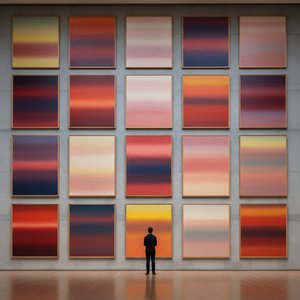
Mark Rothko's Masterpieces: 25 Paintings That Define Abstract Expressionism | ArtsDot
Explore 25 iconic Mark Rothko paintings that define Abstract Expressionism. Discover the stories, colors & emotions behind these masterpieces. Find museum-quality art reproductions and curated decor ideas at ArtsDot.com.


