

 Preview
 Send
Send Share
Share
 Details
 Guide
Guide

 Download
 Similars
 X-Ray
X-Ray Diaporama
 Q&A
Q&A Stats
StatsThe Watering Trough

- 99.0 x 88.0 cm


 Read More
The artwork displayed on this page is protected by copyright law, which means we cannot legally create or sell an identical reproduction. This protection is enforced under international agreements such as the Berne Convention and by national laws, including those outlined by the U.S. Copyright Law - Title 17.
This method fully complies with copyright regulations because it does not involve copying or duplicating the protected artwork. Instead, it is a creative reinterpretation - a new painting that is influenced by the original but not identical to it.
Giclée / Art Print
Museum-quality giclée or canvas print with fast production and flexible finish options. ( Buy Hand Made Painting Switch to Digital Image)




P118B $10

P118H $10

P118W $10

P438Z $10

P508JH $12

P508YH $12

P805H $10

P805Z $10

P919BZ $10

P919G $10

P919XJ $10

P959ZH $10

P968JZ $12

W106C $8

W218G $10

W218JH $8

W218Y $10

W307PJ $10

W316G $10

W316PJ $8

W316Y $10

W398PJ $8

W4111J $10

W500HY $15

W500JH $15

W692G $12

W849H $8

W940BG $15

W953PJ $8




Pick from our preset sizes that match the artwork's original proportions.

Type the width and the height you need, to fit your frame or your wall. A print can only be cut, never made bigger than the picture, so a size with a different shape loses a part of the image. We send you a digital mockup to approve before we print anything. The picture shown on this page does not show the real cut — only the mockup does.
Worldwide Delivery () in 2 weeks instead of standard 4/5 weeks. (10 November)

Free Worldwide Express Shipping

High-Quality Linen Canvas

Full Shipping Insurance

Customs Tax Refund Guarantee

True Color Matching Guarantee

100-Day Return Policy (Defects Only)

100% Money-Back Guarantee

Bulk Discount Offer
 Glass option is only available in size under 110 CM

The Watering Trough
Giclée / Art Print
Reproduction Size
-


Total Price
$ 63
The Enigmatic Charm of Marc Chagall’s “The Watering Trough”
Marc Chagall's "The Watering Trough," painted in 1925 during his vibrant Parisian period, is more than just a depiction of a rural scene; it’s an immersion into a dreamscape brimming with symbolic resonance and the artist’s signature Cubist-Surrealist blend. Measuring 99 x 88 cm, this oil on canvas invites viewers to linger over its intricate details – a quiet forest bathed in an ethereal light, where a solitary man and a fox share a contemplative gaze directed towards an unseen horizon. The painting immediately establishes a sense of serene mystery, a feeling that’s deepened by Chagall's masterful manipulation of perspective and color. It’s a work that speaks to the interconnectedness of nature, humanity, and the realm of imagination, hallmarks of the artist’s distinctive vision.A Composition Woven with Symbolism
At first glance, “The Watering Trough” presents a seemingly simple tableau: a man and a fox observing something beyond the frame. However, closer inspection reveals a carefully constructed composition layered with symbolic elements. The inclusion of two birds perched on branches and three deer grazing peacefully adds depth to the scene, suggesting a harmonious ecosystem governed by an unspoken understanding. Notably, a book lies open on a surface near the bottom of the painting – a subtle nod to knowledge, reflection, and perhaps even storytelling. Similarly, a bottle suspended in the top right corner acts as another intriguing symbol, hinting at refreshment, aspiration, or the fleeting nature of desire. These objects aren’t merely decorative; they contribute to the painting's rich tapestry of meaning, prompting viewers to consider the broader themes it explores. The arrangement itself feels deliberately unbalanced, creating a dynamic tension that mirrors the emotional complexity of the scene.The Dance of Cubism and Surrealism
Chagall’s artistic style in “The Watering Trough” is powerfully defined by his embrace of both Cubism and Surrealism. The geometric shapes and fragmented forms – particularly evident in the depiction of the trees and the figures – are characteristic of Cubist techniques, creating a sense of dynamism and multiple viewpoints simultaneously. However, these fractured elements aren’t presented with cold detachment; instead, they're interwoven with dreamlike imagery and unexpected juxtapositions, firmly anchoring the work within the Surrealist tradition. This fusion results in a visual experience that is both intellectually stimulating and emotionally evocative – a testament to Chagall’s unique ability to synthesize disparate artistic approaches. The interplay of light and shadow, intensified by this stylistic blend, imbues the painting with an almost palpable energy.A Window into Marc Chagall's World
Born in 1887 in Liozna, Belarus, Marc Chagall’s life was deeply intertwined with his art. His early years spent in Vitebsk, a vibrant crossroads of cultures and religions, profoundly shaped his artistic sensibilities. This painting reflects that formative experience, drawing upon the rich folklore and symbolic traditions of Eastern Europe. Chagall's work consistently explored themes of Jewish identity, family, love, and faith, often blending realistic depictions with fantastical elements. “The Watering Trough” exemplifies this approach, presenting familiar rural motifs within a context of heightened emotional intensity and symbolic weight. The painting’s presence in the Kunstmuseum Basel, one of Europe’s oldest public art collections, underscores its significance as a pivotal work within Chagall's oeuvre – a testament to his enduring legacy as a visionary artist who continues to captivate audiences today. For those seeking a high-quality reproduction, ArtsDot offers exceptional reproductions that faithfully capture the painting’s luminous colors and intricate details, allowing you to bring this enchanting masterpiece into your own space.Questions & Answers
Which period of Marc Chagall's career does "The Watering Trough" belong to?
"The Watering Trough" belongs to the Early Period of Marc Chagall's career. This classification relates the work to the artist's development.
Where is "The Watering Trough" suggested to be displayed, considering its palette?
With its earthy palette, "The Watering Trough" by Marc Chagall is recommended for a living room. The colors are part of the reason for this suggestion.
How much light do the colors of "The Watering Trough" appear to reflect?
The luminance recorded for "The Watering Trough" by Marc Chagall is soft shadow.
Related Artworks


Artist Biography
Early Life, Family and Training
Marc Chagall enters the world on July 7, 1887, in Vitebsk, Russian Empire, born Moishe Segal. He is the first of nine children in a modest Jewish family. Life is defined by the rhythms of labor and small-scale commerce. His father, Khatskel Segal, works as a herring pickler at a warehouse, while his mother, Feïga-Ita Tchernina, manages a small grocery store. These early years are rooted in the specific textures of a provincial town, where the boundaries of his world are shaped by the needs of a large household and the traditions of his community.
Education begins within the walls of the heder, a traditional Jewish elementary school. Here, the focus remains on religious instruction and the foundational texts of his upbringing. By age thirteen, the scope of his learning shifts toward the secular. He enters Vitebsk’s official middle school to pursue a Russian education, a move that marks a departure from the strictly religious sphere of his childhood. This dual existence—between the sacred traditions of the heder and the secular requirements of the state school—creates a tension that defines his early development.
Artistic impulse finds its first formal outlet in Vitebsk. Chagall receives his initial training at a local art school operated by Iouri Pen. It is here that the raw instinct for visual expression begins to coalesce into a disciplined practice. He moves from the structured lessons of the classroom toward a more profound engagement with the act of seeing, setting the stage for a life spent translating memory into form.
The Formative Years in St. Petersburg
The transition from the provincial quiet of Vitebsk to the imperial scale of Saint-Petersburg is marked by struggle. Between 1907 and 1909, the capital offers little in the way of comfort. Poverty is a constant companion; there are moments of hunger so severe that physical collapse becomes a reality. To survive, he takes to the streets, earning a meager living by drawing shop signs. These commercial tasks provide the necessary rubles to sustain a presence in the city while he navigates the complexities of being a Jewish student in a vast, shifting empire.
The academic pursuit is relentless. He enrolls in several academies, seeking a formal structure for his burgeoning visual language. The atmosphere of the capital is heavy with the influence of the avant-garde, a tension that pulls him away from classical training. He finds himself in the studio of Léon Bakst, a designer for the Ballets Russes, where the theatricality of set design begins to seep into his perception of space and form. This period is a collision of necessity and ambition, a time of sketching for survival while simultaneously absorbing the radical shifts occurring in the Russian art scene.
The Paris Years and Avant-Garde Influence
Paris arrives in 1910 or 1911, a sudden shift from the provincial constraints of the Russian Empire. The city offers a sensory shock. He finds light, color, and liberty in the streets of Montparnasse. This is no longer the world of the herring merchant or the traditional heder school; it is a landscape of radical possibility. He settles in La Ruche, the famous artist's residence, where the air is thick with the presence of the new avant-garde. He shares this space with Amedeo Modigliani and Fernand Léger, figures who are redefining the boundaries of modern expression. The influence of the era is inescapable, yet he remains an outlier, absorbing the discoveries of Fauvism and Cubism without surrendering his own internal logic.
The work produced during this period begins to reflect a departure from literal representation. He moves toward a style that prioritizes emotional and poetic associations over the strict rules of pictorial logic. The colors brighten, fueled by the exposure to the Parisian scene. He navigates the tension between the formal training of his past and the experimental freedom of the present. This period of intense creative friction continues until the political upheavals of the war pull him back toward the East. It is not until 1923 that he returns to Paris with his family, re-establishing his presence in the city that first unlocked his visual language.
- The Betrothed and Eiffel Tower (1913)
- Hommage à Apollinaire (1912-1913)
The Russian Years and Revolution
The revolution pulls Chagall back to Vitebsk. He does not merely observe the upheaval; he attempts to shape its cultural landscape. He takes on the mantle of Vitebsk Commissioner of Fine Arts and assumes the directorship of a local Fine Arts School. His vision is one of community and education, yet the political climate shifts beneath his feet. The rise of Suprematism creates a fracture. Figures like Malevitch and Lissitzky push for a radical, non-objective abstraction that clashes with Chagall’s more lyrical, figurative approach. The tension is unsustainable. He is forced out of his positions, his dream of a localized artistic renaissance colliding with the rigid demands of the new regime.
By 1920, the focus shifts to Moscow. He works on the decoration of the Jewish theatre, a project that captures the intersection of his personal identity and the public stage. His lines are confident, his colors strong and pale, even as the world around him fractures. He navigates a period of intense creative output and profound material struggle, moving between the memory of the shtetl and the demands of a changing state. The era is defined by this friction: the attempt to build a cultural home while the very foundations of his world are being rewritten.
- Over the Town (1914–1918)
- Apparition (about 1917-18)
Life in the United States
The outbreak of World War II forces a sudden shift in geography. In 1941, Chagall and his family seek refuge in the United States, fleeing the instability of occupied France. He settles in and around New York City, a period of residence that lasts until 1948. The city provides a backdrop of profound emotional upheaval. Amidst the anxieties of the war years, his brush captures the tension of a world in flux. The work reflects the uncertainty of the era, translating personal and global unrest into a visual language of suffering and hope.
During these seven years, the artist finds a way to engage with large-scale institutional projects. He undertakes major commissions for the United Nations headquarters, translating his poetic vision into the architectural fabric of a global institution. This period in America marks a significant chapter of experimentation and survival, bridging his European roots with a new, intense reality. He remains a man between worlds, his heart still pulling him toward France even as he navigates the complexities of his American exile.
- White Crucifixion (1938)
Technique and Artistic Style
Logic yields to emotion. Chagall rejects the rigid rules of pictorial logic, choosing instead to compose images through poetic association. His canvases operate on the mechanics of a dream. Figures float through the air, defying gravity, while colors pulse with a non-naturalistic intensity. This approach allows him to capture the essence of feeling rather than the literal appearance of the world. He moves beyond mere imitation, using a bold palette to translate memory into a visual language.
His aesthetic is a collision of influences. He absorbs the fragmented structures of Cubism and the intense color of Fauvism, yet he filters these avant-garde movements through a deeply personal lens. The result is a style that bridges Expressionism and abstraction. He weaves together the sacred and the mundane, populating his scenes with symbolic and surreal imagery. Jewish folktales and the quiet, lived-in details of shtetl life become the building blocks of a private mythology. The familiar becomes fantastic.
The imagery often centers on recurring motifs: flying lovers, fiddlers, and massive bouquets. These elements are not mere decorations but symbols of a spiritual and emotional landscape. In works like The Lovers (1929), the sense of weightlessness and the use of intense color create a space where the physical laws of the world no longer apply. His work remains a constant negotiation between the tangible reality of his upbringing and the boundless possibilities of the imagination.
- I and the Village (1911)
- The Green Violinist (1924)
- White Crucifixion (1938)
Patrons, Workshop and Commissions
The mid-1920s find Chagall in Paris, navigating the influential circles of the art market. He enters the orbit of Ambroise Vollard, a dealer whose influence shapes the trajectory of many avant-garde artists. Vollard commissions a series of engravings from Chagall, tasking him with illustrating the works of Nikolay Gogol, specifically Dead Souls. This period marks a shift toward the precision of printmaking, moving away from the fluid spontaneity of his earlier canvases.
In 1931, the focus shifts toward the Middle East. The Mayor of Tel Aviv extends an invitation to Chagall to travel to Palestine. The objective is ambitious: the founding of a Jewish Art Museum. This period deepens his engagement with religious and cultural symbolism, a theme that would persist through his later, large-scale architectural works. His ability to translate personal and communal memory into physical space becomes a defining aspect of his professional output.
As his reputation grows, the scale of his work expands from the intimate page to the monumental. He moves into the realm of light and architecture, designing stained-glass windows for the Cathedral of Metz and the United Nations building in New York. These works demand a mastery of how color interacts with sunlight. In 1964, he reaches a peak of public recognition with a commission for the ceiling of the Paris Opera, a massive undertaking that brings his dreamlike imagery into one of Europe's most significant cultural venues.
Where to See the Works Today
The legacy of his vision remains anchored in several key institutions across the globe. In Nice, France, the Musée National Marc Chagall houses an extensive collection of his works, preserving the core of his creative output. This museum offers a concentrated look at the imagery that defined his long career. Meanwhile, the State Russian Museum in Saint-Petersburg, Russia, maintains a significant presence of his art, holding pieces that connect back to his early years and his time in the Russian Empire.
The reach of his work extends across the Atlantic to the United States. The Museum of Modern Art in New York City holds works that reflect his complex relationship with the city during his years of exile. In the American Midwest, the Art Institute of Chicago features his art, ensuring his presence in major international collections. These locations provide the primary physical touchpoints for those seeking to encounter his specific use of color and form.
- I and the Village (1911)
- The Wedding (1944)
- White Crucifixion (1938)
- The Lovers (1929)
- The Circus (1964)
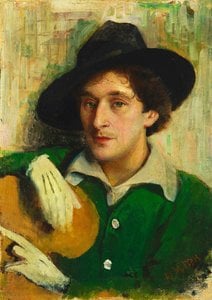
Marc Chagall
1887 - 1985 , Belarus
Quick Facts
- Artistic Movement Or Style: Expressionism, Cubism, Fauvism, Surrealism
- Artists Or Movements Influenced By This Artist: ['Surrealists']
- Artists Who Influenced This Artist: ['Léon Bakst']
- Full Name: Moishe Shagal
- Nationality: Russian-French
- Notable Artworks:
- I and the Village
- The Birthday
- The Wedding
- White Crucifixion
- Over Vitebsk
- Place Of Birth: Liovana, Belarus
- Date Of Birth: 1887
- Date Of Death: 1985
Related Articles

Beastly Brushstrokes: A Historical Journey Through Animal Painting & Aesthetic Movements
Explore the rich history of animal painting across cultures & movements. Discover iconic artists, symbolism, collecting trends & expert art consultation at ArtsDot.com.

Jean Dominique Antony Metzinger: Pioneering Cubism & the Evolution of Abstract Form
Explore the life & work of Jean Metzinger, a pivotal Cubist painter and theorist. Discover his innovations in proto-Cubism, 'Du Cubisme,' and Crystal Cubism – a journey through modern art's evolution.

Deconstructing Reality: Cubism's Evolution, Impact & Enduring Legacy
Explore the revolutionary world of Cubism with expert insights from ArtsDot. Discover Picasso & Braque's groundbreaking techniques, its philosophical roots, and lasting impact on modern art. Expert appraisal & custom reproductions available.

Animalia: Exploring the Enduring Presence of Animals in Art & Interior Design
Explore the rich history of animal symbolism in art, from ancient mythology to modern masterpieces. Discover how animals have inspired artists for centuries and learn how to incorporate these powerful motifs into your home décor.

Deconstructing Reality: Cubism's Revolutionary Impact on 20th-Century Art
Explore the revolutionary world of Cubism with ArtsDot. Discover Picasso & Braque's groundbreaking techniques, its philosophical roots, and lasting impact on modern art. Expert insights for collectors.


