Preview
 Send
Send Share
Share
 Details
 Guide
Guide

 Download
 Similars
 X-Ray
X-Ray Diaporama
 Q&A
Q&A Stats
StatsNacht

 Read More
Giclée / Art Print
Museum-quality giclée or canvas print with fast production and flexible finish options. ( Buy Hand Made Painting Switch to Digital Image)




































Pick from our preset sizes that match the artwork's original proportions.

Type the width and the height you need, to fit your frame or your wall. A print can only be cut, never made bigger than the picture, so a size with a different shape loses a part of the image. We send you a digital mockup to approve before we print anything. The picture shown on this page does not show the real cut — only the mockup does.
Worldwide Delivery () in 2 weeks instead of standard 4/5 weeks. (18 November)

Free Worldwide Express Shipping

High-Quality Linen Canvas

Full Shipping Insurance

Customs Tax Refund Guarantee

True Color Matching Guarantee

100-Day Return Policy (Defects Only)

100% Money-Back Guarantee

Bulk Discount Offer
 Glass option is only available in size under 110 CM

Nacht
Giclée / Art Print
Reproduction Size
-


Total Price
$ 63
Nacht by Lyonel Feininger: A Dreamlike Expressionist Vision
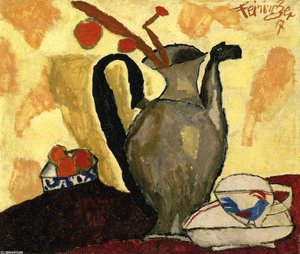
“Nacht,” meaning “Night” in German, is a captivating artwork by Lyonel Feininger that exemplifies the core tenets of Expressionism while demonstrating influences from Cubism. Created sometime during an unknown date, this piece transports viewers to a stylized and abstracted cityscape bathed in the ethereal glow of moonlight or artificial light.
Subject and Style: An Abstracted Nightscape
The artwork depicts an abstracted cityscape at night, likely inspired by German towns or villages. Feininger doesn't aim for photographic realism; instead, he prioritizes conveying a feeling—a mood of quiet contemplation tinged with melancholy. The style is distinctly Expressionist, characterized by its subjective interpretation of reality and emphasis on emotional expression over objective representation. Geometric simplification of forms, reminiscent of Cubism, further enhances the artwork’s unique visual language. Buildings are rendered as geometric blocks with pointed roofs, arranged in a seemingly chaotic yet balanced composition. A large circular form, likely representing the moon, dominates the right side of the canvas, while scattered stars punctuate the upper portion.
Technique and Materials: Watercolor's Fluidity
Feininger masterfully employs watercolor as his primary technique. The loose brushstrokes and washes of color create a fluid and atmospheric effect. Lines are used sparingly but effectively to define edges and structure, often appearing as thin, sketchy outlines that suggest movement or impermanence. The palette is predominantly cool and muted—shades of blue-green, purple, grey, and touches of orange—contributing to the somber yet peaceful mood. This technique lends a dreamlike quality to the scene, blurring the lines between reality and imagination.
Symbolism and Emotional Impact: Towers, Stars, and Contemplation
Beyond its visual appeal, “Nacht” is rich in symbolic elements. The tall, angular tower that dominates the composition could symbolize power, aspiration, or even spirituality—reaching towards the heavens amidst the nocturnal setting. The scattered stars evoke a sense of wonder and mystery, hinting at the vastness of the universe beyond the confines of the cityscape. Overall, the artwork evokes a feeling of quiet contemplation, inviting viewers to reflect on the stillness and solitude of night. It’s a powerful exploration of emotion through abstraction, characteristic of Feininger's artistic vision.
Questions & Answers
Is "Nacht" by Lyonel Feininger in the public domain?
Regarding copyright, "Nacht" is in the public domain - its copyright has expired.
Who is the artist behind "Nacht"?
"Nacht" was created by Lyonel Feininger. The information on this page describes Lyonel Feininger's original work.
Are the colors of "Nacht" by Lyonel Feininger vivid or muted?
"Nacht" by Lyonel Feininger is recorded with a subtle color saturation and a balanced intensity.
Related Artworks


Artist Biography
Early Life and Career: From Caricaturist to Fine Artist
- Birth and Family: Lyonel Charles Adrian Feininger was born on July 17, 1871, in New York City. His father, Karl Feininger, was a German-American violinist and composer, and his mother, Elizabeth Feininger, was an American singer. This artistic background significantly influenced his early development.
- Early Education and European Travels: In 1887, at the age of 16, Feininger traveled to Europe to study music but soon shifted his focus to art. He studied drawing in Hamburg and Berlin.
- Commercial Art Career: From 1894 onwards, Feininger established a successful career as a caricaturist for various German, French, and American magazines. His comic strips, such as "The Kin-der-Kids" and "Wee Willie Winkie's World," gained considerable popularity and showcased his unique graphic style.
- Transition to Fine Art: After a 20-year stint in commercial art, Feininger transitioned to fine art at the age of 36. This marked a significant turning point in his artistic journey.
Expressionism and Bauhaus Influence
- Joining Expressionist Groups: Feininger became a leading exponent of Expressionism, joining influential groups like Die Brücke, Novembergruppe, and Gruppe 1919. His work during this period reflected the movement's emphasis on emotional expression and subjective experience.
- First Solo Exhibition: His first solo exhibition at the Sturm Gallery in Berlin (1917) was a pivotal moment, establishing him as a prominent figure in the art world.
- Bauhaus Master: In 1919, Walter Gropius appointed Feininger as the first faculty member at the Bauhaus, a groundbreaking school of art and design. He served as the master artist in charge of the printmaking workshop, significantly influencing numerous students.
- Artistic Style: His work was characterized by prismatically broken forms, translucent colors, and references to architecture and the sea, aligning him with classical modernism.
Major Works and Artistic Development
- Early Marine Paintings: During summer vacations on the island of Usedom (1909-1918), Feininger created numerous marine paintings depicting the Baltic Sea, showcasing his evolving style.
- Notable Works: Some of his significant works include "Werder I" (watercolor), "Gaberndorf II" (paper), and "Boats" (cubism, oil on canvas). These pieces exemplify his unique blend of Expressionist techniques and architectural themes.
- Photographic Works: Between 1928 and the mid-1950s, Feininger produced a substantial body of photographic works, demonstrating his versatility as an artist.
- Musical Compositions: He also composed several piano pieces and fugues for organ, revealing another facet of his artistic talent.
Later Years and Legacy
- Emigration to the United States: Due to the rise of the Nazi Party in 1933, Feininger emigrated to the United States with his wife.
- Continued Artistic Practice: He continued painting and creating art throughout his life, maintaining a distinctive style.
- Death and Recognition: Lyonel Feininger died on January 13, 1956. His work has left an indelible mark on the art world, inspiring artists and enthusiasts alike with its unique blend of Expressionism, graphic experimentation, and architectural themes.
- Historical Significance: As a key figure in both Expressionism and the Bauhaus movement, Feininger's contributions significantly shaped the course of modern art. His innovative use of color, form, and perspective continues to resonate with audiences today.

Lyonel Feininger
1871 - 1956 , United States
Quick Facts
- Full Name: Lyonel Charles Adrian Feininger
- Nationality: German-American
- Date Of Birth: 1871
- Date Of Death: 1956
- Place Of Birth: New York, United States of America
- Notable Artworks:
- Werder I (watercolour)
- Gaberndorf II (paper)
- Boats (oil on canvas)
- Artistic Movement Or Style: Expressionism, Cubism
- Artists Or Movements Influenced By This Artist:
- Bauhaus movement
- Ludwig Hirschfeld Mack
Related Articles

Clyfford Still's Abstract Expressionism: A Study of Color, Form & the Existential Landscape
Explore the profound world of Clyfford Still's Abstract Expressionism with ArtsDot. Discover his unique style, existential themes & investment potential. Expert analysis for discerning collectors.

Masterpieces of Light: The Top 25 Artworks by James McNeill Whistler
Explore the iconic masterpieces of James McNeill Whistler. Discover the essence of Tonalism and fine art on ArtsDot.com.
Cubist Expressionism's 10 Defining Masterpieces | Art for Your Home
Explore 10 defining Cubist Expressionism masterpieces by Picasso, Braque & more. Discover the stories behind these bold, geometric paintings and bring museum-quality art to your home with ArtsDot.com. Explore the full collection online.

Deconstructing Reality: Cubist Expressionism's Aesthetic & Philosophical Foundations
Explore the profound aesthetic & philosophical foundations of Cubist Expressionism. Discover key artists, movements, and lasting influence on modern art history. A guide for discerning collectors.

Lyonel Feininger: Bridging Expressionism & Cubism – A Study of Spiritual Geometry
Explore the captivating world of Lyonel Feininger, a pivotal figure bridging Expressionism & Cubism. Discover his architectural visions, Bauhaus influence, and enduring legacy in modern art history. Learn more at ArtsDot.