Preview
 Send
Send Share
Share
 Details
 Guide
Guide

 Download
 Similars
 X-Ray
X-Ray Diaporama
 Stats
StatsBoats


 Read More
Giclée / Art Print
Museum-quality giclée or canvas print with fast production and flexible finish options. ( Buy Hand Made Painting Switch to Digital Image)




P118B $10

P118H $10

P118W $10

P438Z $10

P508JH $12

P508YH $12

P805H $10

P805Z $10

P919BZ $10

P919G $10

P919XJ $10

P959ZH $10

P968JZ $12

W106C $8

W218G $10

W218JH $8

W218Y $10

W307PJ $10

W316G $10

W316PJ $8

W316Y $10

W398PJ $8

W4111J $10

W500HY $15

W500JH $15

W692G $12

W849H $8

W940BG $15

W953PJ $8




Pick from our preset sizes that match the artwork's original proportions.

You may enter your own dimensions to fit a specific frame or space. If your selected size does not match the original image's proportions, we will either crop the artwork or extend the image with a mirrored or solid-fill edge. A digital mockup will be sent for your approval before production begins.
Please note that the on-screen preview does not reflect the actual cropping or extension. Only the mockup will accurately show the final composition.
While custom sizes are available, we recommend selecting a dimension from the predefined list to preserve the original proportions.
Worldwide Delivery () in 2 weeks instead of standard 4/5 weeks. (13 October)

Free Worldwide Express Shipping

High-Quality Linen Canvas

Full Shipping Insurance

Customs Tax Refund Guarantee

True Color Matching Guarantee

100-Day Return Policy (Defects Only)

100% Money-Back Guarantee

Bulk Discount Offer
 Glass option is only available in size under 110 CM

Boats
Giclée / Art Print
Reproduction Size
-


Total Price
$ 63
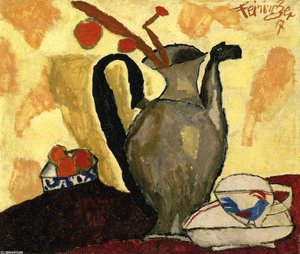
A Symphony of Geometry: Reimagining Feininger's Boats
In the vast landscape of early twentieth-century modernism, few works capture the rhythmic pulse of movement and light as elegantly as Lyonel Feininger’s Boats. Painted in 1917, this masterpiece serves as a breathtaking bridge between the whimsical precision of graphic illustration and the profound structural depth of Cubism. At first glance, the viewer is greeted by a serene maritime scene, yet upon closer inspection, the water and vessels dissolve into a mesmerizing dance of geometric planes. Feininger, a master who could just as easily navigate the sharp lines of a comic strip as the ethereal complexities of Expressionism, uses this piece to invite us into a world where reality is fragmented, yet harmoniously reconstructed through the lens of color and form.
The composition is a masterful study in perspective and spatial layering. Several sailboats, varying in scale, drift across a canvas dominated by deep, evocative blues. Some vessels appear anchored in the foreground, their sails catching the light with sharp, angular clarity, while others recede into a misty background, creating an illusion of infinite depth. This technique of multiple viewpoints—a hallmark of the Cubist movement—allows the eye to wander through the scene, experiencing the boats from several angles simultaneously. The presence of two subtle human figures, positioned near the edges of the frame, provides a sense of scale and a quiet, contemplative narrative, grounding the abstract geometry in a moment of lived experience.
The Intersection of Light and Structure
Technically, Boats is an extraordinary testament to Feininger’s ability to manipulate light as if it were a physical substance. The artist employs a palette that balances cool, aquatic tones with sudden, brilliant highlights that suggest the sun reflecting off a moving tide. His use of line is particularly noteworthy; there is a stained-glass quality to the way the shapes intersect, a precursor to his later, even more architectural works. Each stroke of oil on canvas contributes to a sense of dynamism, where the stillness of the water is constantly challenged by the sharp, energetic edges of the sails.
For the discerning collector or interior designer, this artwork offers much more than mere decoration. It provides a sophisticated focal point that embodies the intellectual rigor of the Cubist era while maintaining an emotional warmth. The painting’s ability to evoke both tranquility and motion makes it a versatile choice for modern spaces, particularly those seeking to introduce a sense of historical depth and avant-garde elegance. To possess a reproduction of Boats is to bring a piece of the Musée National d'Art Moderne into one's own sanctuary, offering a daily encounter with the transformative power of light, color, and geometric grace.
Questions & Answers
How do the colors of "Boats" relate to each other?
The color harmony of "Boats" is recorded as strong color unity.
Which artistic current is "Boats" by Lyonel Feininger part of?
The movement associated with "Boats" by Lyonel Feininger is Cubism. This classification situates the work among related artists and artworks.
How do contrast and harmony combine in "Boats"?
In "Boats", a serene contrast is paired with a strong color unity harmony.
Where does "Boats" fall in Lyonel Feininger's career?
"Boats" belongs to the Transition to Cubism of Lyonel Feininger's career. This classification relates the work to the artist's development.
How many people view "Boats"?
Statistics about "Boats" by Lyonel Feininger are on the artwork's Stats page: monthly visits of the artwork, visits of the artist's works, and country and language breakdowns of recent visitors.
From which era does "Boats" date?
"Boats" by Lyonel Feininger dates from the Modern period. The period gives the historical context of the work.
Who created "Boats" and in what year?
Lyonel Feininger made "Boats" in 1917.
How can I get a print of "Boats" by Lyonel Feininger?
To get a print of "Boats" by Lyonel Feininger, simply order it on this page: a fine art print on cotton canvas or archival canvas paper.
Related Artworks


Artist Biography
Early Life and Career: From Caricaturist to Fine Artist
- Birth and Family: Lyonel Charles Adrian Feininger was born on July 17, 1871, in New York City. His father, Karl Feininger, was a German-American violinist and composer, and his mother, Elizabeth Feininger, was an American singer. This artistic background significantly influenced his early development.
- Early Education and European Travels: In 1887, at the age of 16, Feininger traveled to Europe to study music but soon shifted his focus to art. He studied drawing in Hamburg and Berlin.
- Commercial Art Career: From 1894 onwards, Feininger established a successful career as a caricaturist for various German, French, and American magazines. His comic strips, such as "The Kin-der-Kids" and "Wee Willie Winkie's World," gained considerable popularity and showcased his unique graphic style.
- Transition to Fine Art: After a 20-year stint in commercial art, Feininger transitioned to fine art at the age of 36. This marked a significant turning point in his artistic journey.
Expressionism and Bauhaus Influence
- Joining Expressionist Groups: Feininger became a leading exponent of Expressionism, joining influential groups like Die Brücke, Novembergruppe, and Gruppe 1919. His work during this period reflected the movement's emphasis on emotional expression and subjective experience.
- First Solo Exhibition: His first solo exhibition at the Sturm Gallery in Berlin (1917) was a pivotal moment, establishing him as a prominent figure in the art world.
- Bauhaus Master: In 1919, Walter Gropius appointed Feininger as the first faculty member at the Bauhaus, a groundbreaking school of art and design. He served as the master artist in charge of the printmaking workshop, significantly influencing numerous students.
- Artistic Style: His work was characterized by prismatically broken forms, translucent colors, and references to architecture and the sea, aligning him with classical modernism.
Major Works and Artistic Development
- Early Marine Paintings: During summer vacations on the island of Usedom (1909-1918), Feininger created numerous marine paintings depicting the Baltic Sea, showcasing his evolving style.
- Notable Works: Some of his significant works include "Werder I" (watercolor), "Gaberndorf II" (paper), and "Boats" (cubism, oil on canvas). These pieces exemplify his unique blend of Expressionist techniques and architectural themes.
- Photographic Works: Between 1928 and the mid-1950s, Feininger produced a substantial body of photographic works, demonstrating his versatility as an artist.
- Musical Compositions: He also composed several piano pieces and fugues for organ, revealing another facet of his artistic talent.
Later Years and Legacy
- Emigration to the United States: Due to the rise of the Nazi Party in 1933, Feininger emigrated to the United States with his wife.
- Continued Artistic Practice: He continued painting and creating art throughout his life, maintaining a distinctive style.
- Death and Recognition: Lyonel Feininger died on January 13, 1956. His work has left an indelible mark on the art world, inspiring artists and enthusiasts alike with its unique blend of Expressionism, graphic experimentation, and architectural themes.
- Historical Significance: As a key figure in both Expressionism and the Bauhaus movement, Feininger's contributions significantly shaped the course of modern art. His innovative use of color, form, and perspective continues to resonate with audiences today.

Lyonel Feininger
1871 - 1956 , United States of America
Quick Facts
- Full Name: Lyonel Charles Adrian Feininger
- Nationality: German-American
- Date Of Birth: 1871
- Date Of Death: 1956
- Place Of Birth: New York, United States of America
- Notable Artworks:
- Werder I (watercolour)
- Gaberndorf II (paper)
- Boats (oil on canvas)
- Artistic Movement Or Style: Expressionism, Cubism
- Artists Or Movements Influenced By This Artist:
- Bauhaus movement
- Ludwig Hirschfeld Mack
Related Articles

Fluid Reflections: Exploring Water's Symbolism in Art History – From Myth to Impressionism
Explore the rich symbolism of water in art history – from ancient myths to Impressionism's fleeting beauty. Discover masterpieces & find your perfect serene artwork with ArtsDot.com.

Monet's Masterpieces: 25 Iconic Artworks to Transform Your Home
Journey through 25 iconic Claude Monet masterpieces! Explore Impressionism’s beauty, from Water Lilies to Rouen Cathedral. Discover stunning art reproductions & curated decor ideas – explore the full collection online at ArtsDot.com.

Slate Blue Masterpieces: 10 Iconic Paintings & Timeless Home Decor Ideas
Immerse yourself in the captivating world of slate blue! Explore 10 iconic paintings by Monet, Van Gogh & Renoir. Discover their stories, techniques & find museum-quality art reproductions for your home at .

Boats on Canvas: 10 Masterpieces of Maritime Art for Your Home Decor
Sail away with 10 iconic boat paintings! Explore masterpieces by Monet, Van Gogh & Turner. Discover the stories behind these timeless seascapes and find museum-quality art reproductions for your home decor at ArtsDot.com.
The Allure of Azure: Exploring the Symbolic & Aesthetic Depths of Blue in Art History
Explore the rich history of blue in art! Discover its symbolism, from ancient pigments to modern masterpieces by Kandinsky & Seurat. Uncover the psychological impact and cultural meanings behind this captivating hue.