Preview
 Send
Send Share
Share
 Details
 Guide
Guide

 Download
 Similars
 X-Ray
X-Ray Diaporama
 Stats
StatsEcstatic Figure


 Read More
The artwork displayed on this page is protected by copyright law, which means we cannot legally create or sell an identical reproduction. This protection is enforced under international agreements such as the Berne Convention and by national laws, including those outlined by the U.S. Copyright Law - Title 17.
As a respectful and legal alternative, we offer custom, hand-painted artworks inspired by the original. Our skilled and professional artists carefully study the original's style, mood, and artistic essence to create a new, unique piece that evokes the same feeling - while remaining an original creation in its own right.
This method fully complies with copyright regulations because it does not involve copying or duplicating the protected artwork. Instead, it is a creative reinterpretation - a new painting that is influenced by the original but not identical to it.
Hand Made Oil Reproduction
Hand-painted oil on canvas in your size and frame, made to order by our artists. ( Switch to Print Switch to Digital Image)




































Pick from our preset sizes that match the artwork's original proportions.

Type the width and the height you need, to fit your frame or your wall. This is hand-painted, so for a size with a different shape the artist can paint a bit more around the picture, or cut a bit — you choose. We send you a digital mockup to approve before the painting starts. The picture shown on this page does not show the real result — only the mockup does.
After order, ArtsDot.com team will email client for instructions and provide a mockup preview
Worldwide Delivery () in 3/4 weeks instead of standard 5 weeks. (22 October). No compromise on quality.

Free Worldwide Express Shipping

High-Quality Linen Canvas

Full Shipping Insurance

Customs Tax Refund Guarantee

True Color Matching Guarantee

100-Day Return Policy (Defects Only)

100% Money-Back Guarantee

Bulk Discount Offer
 Glass option is only available in size under 110 CM

Ecstatic Figure
Reproduction Medium
Reproduction Size
-


Total Price
$ 263
Related Artworks


Artist Biography
A Life Shaped by Change
Born in Bernstadt, Germany, in 1884, Ludwig Meidner began his adult life far from the canvas. He first followed his parents' wishes by taking up an apprenticeship as a stonemason, though he did not complete this training. His path eventually led him to the Royal School of Art in Breslau and later to Paris, where he studied at the Académie Julian and Cormon Academies. During these years in Paris, he met Amedeo Modigliani, a connection that placed him at the center of a changing artistic landscape. After returning to Berlin, he worked as a fashion illustrator and draftsman, finding his footing within the city's growing avant-garde circles.
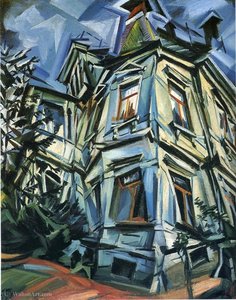
The years leading up to the First World War brought a profound shift in his vision. In 1912, he began creating what are often called his apocalyptic landscapes. These works featured chaotic scenes of urban life, with comets crossing skies like shells and buildings appearing on the verge of collapse. While some saw these images as predictions of the coming war, they were also reflections of the intense energy and social unrest present in the modern metropolis. His involvement with the Die Pathetiker group further solidified his place in the German expressionist movement.
Faith and Displacement
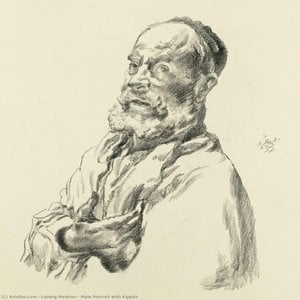
The devastation of the First World War changed Meidner deeply. Having served in the German military as an infantry soldier and a French interpreter, he emerged from the conflict with a different perspective on life and art. He turned toward Orthodox Judaism, finding a new source of meaning through religious themes. His work began to include portraits of prophets and scenes of Jewish ritual, such as his 1937 drawing, Blowing the Shofar. This period saw him moving away from pure expressionist chaos toward more structured, religious imagery that explored the inner experience of faith.
The rise of the Nazi party forced another period of movement and hardship. In 1935, Meidner moved to Cologne to teach at a Jewish school, but the increasing pressure in Germany became impossible to ignore. His work was included in the 1937 Degenerate Art exhibition in Munich, an event that marked him as a target of the regime. In August 1939, he and his wife, Else Meidner, fled to England. Life in London was difficult; he was interned at Huyton Camp and later on the Isle of Man. During these years of exile, he lived in near poverty, often relying on the support of the local Jewish community while continuing to draw and paint from his observations of the world around him.
A Return to Germany
After many years in England, Meidner chose to return to Germany in 1953. He settled in Frankfurt, a city that offered him both a sense of stability and a connection to his heritage. This later period of his life was marked by a renewed recognition within the German art scene. In 1964, he received the Order of Merit of the Federal Republic of Germany and became a member of the Berlin Academy of Fine Arts. His late works continued to reflect his lifelong engagement with both the physical world and the spiritual realm.
Meidner passed away in Darmstadt in 1966. His legacy remains visible in major institutions such as the Jewish Museum Frankfurt, the Museum of Modern Art in New York, and the Metropolitan Museum of Art. Through his varied roles as a painter, printmaker, and writer, he left behind a body of work that documented the turbulent transitions of the twentieth century.

Ludwig Meidner
1884 - 1966
Quick Facts
- Artistic Movement Or Style: Expressionism, Dada
- Artists Who Influenced This Artist:
- Amedeo Modigliani
- Rembrandt
- Full Name: Ludwig Meidner
- Nationality: German
- Notable Artworks:
- Blowing the Shofar
- Apocalyptic Landscapes
- The Bomb
- Street at Kreuzberg
- Place Of Birth: Bernstadt, Germany
- Date Of Birth: 1884
- Date Of Death: 1966