

- 50.0 x 35.0 cm


The picture follows your choices: , .
Collectible Description
Lucas Cranach’s ‘The Three Graces’ captures Renaissance beauty with ethereal figures and classical symbolism. This Northern Renaissance masterpiece, painted in 1535, offers a timeless depiction of feminine grace – discover this iconic artwork.
 Read More
Artist Biography
Explore the captivating world of Lucas Cranach the Elder, a pivotal German Renaissance master known for his portraits, Reformation art, and mythological scenes. Discover his legacy!
Hand Made Oil Reproduction
Hand-painted oil on canvas in your size and frame, made to order by our artists. ( Switch to Print Switch to Digital Image)
More about this painting
 Preview
 Send
Send Share
Share
 Details
 Guide
Guide

 Download
 Similars
 X-Ray
X-Ray Diaporama
 Q&A
Q&A Stats
StatsOrder your painting in four simple steps
Take your time. You can change any answer; the price in your order card follows each choice.
1 Step one of four
Which size would you like?
These sizes keep the proportions of the original painting. The drawing shows your choice on a wall, above a two-metre sofa.
Or give your own measurements
Pick from our preset sizes that match the artwork's original proportions.

Type the width and the height you need, to fit your frame or your wall. This is hand-painted, so for a size with a different shape the artist can paint a bit more around the picture, or cut a bit — you choose. We send you a digital mockup to approve before the painting starts. The picture shown on this page does not show the real result — only the mockup does.
2 Step two of four
How should it be prepared: rolled, stretched or framed?
The prices below are for the size you chose in step one.
Choose the edges of the stretched canvas
Choose your frame

White $1

Blurside $1

Extended $1

P118B $10

P118H $10

P118W $10

P438Z $10

P508JH $12

P508YH $12

P805H $10

P805Z $10

P919BZ $10

P919G $10

P919XJ $10

P959ZH $10

P968JZ $12

W106C $8

W218G $10

W218JH $8

W218Y $10

W307PJ $10

W316G $10

W316PJ $8

W316Y $10

W398PJ $8

W4111J $10

W500HY $15

W500JH $15

W692G $12

W849H $8

W940BG $15

W953PJ $8

H24-GOLD $30

H24-SILVER $30

H36-GOLD $45

H36-SILVER $45
Framed
Moulding: . Overall size with the frame: .
3 Step three of four
Would you like anything changed in the painting?
Most people answer no. Because each painting is made by hand, our artist can also adapt it for you.
After order, ArtsDot.com team will email client for instructions and provide a mockup preview
4 Step four of four
A few finishing options
All of them are optional. The answers already selected cost nothing extra.
Who paints it?
Worldwide Delivery () in 3/4 weeks instead of standard 5 weeks. (3 November). No compromise on quality.
A nameplate, as in a museum?
Engraved Bronze Plaque Details
This elegant plaque features the artist's name and the title of the artwork, finely engraved for a timeless presentation.
It is made from bronze with a refined, elegant finish. The text is precisely laser-engraved for a sharp and permanent result. Measuring 9x2 cm, the plaque is compact yet easy to read. It's built to be durable and scratch-resistant, offering a professional, museum-quality look. Mounting is simple thanks to the included adhesive backing.
Transparent Acrylic Plaque Details
The plaque includes essential engraved details such as the artist's name, the title of the artwork, the date it was created, the type of media used-like oil on canvas or watercolor-a brief description of the piece, and a QR code that links to the complete artwork information.
It is crafted from clear acrylic, offering a sleek, modern appearance. The text is UV-engraved in black to ensure strong visual contrast. With a size of 10x15 cm, it ensures optimal readability. It comes equipped with two metal hooks for secure wall mounting. The plaque is designed to be weather-resistant, making it suitable for various environments, and it includes interactive features that work seamlessly with smartphone scanning.
Black Acrylic Plaque Details
This elegant plaque includes engraved information such as the artist's name, the title of the artwork, the date it was created, the type of media used (like oil on canvas or watercolor), a short description of the artwork, and a QR code for quick access to more information.
The plaque itself is made from refined black acrylic with a premium finish. The text is laser-engraved in white for high contrast and readability. Its size is 10x15 cm, designed to be easy to read. It comes with two metal hooks for professional mounting. The design is sleek and fits any interior style. It is also weather-resistant and durable, with built-in digital integration for mobile compatibility.
A protective varnish?
When do you need it?
✓ Check and order
Your painting, as you ordered it

The Three Graces
Reproduction Medium
Reproduction Size
-

Elite Senior Artist
More detail, finesse, and extra production time
-

Reproduction Frame
-
-
For artworks or reproductions larger than 105 cm (approximately 41 inches) on any side, the frame will be shipped as a kit, disassembled. This method ensures safe delivery and prevents damage during transport.
Professional assembly required - this is not a DIY product.
The kit must be assembled and the canvas stretched by an experienced professional framer, using wood glue (not supplied), a canvas stretching plier and clamps to hold the bars square while the glue dries. Incorrect assembly or uneven canvas tension can permanently damage the artwork and is not covered by our warranty.
 For artworks or reproductions larger than 105 cm (approximately 41 inches) on any side, the frame will be shipped as a kit, disassembled. This method ensures safe delivery and prevents damage during transport.
All solid wood bars are included, precisely cut to size.
Assembled with the screws provided, plus wood glue for the corner joints, which is not supplied and must be sourced by your framer.
Professional tools are required and not included: a canvas stretching plier (tensioner) and clamps to hold the bars square while the glue dries.
Important:
The corner joints require wood glue, the bars must be held with clamps until the glue is fully dry, and tightening the canvas on the assembled frame requires a canvas stretching plier. None of these are included in the kit. Please arrange an experienced professional framer before ordering this size.

Nameplate
-
-

Protective Varnish
Glossy Varnish (enhances colors, protects against light/moisture)
-

Customize My Artwork
Examples of what can be changed: Replace face with customer photo; Add pet (e.g., replace cat with dog); Include hidden message in background; Change background landscape or elements.
-

Urgent
Worldwide Delivery () in 3/4 weeks instead of standard 5 weeks. (3 November). No compromise on quality.
-
Express Shipping
Worldwide Delivery () in 5 weeks. (10 November).
Included
Total Price
$ 263
Glass option is only available in size under 110 CM
Included with every order
- Free Worldwide Express Shipping
- High-Quality Linen Canvas
- Full Shipping Insurance
- Customs Tax Refund Guarantee
- True Color Matching Guarantee
- 100-Day Return Policy (Defects Only)
- 100% Money-Back Guarantee
- Bulk Discount Offer


The Three Graces by Lucas Cranach the Elder: A Renaissance Reverie
Lucas Cranach the Elder’s “The Three Graces” transcends mere depiction; it embodies the very spirit of Northern Renaissance artistry—a harmonious blend of classical ideals and humanist observation. Painted in 1535 during a period marked by religious upheaval, this masterpiece at the Nelson-Atkins Museum of Art stands as a testament to Cranach’s mastery of capturing beauty and conveying profound symbolic meaning.
Style and Influences: Cranach's work firmly establishes itself within the Northern Renaissance tradition. Drawing inspiration from Italian humanist thinkers like Leonardo da Vinci and Michelangelo, he skillfully integrates classical motifs—particularly those derived from Greek mythology—into his compositions. Unlike the opulent grandeur of Florentine art, Cranach’s aesthetic prioritizes restraint and elegance, favoring subtle tonal gradations and meticulous detail to illuminate the human form.
Painting Details and Technique: Executed in oil on panel, “The Three Graces” showcases Cranach's unparalleled technical prowess. The artist employs a pyramidal composition—a hallmark of Renaissance painting—to elevate the figures of Euphrosyne, Aglaea, and Thalia to a position of prominence. Delicate brushstrokes create an illusion of soft flesh tones and drapery folds, capturing the ethereal quality characteristic of Northern Renaissance art. Cranach’s meticulous attention to anatomical accuracy reflects his deep understanding of human anatomy, furthering enhancing the realism of the scene.
Symbolism: The painting's symbolism resonates deeply with humanist beliefs prevalent during Cranach’s time. The Graces—Euphrosyne (Joy), Aglaea (Splendor), and Thalia (Youth)—represent virtues associated with feminine beauty, grace, and prosperity. Their poses are deliberately reminiscent of sculptures by Praxiteles, emphasizing the ideal human form and celebrating divine harmony. The black background serves to heighten the luminosity of the nude figures, directing the viewer’s gaze towards their serene expressions and idealized postures.
Historical Context: Created amidst the Protestant Reformation, “The Three Graces” reflects a renewed interest in classical art as a counterbalance to medieval religious dogma. Cranach's patrons—including Frederick III of Saxony—embraced humanist ideals, fostering an environment conducive to artistic innovation. This painting exemplifies the Renaissance’s commitment to portraying human beauty and virtue with dignity and grace – values that continue to inspire artists and collectors today.
Availability: Explore a stunning reproduction of “The Three Graces” at ArtsDot.com, where you can acquire a high-quality print that captures the essence of this iconic Renaissance artwork.
Questions & Answers
How can I view "The Three Graces" by Lucas Cranach the Elder as a slideshow?
The diaporama of "The Three Graces" can be watched on the artwork's Diaporama page.
Who made "The Three Graces", and when?
Lucas Cranach the Elder made "The Three Graces" in 1535.
Does "The Three Graces" show strong light-dark contrasts?
The light-dark contrast of "The Three Graces" is recorded as statement. Contrast describes how strongly light and dark areas differ.
Related Artworks


Lucas Cranach the Elder
1472 - 1553, Germany
Artist Biography
A Renaissance Master of Saxony: The Life and Art of Lucas Cranach the Elder
Lucas Cranach the Elder, born in Kronach, Germany around 1472, stands as a pivotal figure of the German Renaissance. His life unfolded during a period of immense religious and political upheaval, and his art became inextricably linked to both the burgeoning Protestant Reformation and the opulent courts he served. Initially trained by his father, Hans Maler, Cranach’s early artistic development remains somewhat shrouded in mystery, though influences from South German masters are evident in his evolving style. He quickly distinguished himself not merely as a skilled craftsman but as an artist capable of capturing psychological depth alongside technical precision – qualities that would soon draw the attention of powerful patrons. In 1504, he entered the service of Frederick III, Elector of Saxony, a relationship that would define much of his career and provide him with both stability and access to influential circles. This appointment as court painter in Wittenberg wasn’t simply about producing decorative works; it placed Cranach at the very heart of one of the most transformative movements in European history.Patronage, Reformation, and Artistic Innovation
Cranach's position within the Saxon court proved crucial not only for his livelihood but also for his artistic development. He wasn’t merely documenting events; he was actively shaping visual narratives during a time of profound change. His most enduring legacy is arguably his close association with Martin Luther, the central figure of the Protestant Reformation. Cranach created no fewer than eleven portraits of Luther, each offering a unique glimpse into the reformer's personality and evolving role. These weren’t simply likenesses; they were carefully constructed images designed to project authority, piety, and intellectual strength – essential qualities for a leader challenging the established religious order. Beyond portraiture, Cranach translated Reformation theology into visual form, producing woodcuts and paintings that disseminated Protestant ideas widely. His depictions of biblical scenes moved away from traditional Catholic iconography, emphasizing direct engagement with scripture and fostering a more personal relationship between the viewer and faith. The Annunciation to Joachim, for example, radiates a joyful spirit, reflecting the new emphasis on individual piety within the reformed church. This innovative approach extended beyond religious subjects; Cranach’s mythological paintings, such as depictions of Venus and other classical figures, often carried allegorical meanings relevant to contemporary political and social issues.A Workshop Dynasty: Style and Technique
Lucas Cranach the Elder was not a solitary artist working in isolation. He ran a remarkably productive workshop, employing numerous assistants and apprentices who contributed significantly to his output. This collaborative approach meant that many works attributed to Cranach were actually produced under his direction or by members of his circle – including his son, Lucas Cranach the Younger. The Cranach workshop became known for its distinctive style: elegant figures with elongated proportions, vibrant colors, and meticulous attention to detail. His technique involved a combination of oil painting, woodcut, and engraving, allowing him to reach a broad audience through both original artworks and affordable prints. Stag Hunt of Elector Friedrich III the Wise, exemplifies his mastery of Northern Renaissance style, showcasing detailed realism alongside noble symbolism. The composition is dynamic, capturing the energy of the hunt while simultaneously conveying the power and status of the elector. Cranach’s use of light and shadow creates a sense of depth and atmosphere, drawing the viewer into the scene. His portraits are equally compelling, characterized by their psychological insight and refined execution.Legacy and Enduring Influence
Lucas Cranach the Elder died in 1553, leaving behind an extraordinary artistic legacy that continues to resonate today. He was a master of portraiture, a skilled interpreter of religious themes, and a shrewd businessman who understood the power of visual communication. His work not only reflects the cultural and intellectual currents of his time but also helped shape them. The Cranach workshop continued to flourish after his death, ensuring that his style and techniques were perpetuated for generations. His influence can be seen in the works of numerous subsequent artists, and his paintings remain highly sought-after by collectors and museums worldwide. From the iconic portraits of Martin Luther to the captivating mythological scenes, Cranach’s art offers a fascinating window into the world of the German Renaissance – a world marked by both profound spiritual questioning and artistic innovation. His ability to blend religious fervor, political savvy, and artistic talent cemented his place as one of the most important artists of his era, and his contributions continue to inspire and captivate audiences centuries later.


Related Articles

Echoes of Time: Exploring the Enduring Appeal & Historical Context of Vintage Art Prints
Explore the captivating world of vintage art prints! Discover their history, collecting tips & enduring appeal. Expert insights on chromolithography and building a legacy collection with ArtsDot.

Lucas van Leyden: Innovation & Intimacy in Early Netherlandish Printmaking
Explore the groundbreaking prints of Lucas van Leyden, a Dutch master bridging Gothic detail & Renaissance innovation. Discover his rare works, investment potential, and legacy for discerning collectors.
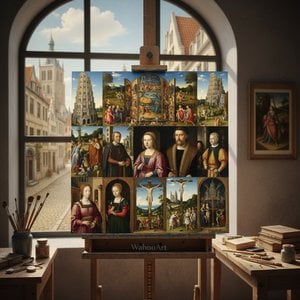
Northern Renaissance Masters: 10 Artworks That Shaped History |
Journey through the Northern Renaissance! Explore 10 iconic paintings by Jan van Eyck, Dürer & Bosch. Discover their stories, techniques & lasting impact. Find museum-quality art reproductions & elevate your home decor on .