

 Preview
 Send
Send Share
Share
 Details
 Guide
Guide

 Download
 Similars
 X-Ray
X-Ray Diaporama
 Q&A
Q&A Stats
StatsUntitled

- 42.0 x 28.0 cm


 Read More
The artwork displayed on this page is protected by copyright law, which means we cannot legally create or sell an identical reproduction. This protection is enforced under international agreements such as the Berne Convention and by national laws, including those outlined by the U.S. Copyright Law - Title 17.
This method fully complies with copyright regulations because it does not involve copying or duplicating the protected artwork. Instead, it is a creative reinterpretation - a new painting that is influenced by the original but not identical to it.
Giclée / Art Print
Museum-quality giclée or canvas print with fast production and flexible finish options. ( Buy Hand Made Painting Switch to Digital Image)




































Pick from our preset sizes that match the artwork's original proportions.

Type the width and the height you need, to fit your frame or your wall. A print can only be cut, never made bigger than the picture, so a size with a different shape loses a part of the image. We send you a digital mockup to approve before we print anything. The picture shown on this page does not show the real cut — only the mockup does.
Worldwide Delivery () in 2 weeks instead of standard 4/5 weeks. (10 November)

Free Worldwide Express Shipping

High-Quality Linen Canvas

Full Shipping Insurance

Customs Tax Refund Guarantee

True Color Matching Guarantee

100-Day Return Policy (Defects Only)

100% Money-Back Guarantee

Bulk Discount Offer
 Glass option is only available in size under 110 CM

Untitled
Giclée / Art Print
Reproduction Size
-


Total Price
$ 63
Questions & Answers
What is the overall mood of "Untitled" by Kim Whan-Ki?
"Untitled" has a serene atmosphere.
Is "Untitled" by Kim Whan-Ki a bright or a dark artwork?
In terms of perceived brightness, "Untitled" by Kim Whan-Ki is brilliant.
What subjects appear in "Untitled" by Kim Whan-Ki?
The themes present in "Untitled" by Kim Whan-Ki include abstract, birds, nature, sky, ocean, minimalism, korean art. Together they summarize the artwork's subject matter.
Related Artworks


Artist Biography
A Pioneer of Korean Abstraction
Kim Whanki stands as a monumental figure in the landscape of twentieth-century modernism, recognized as a pioneering abstract artist and a cornerstone of the first generation of Korean abstract painters. His life was a nomadic journey through some of the world's most vibrant cultural hubs, including Tokyo, Japan; Seoul and Busan, Korea; Paris, France; and New York City, USA. This peripatetic existence allowed him to absorb the energetic currents of global modernism while maintaining a profound connection to his Korean heritage. Through this unique synthesis, he developed a characteristic art world that blended Oriental concepts and ideals with the formal rigor of Western abstraction.
The evolution of his style is a captivating narrative of artistic transformation. In his earlier periods, particularly during his studies in Paris, Kim utilized a more semi-abstract language. He sought to express a distinct Korean sentiment and sense of beauty by selecting natural and traditional subjects such as mountains, rivers, the moon, cranes, Japanese apricots, and moon jars. These works often featured simple, stylized lines and shapes that captured the essence of the natural world through an understated, lyrical lens.
The Symphony of Color and Form
As his career progressed, Kim's work underwent a deep metamorphosis, moving from geometric abstraction toward more deeply absorbed abstract paintings. He became masterfully adept at using diverse hues and patterns to create a meditative realm for the viewer. His later masterpieces are often celebrated for their use of dot painting and monochrome compositions, where the boundaries between the physical canvas and the infinite cosmos seem to dissolve.
One of his most evocative techniques involved the sophisticated layering of blues, creating atmospheric depths reminiscent of a twilight ocean or a star-strewn night sky. This mastery of color allowed him to bridge the gap between the organic world and structured intellect. His work often presents a mesmerizing field of deep, atmospheric tones, where geometric motifs suggest celestial fragments suspended in an eternal moment. This rhythmic dance of light and shadow captures the very soul of abstraction, reflecting his ability to balance Korean values with foreign techniques.
Legacy and Historical Significance
Kim Whanki's impact on the history of art is profound, particularly as a godfather of the Dansaekhwa movement. His ability to incorporate new, global techniques while keeping Korean identity at the heart of his practice reflects the complex political and social conditions of the mid-1900s. He successfully created a refined and moderated formative expression based on Korean Lyricism, leaving behind a legacy that continues to resonate in the international art community.
His enduring influence is preserved through various institutions and foundations dedicated to his memory, ensuring that his contribution to both Korean and global modernism remains a vital part of the artistic conversation. His life's work remains a breathtaking testament to a journey spent chasing the very essence of form, color, and spirit.

Kim Whan-Ki
1913 - 1974 , South Korea
Quick Facts
- Artistic Movement Or Style: Abstract art, Korean Lyricism
- Artists Or Movements Influenced By This Artist: ['Dansaekhwa movement']
- Full Name: Kim Whanki
- Nationality: Korean
- Notable Artworks:
- Work 20-V-74
- Heaven and Earth (24-IX-73#320)
- Untitled
- Place Of Birth: Gijewa, South Korea
- Date Of Birth: 1913
- Date Of Death: 1974
Related Articles

Slate Blue Masterpieces: 10 Iconic Paintings & Timeless Home Decor Ideas
Immerse yourself in the captivating world of slate blue! Explore 10 iconic paintings by Monet, Van Gogh & Renoir. Discover their stories, techniques & find museum-quality art reproductions for your home at .
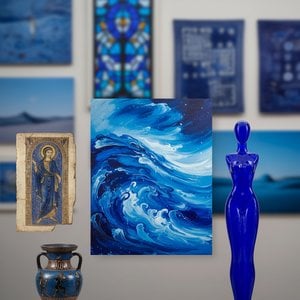
The Allure of Azure: Exploring the Symbolic & Aesthetic Depths of Blue in Art History
Explore the rich history of blue in art! Discover its symbolism, from ancient pigments to modern masterpieces by Kandinsky & Seurat. Uncover the psychological impact and cultural meanings behind this captivating hue.

Mastering Abstraction: The 25 Most Iconic Works by Wassily Kandinsky
Explore 25 iconic Kandinsky masterpieces and the birth of abstraction. Discover the full collection online at ArtsDot.com.

Abstract Expressionism's 10 Defining Masterpieces |
Explore 10 defining Abstract Expressionism masterpieces by Pollock, Rothko & de Kooning. Discover the stories behind these iconic paintings and find museum-quality art reproductions to elevate your home decor on .

Geometric Abstraction's 10 Defining Masterpieces | Art for Your Home - ArtsDot
Explore 10 defining masterpieces of Geometric Abstraction! Discover Kandinsky, Mondrian & Malevich’s iconic works. Find museum-quality art reproductions and curated decor ideas to elevate your home at ArtsDot.com.


