Preview
 Send
Send Share
Share
 Details
 Guide
Guide

 Download
 Similars
 X-Ray
X-Ray Diaporama
 Q&A
Q&A Stats
StatsOkitsu

 Read More
Giclée / Art Print
Museum-quality giclée or canvas print with fast production and flexible finish options. ( Buy Hand Made Painting Switch to Digital Image)




P118B $10

P118H $10

P118W $10

P438Z $10

P508JH $12

P508YH $12

P805H $10

P805Z $10

P919BZ $10

P919G $10

P919XJ $10

P959ZH $10

P968JZ $12

W106C $8

W218G $10

W218JH $8

W218Y $10

W307PJ $10

W316G $10

W316PJ $8

W316Y $10

W398PJ $8

W4111J $10

W500HY $15

W500JH $15

W692G $12

W849H $8

W940BG $15

W953PJ $8




Pick from our preset sizes that match the artwork's original proportions.

Type the width and the height you need, to fit your frame or your wall. A print can only be cut, never made bigger than the picture, so a size with a different shape loses a part of the image. We send you a digital mockup to approve before we print anything. The picture shown on this page does not show the real cut — only the mockup does.
Worldwide Delivery () in 2 weeks instead of standard 4/5 weeks. (15 November)

Free Worldwide Express Shipping

High-Quality Linen Canvas

Full Shipping Insurance

Customs Tax Refund Guarantee

True Color Matching Guarantee

100-Day Return Policy (Defects Only)

100% Money-Back Guarantee

Bulk Discount Offer
 Glass option is only available in size under 110 CM

Okitsu
Giclée / Art Print
Reproduction Size
-


Total Price
$ 63
A Silent Testament to Mortality: Exploring Katsushika Hokusai’s *Okitsu*
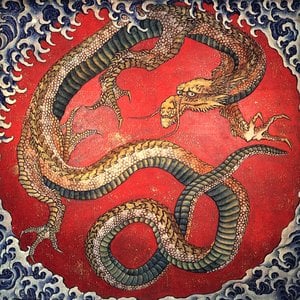
The painting, tentatively titled *Okitsu*, presents a stark and unsettling tableau—a solitary fish sprawled upon the seabed, its exposed viscera illuminated by an unseen light. While seemingly simple in composition, this monochrome depiction encapsulates profound themes of decay, vulnerability, and the inevitable passage of time, firmly anchoring itself within the artistic landscape of Edo-period Japan. Its creator, Katsushika Hokusai (1760–1849), a titan amongst printmakers and arguably Japan’s most celebrated artist, transcends mere representation; he crafts an experience for the viewer that lingers long after initial observation.- Subject Matter & Composition: The focal point is undeniably the fish itself—a creature rendered with meticulous detail despite its lifeless state. Its positioning on its side emphasizes its vulnerability and underscores the artist’s deliberate choice to confront mortality head-on. Surrounding it are scattered fish, subtly hinting at a broader ecosystem grappling with similar forces of decline.
- Style & Technique: Hokusai's signature style—characterized by bold outlines and expressive brushstrokes—is evident throughout *Okitsu*. The artist employs a masterful use of black ink on paper, utilizing varying densities to create tonal gradations that convey texture and depth. This technique is particularly adept at capturing the subtle nuances of light and shadow, enhancing the painting’s dramatic impact.
- Emotional Impact: *Okitsu* evokes a palpable sense of melancholy and contemplation. The artist's unflinching portrayal of death compels viewers to confront their own mortality, fostering introspection and prompting reflection on the beauty inherent in accepting the inevitable end. It’s a piece that transcends time, offering solace and inspiration to those who appreciate its profound artistic merit.
Questions & Answers
Is "Okitsu" by Katsushika Hokusai a portrait, landscape or square composition?
The format of "Okitsu" is landscape. This is useful when planning where a reproduction will be placed.
What mood and emotion does "Okitsu" by Katsushika Hokusai express?
"Okitsu" by Katsushika Hokusai conveys a melancholic feeling within an overall dramatic mood.
What emotion does "Okitsu" by Katsushika Hokusai convey?
"Okitsu" by Katsushika Hokusai conveys a melancholic emotional tone.
Related Artworks


Artist Biography
The Restless Pursuit of the Floating World
In the bustling streets of Edo, the son of a mirror maker begins to draw. By the age of six, the boy is already sketching, driven by a hunger that his father, Nakajima Ise, recognizes but cannot fully direct. This is not a life of comfort. It is a steady, gritty climb through the social strata of the Tokugawa shogunate. By twelve, he enters the studio of Katsukawa Shunshō, learning the demanding precision of ukiyo-e woodblock printing. He is not there to mimic his master. Instead, he absorbs the techniques of the "floating world"—the depictions of actors and courtesans—and begins to pull at the threads of the genre, seeking something more expansive.
His career is a series of reinventions. He changes his name over thirty times, a practice that marks his shifting affiliations and his refusal to remain static. He moves from illustrating books to the creation of single-sheet prints, a transition that allows his vision to expand. He is a man of constant movement, a restless spirit who views art as a lifelong evolution rather than a destination.
The Geometry of Nature
The focus shifts. The urban scenes of Edo give way to the immense scale of the natural landscape. Around 1831, the series Thirty-six Views of Mount Fuji emerges, fundamentally altering the scope of Japanese printmaking. In The Great Wave off Kanagawa, the ocean is a towering, claw-like force, a study in tension and perspective that captures the terrifying power of the sea against the fragility of human vessels. This is not merely a landscape; it is a confrontation with the sublime. He uses Prussian blue, a pigment imported from Europe, to lend a new depth to the water and the sky, creating a visual language that feels both ancient and startlingly modern.
His observations extend beyond the grand to the minute. The Hokusai Manga collections reveal a mind obsessed with the mechanics of life. He sketches everything: the curve of an animal's spine, the frantic movement of a crowd, the strange anatomy of mythical creatures. His line is bold and decisive. He captures the ephemeral—the spray of a wave, the sudden movement of a traveler—with a precision that bridges the gap between the seen and the felt.
A Global Resonance
As Japan opens its borders in the late 19th century, his influence travels across the oceans. The phenomenon of Japonisme takes hold in Europe. His compositions, characterized by unconventional perspectives and flattened planes, reach the eyes of Claude Monet and Vincent van Gogh. They see in his work a way to break from traditional Western realism. The impact is profound. His ability to find meaning in the everyday and the monumental alike leaves a permanent mark on the trajectory of modern art.
He remains a student until the end. Even in his eighties, he refers to himself as Gakyō Rōjin, the "Old Man Crazy to Paint." He dies in 1849, leaving behind a vast body of work that spans nearly nine decades of constant experimentation. He did not just document the world; he reconfigured how the world is seen.

Katsushika Hokusai
1760 - 1849 , Japan
Quick Facts
- Artistic Movement Or Style: Ukiyo-e
- Artists Or Movements Influenced By This Artist:
- Claude Monet
- Edgar Degas
- Vincent van Gogh
- Japonisme
- Full Name: Katsushika Hokusai
- Nationality: Japanese
- Notable Artworks:
- The Great Wave off Kanagawa
- Thirty-six Views of Mount Fuji
- Place Of Birth: Tokyo, Japan
- Date Of Birth: 1760
- Date Of Death: 1849
Related Articles
Mars Black Masterpieces: 10 Iconic Paintings & Timeless Art Decor Ideas
Delve into the power of 'Mars Black' with 10 iconic paintings by masters like Rembrandt & Caravaggio. Explore dramatic chiaroscuro, gothic art, and timeless beauty. Find museum-quality reproductions & elevate your home decor on .

White on Canvas: 10 Masterpieces & Timeless Elegance for Your Home Decor
Explore 10 iconic white paintings by Monet, Whistler & Rothko! Discover the stories behind these serene masterpieces and their impact on art history. Find museum-quality reproductions for your home decor at .

Whistler's Masterpieces: Explore 25 Iconic Paintings & Aesthetic Art for Your Home
Journey through 25 iconic James Abbott McNeill Whistler paintings! Explore his masterpieces of Aestheticism, from 'Nocturne in Black and Gold' to captivating portraits. Find museum-quality art reproductions & elevate your home decor with ArtsDot.com. Discover the full collection online.

Masterpieces of the Floating World: Top 25 Katsushika Hokusai Artworks
Explore 25 iconic Hokusai masterpieces, from The Great Wave to Fuji views. Discover the soul of ukiyo-e on ArtsDot.com.

Dark Masterpieces: 10 Iconic Paintings Dominated by Black Tones |
Explore 10 iconic paintings dominated by black tones, from Rembrandt’s chiaroscuro to Goya's dark expressions. Discover the stories behind these masterpieces & find museum-quality art reproductions for your home at .