


The picture follows your choices: , .
Collectible Description
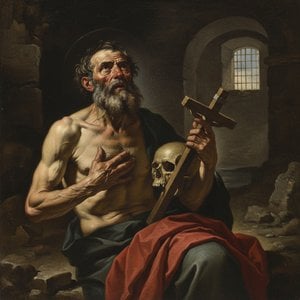
This Baroque oil painting by Jusepe de Ribera depicts Saint Jerome in contemplation. Discover the beauty of this masterpiece today.
 Read More
Artist Biography
Explore the dramatic Baroque paintings of Jusepe de Ribera (Lo Spagnoletto)! Master of tenebrism & intense realism, famed for powerful religious scenes & martyrdoms. A key Spanish artist alongside Velázquez & Zurbarán.
Hand Made Oil Reproduction
Hand-painted oil on canvas in your size and frame, made to order by our artists. ( Switch to Print Switch to Digital Image)
More about this painting
 Preview
 Send
Send Share
Share
 Details
 Guide
Guide

 Download
 Similars
 X-Ray
X-Ray Diaporama
 Q&A
Q&A Stats
StatsOrder your painting in four simple steps
Take your time. You can change any answer; the price in your order card follows each choice.
1 Step one of four
Which size would you like?
These sizes keep the proportions of the original painting. The drawing shows your choice on a wall, above a two-metre sofa.
Or give your own measurements
Pick from our preset sizes that match the artwork's original proportions.

Type the width and the height you need, to fit your frame or your wall. This is hand-painted, so for a size with a different shape the artist can paint a bit more around the picture, or cut a bit — you choose. We send you a digital mockup to approve before the painting starts. The picture shown on this page does not show the real result — only the mockup does.
2 Step two of four
How should it be prepared: rolled, stretched or framed?
The prices below are for the size you chose in step one.
Choose the edges of the stretched canvas
Choose your frame

White $1

Blurside $1

Extended $1

P118B $10

P118H $10

P118W $10

P438Z $10

P508JH $12

P508YH $12

P805H $10

P805Z $10

P919BZ $10

P919G $10

P919XJ $10

P959ZH $10

P968JZ $12

W106C $8

W218G $10

W218JH $8

W218Y $10

W307PJ $10

W316G $10

W316PJ $8

W316Y $10

W398PJ $8

W4111J $10

W500HY $15

W500JH $15

W692G $12

W849H $8

W940BG $15

W953PJ $8

H24-GOLD $30

H24-SILVER $30

H36-GOLD $45

H36-SILVER $45
Framed
Moulding: . Overall size with the frame: .
3 Step three of four
Would you like anything changed in the painting?
Most people answer no. Because each painting is made by hand, our artist can also adapt it for you.
After order, ArtsDot.com team will email client for instructions and provide a mockup preview
4 Step four of four
A few finishing options
All of them are optional. The answers already selected cost nothing extra.
Who paints it?
Worldwide Delivery () in 3/4 weeks instead of standard 5 weeks. (14 November). No compromise on quality.
A nameplate, as in a museum?
Engraved Bronze Plaque Details
This elegant plaque features the artist's name and the title of the artwork, finely engraved for a timeless presentation.
It is made from bronze with a refined, elegant finish. The text is precisely laser-engraved for a sharp and permanent result. Measuring 9x2 cm, the plaque is compact yet easy to read. It's built to be durable and scratch-resistant, offering a professional, museum-quality look. Mounting is simple thanks to the included adhesive backing.
Transparent Acrylic Plaque Details
The plaque includes essential engraved details such as the artist's name, the title of the artwork, the date it was created, the type of media used-like oil on canvas or watercolor-a brief description of the piece, and a QR code that links to the complete artwork information.
It is crafted from clear acrylic, offering a sleek, modern appearance. The text is UV-engraved in black to ensure strong visual contrast. With a size of 10x15 cm, it ensures optimal readability. It comes equipped with two metal hooks for secure wall mounting. The plaque is designed to be weather-resistant, making it suitable for various environments, and it includes interactive features that work seamlessly with smartphone scanning.
Black Acrylic Plaque Details
This elegant plaque includes engraved information such as the artist's name, the title of the artwork, the date it was created, the type of media used (like oil on canvas or watercolor), a short description of the artwork, and a QR code for quick access to more information.
The plaque itself is made from refined black acrylic with a premium finish. The text is laser-engraved in white for high contrast and readability. Its size is 10x15 cm, designed to be easy to read. It comes with two metal hooks for professional mounting. The design is sleek and fits any interior style. It is also weather-resistant and durable, with built-in digital integration for mobile compatibility.
A protective varnish?
When do you need it?
✓ Check and order
Your painting, as you ordered it

San Jerónimo
Reproduction Medium
Reproduction Size
-

Elite Senior Artist
More detail, finesse, and extra production time
-

Reproduction Frame
-
-
For artworks or reproductions larger than 105 cm (approximately 41 inches) on any side, the frame will be shipped as a kit, disassembled. This method ensures safe delivery and prevents damage during transport.
Professional assembly required - this is not a DIY product.
The kit must be assembled and the canvas stretched by an experienced professional framer, using wood glue (not supplied), a canvas stretching plier and clamps to hold the bars square while the glue dries. Incorrect assembly or uneven canvas tension can permanently damage the artwork and is not covered by our warranty.
 For artworks or reproductions larger than 105 cm (approximately 41 inches) on any side, the frame will be shipped as a kit, disassembled. This method ensures safe delivery and prevents damage during transport.
All solid wood bars are included, precisely cut to size.
Assembled with the screws provided, plus wood glue for the corner joints, which is not supplied and must be sourced by your framer.
Professional tools are required and not included: a canvas stretching plier (tensioner) and clamps to hold the bars square while the glue dries.
Important:
The corner joints require wood glue, the bars must be held with clamps until the glue is fully dry, and tightening the canvas on the assembled frame requires a canvas stretching plier. None of these are included in the kit. Please arrange an experienced professional framer before ordering this size.

Nameplate
-
-

Protective Varnish
Glossy Varnish (enhances colors, protects against light/moisture)
-

Customize My Artwork
Examples of what can be changed: Replace face with customer photo; Add pet (e.g., replace cat with dog); Include hidden message in background; Change background landscape or elements.
-

Urgent
Worldwide Delivery () in 3/4 weeks instead of standard 5 weeks. (14 November). No compromise on quality.
-
Express Shipping
Worldwide Delivery () in 5 weeks. (21 November).
Included
Total Price
$ 263
Glass option is only available in size under 110 CM
Included with every order
- Free Worldwide Express Shipping
- High-Quality Linen Canvas
- Full Shipping Insurance
- Customs Tax Refund Guarantee
- True Color Matching Guarantee
- 100-Day Return Policy (Defects Only)
- 100% Money-Back Guarantee
- Bulk Discount Offer


Identification of San Jerónimo by Jusepe de Ribera
San Jerónimo, executed by Jusepe de Ribera in 1651, presents the biblical figure in the advanced stages of old age. The subject is rendered from the waist up in profile, captured during the act of composing Latin translations of the Bible. This specific portrayal focuses on the intellectual and scholarly labor of the saint.
The work belongs to the Baroque period. Ribera’s approach to the subject emphasizes the physical realities of aging and the intense concentration required for his scriptural work. The composition centers on the saint's engagement with his text, highlighting the intersection of religious devotion and academic rigor.
Composition and Visual Elements of the Work
The figure is rendered from the waist up in profile. A gaze fixed on the viewer creates a direct connection between the subject and the observer. This positioning emphasizes the psychological presence of the saint, capturing a moment of intense contemplation. The composition relies on the starkness of the subject's posture to command attention within the frame.
The artist includes a signature and date within the left hand of the figure. This detail integrates the documentation of the work directly into the physical presence of the saint. The arrangement of the body and the placement of the hands contribute to a sense of stillness and focused intent.
Technical Details and Artistic Medium
Executed in the Baroque style, this work utilizes oil on canvas to achieve its specific tonal qualities. The application of the oil technique allows for the precise rendering of textures and the dramatic interplay of light and shadow characteristic of the period. The physical dimensions of the piece measure 125 cm by 100 cm.
The artist's approach emphasizes a controlled use of pigment to define form and depth. Through the layering of oil, the composition achieves a sense of physical presence and structural clarity. The medium supports the intense focus required to depict the subject's features and the heavy folds of the drapery.
Current Location and Museum Collection
The work is held within the Museo Nacional de San Martino in Naples, Italy. It remains part of the permanent collection of this institution, preserved as a significant example of the artist's output during his time in the Neapolitan art world.
The painting was commissioned as part of a series of works for the Carthusian monastery of San Martino. This specific piece was one of several intended for the private quarters of the prior. The museum maintains the work within its curated holdings, ensuring its continued presence in the historical context of Naples.
Questions & Answers
Does "San Jerónimo" have an augmented reality preview?
"San Jerónimo" by Jusepe de Ribera can be previewed on your own wall with the artwork's AR Preview page, using augmented reality on a compatible device.
How does "San Jerónimo" fit into Jusepe de Ribera's themes and style?
Within Jusepe de Ribera's output, "San Jerónimo" sits in the Baroque style, alongside the themes of caravaggio and guido reni, baroque religious art, spiritual contemplation, major neapolitan commission, spanish baroque tradition.
What is "San Jerónimo" made with?
The medium of "San Jerónimo" by Jusepe de Ribera is oil on canvas. Reproductions aim to render the appearance of this technique.
Related Artworks


Jusepe de Ribera
1591 - 1652, Spain
Artist Biography
A Life Forged in Shadow and Light
Jusepe de Ribera, known to many as Lo Spagnoletto – “the Little Spaniard” – was a towering figure of the Baroque era, an artist whose canvases pulsed with dramatic intensity and unflinching realism. Born in Xàtiva, Spain, in 1591, his journey took him far from his Valencian origins, ultimately establishing him as one of the most significant painters in 17th-century Naples, a city then under Spanish rule. Ribera’s life was not merely a chronicle of artistic development; it was a narrative woven with hardship, ambition, and an unwavering commitment to portraying the human condition in all its raw complexity. While early biographical details remain shrouded in some mystery, we know he arrived in Italy around 1607, initially settling in Rome before gravitating towards Naples in 1616 – a city that would become both his artistic home and the crucible for his unique style. His marriage to Caterina Azzolino, daughter of a local painter, further cemented his ties to the Neapolitan art world, allowing him to flourish within its vibrant, yet often turbulent, atmosphere.The Embrace of Tenebrism and Realist Vision
Ribera’s artistic formation was profoundly shaped by the prevailing currents of Italian painting. The influence of Caravaggio is undeniable; Ribera absorbed the master's revolutionary use of tenebrism – that dramatic interplay of light and shadow – to create scenes charged with emotional power. However, he didn’t simply imitate. He synthesized this technique with elements gleaned from other masters like Guido Reni, incorporating a classical sensibility into his compositions while retaining the visceral impact of Caravaggio's realism. This fusion resulted in a style uniquely his own: one characterized by stark contrasts, intensely focused figures, and an almost brutal honesty in depicting human suffering and spiritual ecstasy. His early works, such as the Martyrdom of Saint Bartholomew, exemplify this approach – a harrowing depiction of pain rendered with unflinching detail. He didn’t shy away from portraying the physical realities of martyrdom, the contorted bodies, the strained muscles, the very texture of skin and bone. This commitment to realism extended beyond religious subjects; his portraits of beggars and common folk, often depicted as philosophers or saints, were groundbreaking in their time, elevating the marginalized to a level of dignity and importance rarely seen in art before.A Career Across Genres and Evolving Styles
Ribera’s artistic output was remarkably diverse. While he is perhaps best known for his religious paintings – scenes of martyrdom, depictions of saints, and dramatic biblical narratives – he also excelled in portraiture, still life, and even landscape painting. His Saint Jerome and the Angel, for instance, showcases a softer, more contemplative side to his artistry, while still retaining the characteristic dramatic lighting that defines his work. Throughout his career, Ribera’s style underwent subtle but significant evolutions. His earlier paintings are marked by an almost austere realism and a stark use of tenebrism. As he matured, particularly after establishing himself firmly in Naples, his palette became richer, his compositions more complex, and his lighting somewhat softened. However, the core elements of his Baroque aesthetic – the emotional intensity, the dramatic narratives, and the unwavering commitment to portraying human experience with honesty – remained constant. He was a master craftsman, capable of rendering textures with astonishing precision, from the rough fabric of a beggar’s cloak to the smooth skin of a youthful saint.Legacy and Lasting Influence
Jusepe de Ribera's impact on the art world extended far beyond his Neapolitan workshop. He became a pivotal figure in Spanish Baroque painting, alongside masters like Velázquez, Zurbarán, and Murillo. His innovative use of tenebrism and his unflinching realism influenced generations of artists throughout Europe. His work resonated with those seeking to break away from the idealized forms of Renaissance art and embrace a more visceral, emotionally charged style. Even later artists drew inspiration from his dramatic compositions and powerful depictions of human suffering. Today, Ribera’s paintings are housed in prestigious museums around the world – the Museo del Prado in Madrid, the National Gallery of Art in Washington D.C., and numerous institutions across Europe – ensuring that his legacy continues to inspire and captivate audiences centuries after his death in 1652. He stands as a testament to the power of art to confront difficult truths, explore the depths of human emotion, and illuminate the enduring spirit of faith and resilience.A Master’s Enduring Appeal
The continued fascination with Ribera's work lies in its ability to transcend time and cultural boundaries. His paintings are not merely historical artifacts; they are powerful statements about the human condition – about suffering, faith, hope, and despair. His unflinching realism forces us to confront uncomfortable truths, while his dramatic compositions and masterful use of light and shadow create an atmosphere of intense emotional resonance. Lo Spagnoletto, as he was affectionately known, left behind a body of work that is both profoundly moving and intellectually stimulating – a legacy that ensures his place among the greatest masters of the Baroque era. His paintings are not simply to be admired; they are to be experienced—felt in the depths of one’s being.


Related Articles

25 Masterpieces by Francisco de Zurbarán: The King of Spanish Baroque Tenebrism
Immerse yourself in the dramatic world of Francisco de Zurbarán. Explore 25 iconic Spanish Baroque masterpieces defined by intense tenebrism and spiritual realism. Find inspiration for museum-quality art reproductions and decor. Discover all masterpieces on ArtsDot.com.
Jusepe de Ribera: Dramatic Realism & Spiritual Intensity in the Spanish Golden Age
Explore the powerful Baroque paintings of Jusepe de Ribera, master of tenebrism and dramatic realism. Discover his spiritual intensity, influence on Spanish art, and considerations for collectors. Expert insights at ArtsDot.

Masterpieces of Il Furioso: The Top 25 Artworks by Jacopo Tintoretto
Explore 25 iconic Tintoretto masterpieces of Venetian Mannerism. Discover the genius of Il Furioso at ArtsDot.com.