

 Preview
 Send
Send Share
Share
 Details
 Guide
Guide

 Download
 Similars
 X-Ray
X-Ray Diaporama
 Q&A
Q&A Stats
StatsGrapes

- 47.0 x 55.0 cm


 Read More
Giclée / Art Print
Museum-quality giclée or canvas print with fast production and flexible finish options. ( Buy Hand Made Painting Switch to Digital Image)




P118B $10

P118H $10

P118W $10

P438Z $10

P508JH $12

P508YH $12

P805H $10

P805Z $10

P919BZ $10

P919G $10

P919XJ $10

P959ZH $10

P968JZ $12

W106C $8

W218G $10

W218JH $8

W218Y $10

W307PJ $10

W316G $10

W316PJ $8

W316Y $10

W398PJ $8

W4111J $10

W500HY $15

W500JH $15

W692G $12

W849H $8

W940BG $15

W953PJ $8




Pick from our preset sizes that match the artwork's original proportions.

Type the width and the height you need, to fit your frame or your wall. A print can only be cut, never made bigger than the picture, so a size with a different shape loses a part of the image. We send you a digital mockup to approve before we print anything. The picture shown on this page does not show the real cut — only the mockup does.
Worldwide Delivery () in 2 weeks instead of standard 4/5 weeks. (6 November)

Free Worldwide Express Shipping

High-Quality Linen Canvas

Full Shipping Insurance

Customs Tax Refund Guarantee

True Color Matching Guarantee

100-Day Return Policy (Defects Only)

100% Money-Back Guarantee

Bulk Discount Offer
 Glass option is only available in size under 110 CM

Grapes
Giclée / Art Print
Reproduction Size
-


Total Price
$ 63
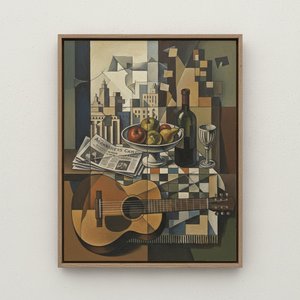
Juan Gris’s “Grapes”: A Symphony of Geometric Light
“Grapes,” painted in 1916 by Juan Gris, isn't merely a still life; it’s a meticulously constructed exploration of form, color, and the very nature of perception. Emerging from the heart of early Cubism, this work represents a pivotal moment in Gris’s artistic evolution, showcasing his burgeoning mastery of geometric abstraction while retaining a profound sensitivity to light and texture. The painting depicts a simple arrangement – a bowl overflowing with plump grapes, a newspaper partially obscured by a hand, and a glass reflecting the scene—yet within this apparent simplicity lies a complex interplay of visual elements that demand careful observation.
Gris’s approach during this period leaned heavily into Synthetic Cubism, a style characterized by its incorporation of collage elements – in this case, fragments of newspaper – alongside meticulously rendered geometric shapes. Unlike the Analytical Cubism of Picasso and Braque, which sought to dissect objects into their constituent parts, Gris employed a more integrated approach, building his compositions from interlocking planes and facets. The newspaper, strategically placed, isn’t merely an added element; it actively disrupts the traditional representation of space, introducing a sense of dynamism and fragmentation that mirrors the artist's own evolving worldview.
The Language of Light and Color
The color palette of “Grapes” is remarkably restrained yet profoundly evocative. Gris utilizes muted tones – ochres, browns, and deep blues – to create a sense of quiet intimacy. However, these seemingly simple colors are carefully modulated, layered upon one another to generate subtle shifts in value and hue. The reflective surface of the glass introduces a crucial element: light itself becomes a subject of the painting. Gris masterfully captures the way light bounces off the grapes, the newspaper, and the bowl, creating an illusion of depth and volume that defies traditional perspective. Notice how the shadows are not dark voids but rather areas of subtle color variation, contributing to the overall sense of luminosity.
Gris’s technique is characterized by a remarkable precision and control. He employs a pointillist approach – using small, distinct dots of color – to build up surfaces with incredible texture and vibrancy. This method allows him to capture the subtle nuances of light and shadow with astonishing accuracy. The meticulous application of paint creates a shimmering effect, as if the grapes themselves are radiating warmth and vitality.
A Reflection of Modernity
“Grapes” was created during a period of immense social and artistic upheaval in Europe. The rise of industrialization, urbanization, and technological advancements were fundamentally altering people’s perceptions of reality. Cubism, with its fragmented forms and rejection of traditional representation, reflected this sense of disorientation and uncertainty. Gris's work can be interpreted as an attempt to grapple with these changes, offering a new way of seeing the world—one that is both intellectually stimulating and emotionally resonant.
The inclusion of the newspaper – a ubiquitous symbol of modern life – further underscores this theme. It suggests a blurring of boundaries between art and everyday experience, inviting the viewer to consider the role of media in shaping our understanding of reality. The painting’s quiet intimacy contrasts sharply with the frenetic pace of urban life, offering a moment of contemplative stillness.
Capturing the Essence: A High-Quality Reproduction
Owning a reproduction of “Grapes” is more than simply acquiring a beautiful image; it's an opportunity to bring a piece of art history into your home. TOPofART’s hand-painted reproductions meticulously recreate Gris’s original techniques, capturing the subtle nuances of color, texture, and light with unparalleled fidelity. Each reproduction is created by experienced European artists trained in academic painting methods, ensuring that every detail—from the delicate brushstrokes to the shimmering reflections—is faithfully reproduced. The canvas is stretched on a high-quality linen surface, providing a timeless and elegant presentation.
Consider this artwork not just as decoration, but as a window into the mind of a visionary artist – a testament to the power of geometric abstraction and the enduring beauty of light and color.
Questions & Answers
How strong are the colors of "Grapes"?
"Grapes" by Juan Gris is recorded with a subtle color saturation and a monochromatic intensity.
Where and for what purpose is "Grapes" recommended?
Use (statement) and space (living room) are the two recommendations recorded for "Grapes" by Juan Gris.
What feeling does "Grapes" by Juan Gris convey?
In "Grapes", a calm mood accompanies a reflective emotion.
Related Artworks


Artist Biography
A Spanish Visionary of Cubism: The Life and Art of Juan Gris
Born José Victoriano González-Pérez in Madrid in 1887, the artist who would become known as Juan Gris embarked on a journey that would place him among the most significant figures of early 20th-century art. His initial path wasn’t one immediately leading to canvas and brush; he pursued engineering at the School of Arts and Sciences, demonstrating an analytical mind that would later profoundly influence his artistic approach. Even during these formative years, a creative spark flickered – contributing drawings to local periodicals hinted at a burgeoning visual talent. It was in 1905 that he adopted the pseudonym Juan Gris, a name resonating with a newfound sense of identity and purpose as he began formal painting studies under José Moreno Carbonero. This marked a pivotal shift, setting him on a course toward artistic innovation.Parisian Awakening and the Embrace of Cubism
The year 1906 witnessed a transformative relocation to Paris, a city then pulsating with artistic energy. Gris immersed himself in this vibrant milieu, forging friendships with luminaries like Henri Matisse, Georges Braque, and Fernand Léger. He initially engaged in satirical illustration for publications such as *L'Assiette au Beurre*, honing his observational skills and developing a keen sense of visual wit. However, the magnetic pull of Pablo Picasso proved particularly influential. Around 1910, Gris began to seriously dedicate himself to painting, moving away from caricature towards the burgeoning language of Cubism. This wasn’t mere imitation; he embarked on a quest to distill the essence of form and space, seeking a new visual order. His early explorations were marked by a deliberate departure from traditional representation, embracing abstraction as a means of capturing reality's underlying structure.The Geometry of Perception: Style and Key Works
Juan Gris’s artistic output is characterized by an exceptional clarity and intellectual rigor. He didn’t simply deconstruct objects; he reconstructed them with deliberate precision, emphasizing geometric forms and a carefully considered palette. This approach led to what became known as his “crystal period,” exemplified in masterpieces like *Still Life Before an Open Window* and *Place Ravignan* (1915). These works showcase a remarkable interplay of planes and angles, creating a sense of depth and solidity while simultaneously challenging conventional notions of perspective. After 1913, Gris wholeheartedly embraced Synthetic Cubism, pioneering the use of *papier collé* – collage – incorporating real-world materials like newspaper clippings and textured papers into his compositions. This technique added another layer of complexity and tactility to his work, blurring the boundaries between painting and sculpture. Notable examples include *Guitar in front of the sea* (1925), a testament to his simplified forms and adherence to cubist principles, and *Homage à Pablo Picasso* (1912), which signaled his growing recognition within the avant-garde art world.Legacy and Lasting Influence
Juan Gris’s contribution to Cubism extends beyond mere stylistic innovation; he brought a unique intellectual depth and structural clarity to the movement. He moved past the analytical phase, towards a more organized and synthetic approach, emphasizing order and precision. His work profoundly influenced the Purist style championed by Amédée Ozenfant and Charles Edouard Jeanneret (Le Corbusier), advocating for a return to classical principles of form and composition. Gris’s emphasis on geometric forms, harmonious color palettes, and the integration of everyday objects into his art established him as a pivotal figure in 20th-century art. His legacy continues to inspire artists today, demonstrating the enduring power of Cubism and the visionary genius of Juan Gris – a Spanish master who reshaped our understanding of perception and representation.
Juan Gris
1887 - 1927 , Spain
Quick Facts
- Full Name: José Victoriano González-Pérez
- Nationality: Spanish
- Date Of Birth: 1887
- Date Of Death: 1927
- Place Of Birth: Madrid, Spain
- Notable Artworks:
- Guitar in front of the sea
- Homage à Pablo Picasso
- The Miller
- Portrait of Madame Josette Gris
- Artistic Movement Or Style: Cubism, Synthetic Cubism
- Artists Who Influenced This Artist:
- Pablo Picasso
- Henri Matisse
- Georges Braque
- Artists Or Movements Influenced By This Artist:
- Purism
- Amédée Ozenfant
- Le Corbusier
Related Articles

Mastering Form: The 25 Greatest Paintings by Paul Cézanne
Explore 25 iconic Paul Cézanne masterpieces and his Post-Impressionist legacy. Discover the full collection online at ArtsDot.com.

Deconstructing Reality: Cubism's Revolutionary Impact on 20th-Century Art
Explore the revolutionary world of Cubism with ArtsDot. Discover Picasso & Braque's groundbreaking techniques, its philosophical roots, and lasting impact on modern art. Expert insights for collectors.

Mastering Cubism: The Top 25 Georges Braque Artworks
Explore 25 iconic Georges Braque masterpieces and the birth of Cubism. Discover museum-quality art on ArtsDot.com.

Deconstructing Identity: A Comprehensive Exploration of Cubist Portraiture
Explore the revolutionary world of Cubist portraiture with our comprehensive guide. Discover Picasso, Braque, Gris & the movement's impact on modern art. Expert analysis for collectors and enthusiasts.
Juan Gris: Cubist Deconstruction & Synthesis – A Comprehensive Exploration
Explore the revolutionary art of Juan Gris – a master of Cubism. Discover his unique approach to deconstruction, vibrant Synthetic Cubist works, and lasting influence on modern art. Expert analysis for collectors.


