- Home

- Oil Painting Reproduction
- John William Waterhouse
- Tale from the Decameron

 Buy print
 Send
Send Share
Share
 Details

 Download
 Similars
 X-Ray
X-Ray Diaporama
Tale from the Decameron
 Oil On Canvas
- WallArt
- Pre-Raphaelite
 1916
1916- 19th Century
 102.0 x 159.0 cm
 Lady Lever Art Gallery
Hand Made Oil Reproduction
Hand-painted oil on canvas in your size and frame, made to order by our artists.




P118B $10

P118H $10

P118W $10

P438Z $10

P508JH $12

P508YH $12

P805H $10

P805Z $10

P919BZ $10

P919G $10

P919XJ $10

P959ZH $10

P968JZ $12

W106C $8

W218G $10

W218JH $8

W218Y $10

W307PJ $10

W316G $10

W316PJ $8

W316Y $10

W398PJ $8

W4111J $10

W500HY $15

W500JH $15

W692G $12

W849H $8

W940BG $15

W953PJ $8




 Read more
Pick from our preset sizes that match the artwork's original proportions.

You may enter your own dimensions to fit a specific frame or space. If your selected size does not match the original image's proportions, we will either crop the artwork or extend the painting with additional hand-painted elements. A digital mockup will be sent for your approval before production begins.
Please note that the on-screen preview does not reflect the actual cropping or extension. Only the mockup will accurately show the final composition.
While custom sizes are available, we recommend selecting a dimension from the predefined list to preserve the original proportions.
After order, ArtsDot.com team will email client for instructions and provide a mockup preview
Worldwide Delivery () in 3/4 weeks instead of standard 5 weeks. (1 July). No compromise on quality.

Free Worldwide Express Shipping

High-Quality Linen Canvas

Full Shipping Insurance

Customs Tax Refund Guarantee

True Color Matching Guarantee

60-Day Return Policy (Defects Only)

100% Money-Back Guarantee

Bulk Discount Offer
 Glass option is only available in size under 110 CM

Tale from the Decameron
Reproduction Medium
Reproduction Size
-


Total Price
-
Artwork Description
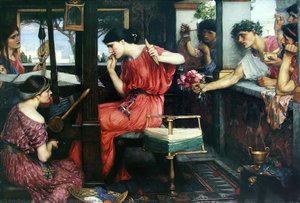
The Enchanting Gathering: A Tale from the Decameron
Step into a world of timeless elegance and serene beauty with this captivating artwork by John William Waterhouse. "Tale from the Decameron" invites viewers to witness a moment of harmony and leisure, where a group of women gather in an idyllic garden setting. This masterpiece is a testament to Waterhouse's skill in capturing the essence of Pre-Raphaelite artistry, blending rich colors, intricate details, and a sense of narrative depth.
A Symphony of Color and Light
The artwork's vibrant yet harmonious color palette is dominated by deep earth tones—rich reds, lush greens, and warm browns—that create a sense of warmth and intimacy. The women's clothing introduces splashes of pinks, purples, and golds, which contrast beautifully with the natural greens and blues of the outdoor setting. The soft, natural lighting enhances the three-dimensional quality of the figures and objects, casting gentle shadows that add depth and realism to the scene.
Composition and Technique
Waterhouse's meticulous technique is evident in every brushstroke. The composition is balanced with the women arranged in a semi-circle around the central figure who is playing a lute. The fountain serves as a focal point, drawing the viewer's eye to the center of the image. The use of both curved and straight lines creates a sense of movement and structure, while the intricate detailing of the women's clothing and the lute showcases the artist's exceptional skill.
Historical Context and Symbolism
Created in 1916, this artwork reflects Waterhouse's deep connection to the Pre-Raphaelite movement, known for its detailed and realistic depictions of subjects, rich colors, and a focus on natural settings. The subject matter revolves around a group of women engaged in a musical gathering, possibly inspired by the tales from Giovanni Boccaccio's "Decameron," a collection of novellas that celebrate human resilience and the joy of storytelling.
The artwork conveys a sense of harmony and community among the women. The musical instruments and the act of playing suggest themes of creativity, friendship, and shared experiences. The lush garden setting may symbolize beauty, nature, and tranquility, inviting viewers to reflect on the simple pleasures of life.
Emotional Impact and Appeal
"Tale from the Decameron" is more than just a beautiful painting; it is an invitation to a world of elegance and serenity. The artwork's emotional impact lies in its ability to evoke a sense of peace and joy, making it a perfect addition to any art collection or interior design project. Whether you are an art lover seeking inspiration or an interior designer looking to create a sophisticated atmosphere, this masterpiece will bring a touch of timeless beauty to your space.
Bringing the Masterpiece Home
Experience the magic of "Tale from the Decameron" with a high-quality reproduction that captures every detail and nuance of Waterhouse's original work. Our hand-painted reproductions are crafted with the utmost care and attention to detail, ensuring that you receive a piece of art that is as close to the original as possible. Elevate your space with this enchanting artwork and let it inspire a sense of tranquility and elegance in your home or office.
Related Artworks


Artist Biography
A Roman Beginning: The Early Life and Influences of John William Waterhouse
John William Waterhouse, a name synonymous with the romantic allure of Pre-Raphaelite painting, began his artistic journey far from the fog-laden landscapes often associated with the movement. Born in Rome in 1849 to English parents, his earliest years were steeped in the classical beauty of Italy – an environment that would profoundly shape his aesthetic sensibilities. This formative period instilled within him a deep appreciation for ancient Roman art and mythology, themes that would recur throughout his prolific career. The Waterhouse family returned to England in 1854, settling in South Kensington, London, a location strategically chosen for its proximity to the burgeoning Victoria and Albert Museum. Here, young John was exposed to an unparalleled collection of classical sculpture and decorative arts, further nurturing his fascination with antiquity. His initial training was conventional, encompassing studies at the Royal Academy Schools, where he honed his technical skills in drawing and painting, but it was the atmosphere of intellectual curiosity and artistic innovation that truly ignited his passion. Even early works reveal a meticulous attention to detail and a commitment to historical accuracy, qualities that would become hallmarks of his style.Embracing the Pre-Raphaelite Brotherhood
While Waterhouse’s initial work displayed classical leanings reminiscent of artists like Alma-Tadema and Frederic Leighton, he gradually gravitated towards the ideals of the Pre-Raphaelite Brotherhood. This artistic collective, founded in 1848, championed a return to the detailed observation of nature and the vibrant colors found in early Italian Renaissance art – before what they perceived as the stylistic decline initiated by Raphael. Waterhouse didn’t join the brotherhood itself, but he wholeheartedly embraced its principles, infusing his paintings with a lyrical beauty and emotional depth that resonated deeply with audiences. His 1874 painting, Sleep and his Half-Brother Death, exhibited at the Royal Academy, marked a turning point, demonstrating his growing mastery of symbolic narrative and atmospheric effects. This success paved the way for consistent inclusion in the annual exhibitions, establishing him as a rising star within the London art scene. He wasn’t merely replicating Pre-Raphaelite techniques; he was interpreting them through his own unique lens, blending classical precision with romantic sensibility.Mythological Visions and Arthurian Echoes
Waterhouse's most celebrated works are those that draw inspiration from mythology and Arthurian legend. He possessed a remarkable ability to breathe life into ancient stories, portraying goddesses, nymphs, and tragic heroines with an exquisite blend of beauty and pathos. The Lady of Shalott, perhaps his most iconic painting, exists in three versions (1888, 1894, and 1916), each a testament to his enduring fascination with Tennyson’s poem. The image of the doomed lady, adrift on her river barge, became emblematic of Victorian romanticism and the plight of artistic isolation. Similarly, his depictions of Ophelia, capturing the moment before her tragic demise, are imbued with a haunting melancholy. He didn't simply illustrate these tales; he explored their psychological depths, focusing on the emotional states of his subjects. Hylas and the Nymphs, Ariadne, and Penelope and the Suitors are further examples of his ability to transform classical narratives into visually stunning and emotionally resonant works of art. His paintings weren’t just beautiful; they were imbued with a sense of narrative power, inviting viewers to contemplate the complexities of human experience.Legacy and Lasting Influence
John William Waterhouse continued to paint prolifically until his death in 1917, achieving widespread recognition and acclaim during his lifetime. He was elected a full Academician in 1895 and dedicated time to teaching at the St. John's Wood Art School, nurturing the next generation of artists. While his popularity waned somewhat after World War I, there has been a significant resurgence of interest in his work in recent decades. Today, Waterhouse is celebrated as one of the most important figures of the Pre-Raphaelite movement and a master of Victorian painting. His paintings continue to captivate audiences with their exquisite beauty, emotional depth, and timeless appeal. He left behind a legacy of romantic visions, mythological interpretations, and tragic heroines that continue to inspire artists and art lovers alike. The enduring power of his work lies in its ability to transport viewers to another world – a realm of myth, legend, and profound human emotion.
John William Waterhouse
1849 - 1917 , Italy
Quick Facts
- Artistic Movement Or Style: Pre-Raphaelite, Victorian
- Artists Who Influenced This Artist:
- Alma-Tadema
- Frederic Leighton
- Date Of Birth: 1849
- Date Of Death: 1917
- Full Name: John William Waterhouse
- Nationality: English
- Notable Artworks:
- The Lady of Shalott
- Ophelia
- Hylas and the Nymphs
- Ariadne
- Place Of Birth: Rome, Italy
Related Articles

The Pre-Raphaelite Brotherhood: Rebellion, Romance & Medieval Revival
Explore the captivating world of the Pre-Raphaelite Brotherhood! Discover their rebellious spirit, iconic masterpieces & lasting influence on art history. Learn about Rossetti, Millais & more.


Arthur Hughes: Pre-Raphaelite Visions of Beauty & Melancholy
Explore the captivating world of Arthur Hughes (1832-1915), a leading Pre-Raphaelite painter. Discover his dreamy landscapes, poetic narratives & iconic Victorian artworks. Learn about his life, style & collecting today.

Henry Thomas Dawson: Navigating Light, Sea & Sentiment in Victorian Marine Painting
Explore the captivating world of Henry Thomas Dawson (1811-1878), a master of Victorian marine painting. Discover his evocative coastal scenes, landscapes & lasting artistic legacy. Learn about collecting Dawson's work and find reproductions at ArtsDot.

Anthony Frederick Sandys: Pre-Raphaelite Vision & Victorian Aesthetic Exploration
Discover the captivating Pre-Raphaelite world of Anthony Frederick Sandys (1829-1904). Explore his mythological scenes, portraits & Victorian artistry. Learn about his influences and lasting legacy.

Heywood Hardy: Navigating Victorian Sentiment Through Marine Painting & Wildlife Illustration
Explore the captivating world of Heywood Hardy (1842-1933), a master of Victorian animal & equestrian painting. Discover his realistic landscapes, hunting scenes, and enduring legacy with ArtsDot.