Preview
 Send
Send Share
Share
 Details
 Guide
Guide

 Download
 Similars
 X-Ray
X-Ray Diaporama
 Q&A
Q&A Stats
StatsA Bridge
 Read More
Giclée / Art Print
Museum-quality giclée or canvas print with fast production and flexible finish options. ( Buy Hand Made Painting Switch to Digital Image)




































Pick from our preset sizes that match the artwork's original proportions.

Type the width and the height you need, to fit your frame or your wall. A print can only be cut, never made bigger than the picture, so a size with a different shape loses a part of the image. We send you a digital mockup to approve before we print anything. The picture shown on this page does not show the real cut — only the mockup does.
Worldwide Delivery () in 2 weeks instead of standard 4/5 weeks. (10 November)

Free Worldwide Express Shipping

High-Quality Linen Canvas

Full Shipping Insurance

Customs Tax Refund Guarantee

True Color Matching Guarantee

100-Day Return Policy (Defects Only)

100% Money-Back Guarantee

Bulk Discount Offer
 Glass option is only available in size under 110 CM

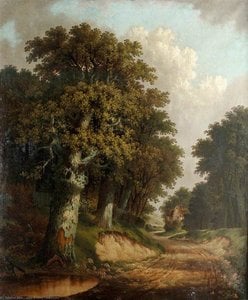
A Bridge
Giclée / Art Print
Reproduction Size
-


Total Price
$ 63
Related Artworks


Artist Biography
John Berney Ladbrooke: A Life in Landscape
Early Life and Education
- Born: 1803, United Kingdom.
- John Berney Ladbrooke emerged from a family deeply rooted in the artistic traditions of Norwich. His father, John Crome, was a founding member of the Norwich School of painters and played a pivotal role in shaping young Ladbrooke’s early development.
- Ladbrooke received both formal education at Norwich School (the grammar school) and practical artistic training from his father. This dual upbringing instilled in him not only intellectual curiosity but also a strong foundation in landscape painting techniques.
- Early sketching expeditions with his father were crucial, fostering an appreciation for the natural world and honing observational skills.
Artistic Development and Influences
- Key Influence: John Crome’s influence is undeniable. Ladbrooke inherited his father's penchant for capturing atmospheric effects, particularly moonlight scenes, and a focus on the Norfolk countryside.
- Ladbrooke expanded his artistic horizons through travels to Paris in 1816 with friends, exposing him to continental art trends.
- He worked in oils, watercolours, and pencil, demonstrating versatility across mediums. His style evolved within the traditions of the Norwich School, emphasizing direct observation of nature and a romanticized depiction of rural life.
Career and Major Achievements
- Ladbrooke assisted his father in teaching art and eventually took over his practice after Crome’s death in 1821. He continued to teach from the family home on Gildengate Street, Norwich.
- He held positions within the Norwich Society of Artists, serving as vice-president and later president, demonstrating his commitment to fostering a vibrant artistic community.
- Ladbrooke exhibited extensively at the Royal Academy, British Institution, and Society of British Artists in London between 1811 and 1843. This exposure broadened his reach and established him as a recognized landscape painter.
- He travelled throughout Europe – France, Holland, Belgium, and Italy – creating sketches and paintings that reflected diverse landscapes.
Themes and Style
- Recurring Themes: Ladbrooke’s work consistently features evocative woodland scenes, charming coastal views, and depictions of rural Norfolk life. He captured the essence of the English countryside with a romantic sensibility.
- Moonlight effects were a particular specialty, reminiscent of his father's style, creating atmospheric and dramatic compositions.
- His paintings often depict quiet moments in nature – thatched cottages nestled amongst trees, winding lanes leading to ponds, and serene shorelines. These scenes evoke a sense of tranquility and nostalgia.
Later Life and Legacy
- Financial difficulties plagued Ladbrooke later in life, culminating in bankruptcy in 1831 and the forced sale of his father’s possessions.
- He moved to Great Yarmouth in 1835, continuing to teach drawing until his death on September 15, 1842.
- Historical Significance: While not reaching the same level of fame as some of his contemporaries, Ladbrooke played a significant role in perpetuating the traditions of the Norwich School. His paintings offer valuable insights into 19th-century English landscape painting and provide a glimpse into the beauty of rural Norfolk.
- His works are held in numerous public collections, including the Tate Gallery, Yale Centre for British Art, and various museums across the UK, ensuring his artistic legacy endures.

John Berney Ladbrooke
1803 - 1879 , United Kingdom
Quick Facts
- Name: John Berney Ladbrooke
- Movement: Norwich School
- Birth_Date: 1803
- Death_Date: 1879
- Birth_Place: United Kingdom
- Nationality: British
- Date Of Birth: 1803
- Date Of Death: 1879
- Influenced_By: John Crome
- Place Of Birth: United Kingdom