


 Send
Send Share
Share
 Details
 Guide
Guide

 Download
 Similars
 Diaporama
 Stats
StatsFancy
 Sculpture Bronze
- Neo-Dada
 133.0 x 114.0 cm
 Chrysler Museum of Art
 Read More
The artwork displayed on this page is protected by copyright law, which means we cannot legally create or sell an identical reproduction. This protection is enforced under international agreements such as the Berne Convention and by national laws, including those outlined by the U.S. Copyright Law - Title 17.
As a respectful and legal alternative, we offer custom, hand-painted artworks inspired by the original. Our skilled and professional artists carefully study the original's style, mood, and artistic essence to create a new, unique piece that evokes the same feeling - while remaining an original creation in its own right.
This method fully complies with copyright regulations because it does not involve copying or duplicating the protected artwork. Instead, it is a creative reinterpretation - a new painting that is influenced by the original but not identical to it.
Hand Made Oil Reproduction
Hand-painted oil on canvas in your size and frame, made to order by our artists. ( Switch to Print Switch to Digital Image)




































Pick from our preset sizes that match the artwork's original proportions.

Type the width and the height you need, to fit your frame or your wall. This is hand-painted, so for a size with a different shape the artist can paint a bit more around the picture, or cut a bit — you choose. We send you a digital mockup to approve before the painting starts. The picture shown on this page does not show the real result — only the mockup does.
After order, ArtsDot.com team will email client for instructions and provide a mockup preview
Worldwide Delivery () in 3/4 weeks instead of standard 5 weeks. (23 October). No compromise on quality.

Free Worldwide Express Shipping

High-Quality Linen Canvas

Full Shipping Insurance

Customs Tax Refund Guarantee

True Color Matching Guarantee

100-Day Return Policy (Defects Only)

100% Money-Back Guarantee

Bulk Discount Offer
 Glass option is only available in size under 110 CM

Fancy
Reproduction Medium
Reproduction Size
-


Total Price
$ 263
Fancy That
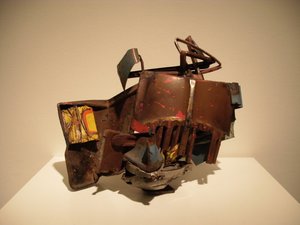
The image captures John Angus Chamberlain’s masterful reimagining of Abstract Expressionism—a movement that championed spontaneity and emotional intensity—within the realm of sculpture. At its core is “Fancy,” a monumental piece constructed from meticulously crushed automobile parts welded together, embodying Chamberlain's signature technique and pushing the boundaries of artistic convention.Material Innovation: Embracing Discarded Metal
Chamberlain’s genius lay in transforming what would typically be considered scrap—the remnants of automobiles—into objects of profound beauty and intellectual contemplation. Rather than striving for polished surfaces or traditional forms, he embraced the inherent textures and imperfections of metal, mirroring the ethos of Dada and Surrealism. This deliberate rejection of conventional aesthetics speaks to a broader artistic impulse: to find significance in unexpected materials and processes. The artist’s choice to weld these parts together wasn't merely a structural necessity; it was an active gesture—a forceful reshaping of reality that echoed the rebellious spirit of his time.A Dialogue with Abstract Expressionism
“Fancy” directly responds to the legacy of artists like Jackson Pollock and Willem de Kooning, who famously abandoned easel painting for drip techniques and action painting. Chamberlain’s method – crushing metal into fragments and fusing them together—represents a radical departure from established sculptural practices. However, he wasn't attempting to replicate Pollock or de Kooning’s style; instead, he sought to translate the emotional core of Abstract Expressionism into three dimensions. The resulting sculptures are characterized by their monumental scale, their rough surfaces, and their unsettling juxtaposition of textures—elements that powerfully convey a sense of dynamism and disorientation.Symbolic Resonance: Fragments of Memory
Beyond its formal innovations, “Fancy” possesses a rich symbolic dimension. The automobile itself has become an emblem of modernity, representing speed, progress, and the relentless march of industrialization. By repurposing these vehicles—symbols of both technological advancement and societal upheaval—Chamberlain invites viewers to contemplate themes of decay, transformation, and the passage of time. The fractured nature of the sculpture reflects a fragmented consciousness, mirroring the anxieties and uncertainties that permeated the postwar era. It’s a visual meditation on loss, remembrance, and the enduring power of art to grapple with complex ideas.Emotional Impact: Confronting Imperfection
Ultimately, “Fancy” succeeds in eliciting an emotional response through its uncompromising honesty—its refusal to conceal the marks of process and material imperfection. Chamberlain deliberately avoids creating idealized representations; instead, he presents viewers with objects that are simultaneously beautiful and unsettling. This aesthetic choice aligns with the broader philosophical currents of Dada and Surrealism, which questioned notions of beauty and rationality. By confronting us with the physicality of creation—the welds, the crushed metal—Chamberlain compels us to reconsider our perceptions of art and its relationship to experience. The sculpture’s impact lingers long after viewing, prompting reflection on themes of materiality, memory, and the transformative potential of artistic intervention.Questions & Answers
What technique and style characterize "Fancy" by John Angus Chamberlain?
"Fancy" is made in sculpture bronze, in the Neo-Dada style.
What is a reproduction of "Fancy" by John Angus Chamberlain recommended for?
A reproduction of "Fancy" by John Angus Chamberlain is recommended for accent. This suggestion follows from the work's subject, mood and colors.
What style does "Fancy" belong to?
"Fancy" is a work of Neo-Dada. The movement indicates the artistic tradition the work is part of.
Related Artworks


Artist Biography
The Alchemist of Automobilia: The Life and Legacy of John Angus Chamberlain
In the intersection of industrial decay and high art, few figures loom as large or as provocatively as John Angus Chamberlain. Born in 1927 in Rochester, Indiana, Chamberlain did not merely create sculpture; he orchestrated a metamorphosis of the discarded. To look upon his work is to witness a violent yet poetic dialogue between the mechanical past and the abstract present. He possessed a singular vision that allowed him to see not just rusted scrap, but a vocabulary of form, color, and texture. His journey from the son of a saloonkeeper in the American Midwest to a titan of the Neo-Dada movement is a testament to an unyielding creative impulse that sought to find beauty within the crushed and the broken.
Chamberlain’s artistic consciousness was forged through a diverse and rigorous educational odyssey. After serving in the United States Navy during the pivotal years of World War II, he utilized the GI Bill to immerse himself in the burgeoning avant-garde scenes of America. His time at the Art Institute of of Chicago provided him with a foundational mastery of form, but it was his tenure at the legendary Black Mountain College that truly expanded his intellectual horizons. At Black Mountain, he moved beyond the purely visual, studying under influential poets such as Charles Olson and Robert Creeley. This literary immersion profoundly shaped his sculptural language; he famously viewed his collection of automotive fragments as a reservoir of words, where the act of welding was akin to composing a stanza, seeking the perfect placement of one jagged edge against another to achieve a rhythmic, poetic resonance.
A Symphony of Steel and Spontaneity
The hallmark of Chamberlain’s oeuvre lies in his revolutionary technique of assemblage. While many of his contemporaries were exploring the flat planes of Abstract Expressionist painting, Chamberlain sought to bring that same gestural energy into three-dimensional space. He became a master of the "crushed" aesthetic, meticulously dismantling abandoned automobiles and extracting their vibrant, enamel-coated metal components. Through the intense processes of welding, bending, and compressing, he transformed these industrial remnants into monumental forms that pulsed with an almost organic vitality.
His work defies easy categorization, existing in a fluid state between several major movements:
- Abstract Expressionism: He translated the spontaneous, emotional brushstrokes of painters like Pollock into the physical manipulation of steel and chrome.
- Neo-Dada: By utilizing found objects and "readymades" from the industrial age, he challenged the sanctity of traditional sculptural materials like marble or bronze.
- Pop Art: His use of consumerist detritus—the very skin of the American automobile—connected his high-art ambitions to the burgeoning mass culture of the mid-20th century.
There is a palpable tension in his sculptures, a sense of captured motion and compressed energy. The bright flashes of Cadillac red or Chevrolet blue, often peeking through layers of rust and grime, create a chromatic intensity that mirrors the dynamism of urban life. He did not seek to represent the car, but rather to capture the spirit of its movement and the inevitable entropy of its decay.
Historical Significance and the Enduring Pulse of Art
Throughout his prolific career, Chamberlain’s presence was felt across the most significant art hubs of the world, from Manhattan and Los Angeles to Shelter Island and even Belgium. His ability to disrupt the boundaries between sculpture and painting left an indelible mark on the trajectory of modern art. He proved that the debris of the industrial revolution could serve as the medium for a profound spiritual and aesthetic inquiry. Critics often noted that while his materials were cold and hard, the emotional impact of his work was deeply visceral, aiming—as he himself desired—to "make the viewer’s heart beat."
As we reflect on his life, which concluded in 2011, Chamberlain remains a pivotal figure who bridged the gap between the mechanical and the lyrical. He taught us that art is not merely about the creation of something new, but about the radical reimagining of what already exists. His legacy lives on in every artist who looks at the wreckage of the world and sees the potential for a masterpiece, reminding us that even in the crushed and the discarded, there is an eternal, unyielding beauty waiting to be welded back together.
John Angus Chamberlain
1927 - 2011 , United States of America
Quick Facts
- Full Name: John Angus Chamberlain
- Nationality: American
- Date Of Birth: 1927
- Date Of Death: 2011
- Place Of Birth: Rochester, United States of America
- Notable Artworks:
- Fancy
- Sleeping Giant
- Artistic Movement Or Style: Abstract Expressionism
- Artists Who Influenced This Artist:
- Robert Delaunay
- Jean Dubuffet
- Artists Or Movements Influenced By This Artist: ['Neo-Dada']
Related Articles

John Singer Sargent's 25 Masterpieces: Portraits & Beyond | ArtsDot
Explore 25 iconic John Singer Sargent paintings – from dazzling portraits to Impressionist landscapes. Discover the stories behind Madame X, El Jaleo & more! Find museum-quality art reproductions and elevate your home decor with ArtsDot.com.

Bronze Sculptures That Defined Art History | ArtsDot
Journey through art history with our Top 10 bronze sculptures! Explore masterpieces by Rodin, Michelangelo & more. Discover stories behind iconic statues and find museum-quality reproductions for your home decor at ArtsDot.com.

John Constable's Masterpieces: Explore 25 Iconic Landscapes for Your Home
Journey through John Constable's 25 most celebrated landscapes. Explore Romanticism, Dedham Vale & his masterful use of light in iconic paintings like 'Hay Wain'. Find museum-quality art reproductions and elevate your home decor on ArtsDot.com.

Abstract Expressionism's 10 Defining Masterpieces |
Explore 10 defining Abstract Expressionism masterpieces by Pollock, Rothko & de Kooning. Discover the stories behind these iconic paintings and find museum-quality art reproductions to elevate your home decor on .

The Enduring Form: Exploring Themes & Techniques in Sculpture Across Historical Periods
Explore the rich history of sculpture from ancient masterpieces to contemporary innovations. Discover key techniques, influential artists & investment potential for discerning art collectors.
