- Home

- Oil Painting Reproduction
- johannes anthonie balthasar stroebel
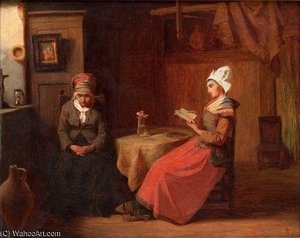
- Dutch Interior

 Buy print
 Send
Send Share
Share
 Details

 Download
 Similars
 X-Ray
X-Ray Diaporama
Dutch Interior

Hand Made Oil Reproduction
Hand-painted oil on canvas in your size and frame, made to order by our artists.




































 Read more
Pick from our preset sizes that match the artwork's original proportions.

You may enter your own dimensions to fit a specific frame or space. If your selected size does not match the original image's proportions, we will either crop the artwork or extend the painting with additional hand-painted elements. A digital mockup will be sent for your approval before production begins.
Please note that the on-screen preview does not reflect the actual cropping or extension. Only the mockup will accurately show the final composition.
While custom sizes are available, we recommend selecting a dimension from the predefined list to preserve the original proportions.
After order, ArtsDot.com team will email client for instructions and provide a mockup preview
Worldwide Delivery () in 3/4 weeks instead of standard 5 weeks. (1 July). No compromise on quality.

Free Worldwide Express Shipping

High-Quality Linen Canvas

Full Shipping Insurance

Customs Tax Refund Guarantee

True Color Matching Guarantee

60-Day Return Policy (Defects Only)

100% Money-Back Guarantee

Bulk Discount Offer
 Glass option is only available in size under 110 CM

Dutch Interior
Reproduction Medium
Reproduction Size
-


Total Price
-
Related Artworks


Artist Biography
Johannes Anthonie Balthasar Stroebel: A Dutch Chronicler of the Golden Age
Johannes Anthonie Balthasar Stroebel (1821 – 1905) emerges from the vibrant artistic landscape of 19th-century The Hague as a master of genre painting, meticulously capturing the essence of the Dutch Golden Age. More than simply an observer, Stroebel became a chronicler, weaving together scenes of domestic life, scholarly pursuits, and quiet moments of contemplation – all rendered with a remarkable sensitivity to light, atmosphere, and the subtle nuances of human interaction. His work offers a poignant glimpse into a bygone era, imbued with both nostalgia and a profound appreciation for the everyday rhythms of Dutch society.
Born in The Hague on November 23, 1821, Stroebel’s artistic journey began within the city's thriving art scene. He received his foundational training at the esteemed Haagsche Teeken-Academie, an institution renowned for nurturing talent and upholding classical principles of art. Crucially, however, his education extended beyond the formal curriculum. He benefited from invaluable mentorship under established painters like Bartholomeus Johannes van Hove and his son, Huib van Hove – figures whose expertise in architectural renderings and genre scenes undoubtedly shaped Stroebel’s artistic sensibilities. This combination of academic rigor and practical apprenticeship provided him with a solid foundation upon which to build his distinctive style.
The Echoes of the Golden Age
Stroebel's most enduring legacy lies in his dedication to depicting scenes from the 17th-century Dutch Golden Age. This era, characterized by unprecedented prosperity, artistic innovation, and a deep reverence for tradition, held an irresistible allure for artists across Europe – and Stroebel was no exception. Rather than attempting grand historical narratives, he focused on capturing intimate moments within domestic interiors, populated with figures engaged in everyday activities. These weren’t heroic scenes of conquest or political intrigue; instead, they were quiet vignettes—a man absorbed in a letter, a woman diligently working at her needlework, a family gathered around a table sharing a meal, or a scholar immersed in his studies.
This deliberate focus on the domestic sphere wasn’t merely stylistic choice. It reflected a broader cultural trend of looking back to the past for inspiration and solace. The 19th century was a time of rapid social change and industrialization, prompting many artists to seek refuge in the idealized world of the Golden Age – a period often romanticized as one of stability, craftsmanship, and communal values. Stroebel’s paintings served as windows into this imagined past, offering viewers a comforting sense of continuity and connection to their heritage.
Mastery of Light and Atmosphere
Beyond his subject matter, Stroebel's artistic skill lay in his masterful manipulation of light and atmosphere. He possessed an exceptional ability to evoke the subtle shifts of illumination within domestic interiors – capturing the dappled sunlight streaming through leaded windows, the warm glow of candlelight, or the diffused light filtering through heavy curtains. This attention to detail wasn’t simply decorative; it served to create a palpable sense of realism and immediacy, drawing viewers into the heart of each scene.
Stroebel's technique was deeply rooted in the traditions of Dutch painting, echoing the work of masters like Johannes Vermeer and Pieter de Hooch. Like these predecessors, he employed a muted palette, favoring subtle gradations of color and carefully observed details to create a sense of depth and atmosphere. His compositions were often characterized by a restrained elegance, prioritizing clarity of form and emotional resonance over elaborate ornamentation.
Legacy and Recognition
Johannes Anthonie Balthasar Stroebel’s work gained considerable recognition during his lifetime, securing him a respected place within the Dutch art world. He became a member of both the Pulchri Studio in The Hague and Arti et Amicitiae in Amsterdam – prestigious artistic societies that provided opportunities for exhibition and professional development. His paintings were exhibited at major salons and acquired by discerning collectors, contributing to his growing reputation as a skilled and insightful genre painter.
Today, Stroebel’s work continues to be appreciated for its evocative depictions of the Dutch Golden Age and its masterful handling of light and atmosphere. His paintings offer a valuable window into the daily lives of ordinary people during a pivotal period in Dutch history – a testament to his artistic talent and his profound understanding of the cultural values that shaped the nation.

johannes anthonie balthasar stroebel
1821 - 1905 , Netherlands
Quick Facts
- Artistic Movement Or Style: Genre painting, Dutch Golden Age
- Artists Who Influenced This Artist: ['Bartholomeus Johannes van Hove, Huib van Hove],\n "Artists or movements influenced by this artist": ["Pieter de Hooch"]\n}']
- Date Of Birth: November 23, 1821
- Date Of Death: August 21, 1905
- Full Name: Johannes Anthonie Balthasar Stroebel
- Nationality: Dutch
- Notable Artworks:
- De Regentenkamer
- Dutch Interior
- Hollandse keukenscène
- Place Of Birth: The Hague, Netherlands
Related Articles

Dutch Masters: 10 Golden Age Paintings That Still Inspire |
Journey into the Dutch Golden Age! Explore 10 iconic paintings by Rembrandt, Vermeer & Hals. Discover the stories behind these Baroque masterpieces and find museum-quality art reproductions to elevate your home decor on .


Oil on Canvas Masters: 10 Paintings That Redefined Art History |
Journey through art history with our guide to 10 legendary oil on canvas masterpieces! Explore iconic works by Van Gogh, Monet & Rembrandt. Find museum-quality reproductions and elevate your home decor at . Discover all masterpieces online.

Pieter de Hooch: Illuminating Dutch Domestic Life & Golden Age Charm
Explore the captivating world of Pieter de Hooch, a master of Dutch Golden Age painting. Discover his innovative use of light, intimate domestic scenes, and lasting influence on art history. Learn more at ArtsDot.

The Bountiful Still Life: Symbolism & Artistic Representation of Fruit Across Art History
Explore the rich history of still life painting & the symbolism of fruit across art movements. Discover masterpieces from Caravaggio to Cézanne with ArtsDot – expert guidance & museum-quality reproductions.

From Classical Still Life to Contemporary Abstraction: Elevating Villa Entertaining Spaces Through Artful Reproduction
Explore the history of still life painting & discover how artful reproductions elevate villa entertaining spaces. Expert guidance, museum-quality prints & custom artwork at ArtsDot.com.