


The picture follows your choices: , .
Collectible Description
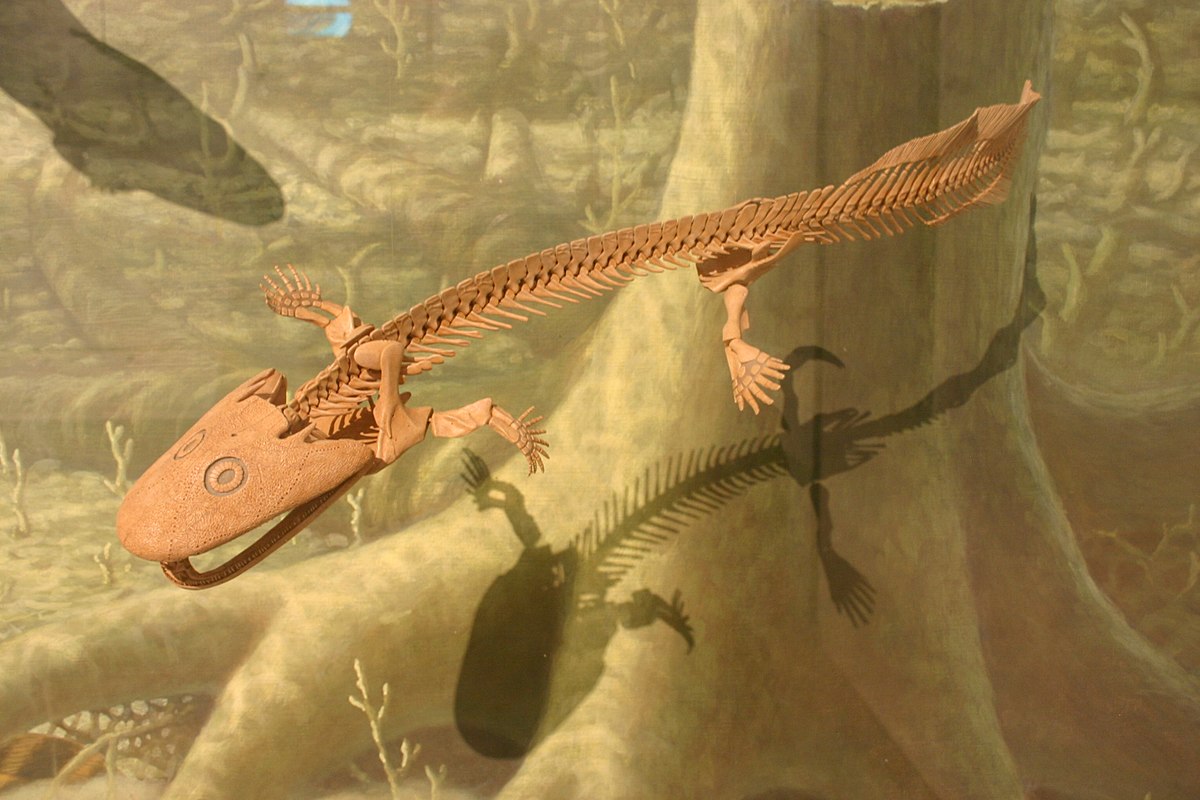
A captivating black & white drawing of Acanthostega, a prehistoric fish-like creature swimming above another, showcasing intricate fins and tail details by Jane Kim.
 Read More
Artist Biography
An American painter and science illustrator known for large-scale conservation murals like the Wall of Birds, Jane Kim blends scientific detail with vibrant advocacy to invite you into a thriving natural world.
Hand Made Oil Reproduction
Hand-painted oil on canvas in your size and frame, made to order by our artists. ( Switch to Print Switch to Digital Image)
This Artwork Is Under Copyright Protection
The artwork displayed on this page is protected by copyright law, which means we cannot legally create or sell an identical reproduction. This protection is enforced under international agreements such as the Berne Convention and by national laws, including those outlined by the U.S. Copyright Law - Title 17.
As a respectful and legal alternative, we offer custom, hand-painted artworks inspired by the original. Our skilled and professional artists carefully study the original's style, mood, and artistic essence to create a new, unique piece that evokes the same feeling - while remaining an original creation in its own right.
This method fully complies with copyright regulations because it does not involve copying or duplicating the protected artwork. Instead, it is a creative reinterpretation - a new painting that is influenced by the original but not identical to it.
More about this painting
 Preview
 Send
Send Share
Share
 Details
 Guide
Guide

 Download
 Similars
 X-Ray
X-Ray Diaporama
 Q&A
Q&A Stats
StatsOrder your painting in four simple steps
Take your time. You can change any answer; the price in your order card follows each choice.
1 Step one of four
Which size would you like?
These sizes keep the proportions of the original painting. The drawing shows your choice on a wall, above a two-metre sofa.
Or give your own measurements
Pick from our preset sizes that match the artwork's original proportions.

Type the width and the height you need, to fit your frame or your wall. This is hand-painted, so for a size with a different shape the artist can paint a bit more around the picture, or cut a bit — you choose. We send you a digital mockup to approve before the painting starts. The picture shown on this page does not show the real result — only the mockup does.
2 Step two of four
How should it be prepared: rolled, stretched or framed?
The prices below are for the size you chose in step one.
Choose the edges of the stretched canvas
Choose your frame

White $1

Blurside $1

Extended $1

P118B $10

P118H $10

P118W $10

P438Z $10

P508JH $12

P508YH $12

P805H $10

P805Z $10

P919BZ $10

P919G $10

P919XJ $10

P959ZH $10

P968JZ $12

W106C $8

W218G $10

W218JH $8

W218Y $10

W307PJ $10

W316G $10

W316PJ $8

W316Y $10

W398PJ $8

W4111J $10

W500HY $15

W500JH $15

W692G $12

W849H $8

W940BG $15

W953PJ $8

H24-GOLD $30

H24-SILVER $30

H36-GOLD $45

H36-SILVER $45
Framed
Moulding: . Overall size with the frame: .
3 Step three of four
Would you like anything changed in the painting?
Most people answer no. Because each painting is made by hand, our artist can also adapt it for you.
After order, ArtsDot.com team will email client for instructions and provide a mockup preview
4 Step four of four
A few finishing options
All of them are optional. The answers already selected cost nothing extra.
Who paints it?
Worldwide Delivery () in 3/4 weeks instead of standard 5 weeks. (6 November). No compromise on quality.
A nameplate, as in a museum?
Engraved Bronze Plaque Details
This elegant plaque features the artist's name and the title of the artwork, finely engraved for a timeless presentation.
It is made from bronze with a refined, elegant finish. The text is precisely laser-engraved for a sharp and permanent result. Measuring 9x2 cm, the plaque is compact yet easy to read. It's built to be durable and scratch-resistant, offering a professional, museum-quality look. Mounting is simple thanks to the included adhesive backing.
Transparent Acrylic Plaque Details
The plaque includes essential engraved details such as the artist's name, the title of the artwork, the date it was created, the type of media used-like oil on canvas or watercolor-a brief description of the piece, and a QR code that links to the complete artwork information.
It is crafted from clear acrylic, offering a sleek, modern appearance. The text is UV-engraved in black to ensure strong visual contrast. With a size of 10x15 cm, it ensures optimal readability. It comes equipped with two metal hooks for secure wall mounting. The plaque is designed to be weather-resistant, making it suitable for various environments, and it includes interactive features that work seamlessly with smartphone scanning.
Black Acrylic Plaque Details
This elegant plaque includes engraved information such as the artist's name, the title of the artwork, the date it was created, the type of media used (like oil on canvas or watercolor), a short description of the artwork, and a QR code for quick access to more information.
The plaque itself is made from refined black acrylic with a premium finish. The text is laser-engraved in white for high contrast and readability. Its size is 10x15 cm, designed to be easy to read. It comes with two metal hooks for professional mounting. The design is sleek and fits any interior style. It is also weather-resistant and durable, with built-in digital integration for mobile compatibility.
A protective varnish?
When do you need it?
✓ Check and order
Your painting, as you ordered it

Acanthostega
Reproduction Medium
Reproduction Size
-

Elite Senior Artist
More detail, finesse, and extra production time
-

Reproduction Frame
-
-
For artworks or reproductions larger than 105 cm (approximately 41 inches) on any side, the frame will be shipped as a kit, disassembled. This method ensures safe delivery and prevents damage during transport.
Professional assembly required - this is not a DIY product.
The kit must be assembled and the canvas stretched by an experienced professional framer, using wood glue (not supplied), a canvas stretching plier and clamps to hold the bars square while the glue dries. Incorrect assembly or uneven canvas tension can permanently damage the artwork and is not covered by our warranty.
 For artworks or reproductions larger than 105 cm (approximately 41 inches) on any side, the frame will be shipped as a kit, disassembled. This method ensures safe delivery and prevents damage during transport.
All solid wood bars are included, precisely cut to size.
Assembled with the screws provided, plus wood glue for the corner joints, which is not supplied and must be sourced by your framer.
Professional tools are required and not included: a canvas stretching plier (tensioner) and clamps to hold the bars square while the glue dries.
Important:
The corner joints require wood glue, the bars must be held with clamps until the glue is fully dry, and tightening the canvas on the assembled frame requires a canvas stretching plier. None of these are included in the kit. Please arrange an experienced professional framer before ordering this size.

Nameplate
-
-

Protective Varnish
Glossy Varnish (enhances colors, protects against light/moisture)
-

Customize My Artwork
Examples of what can be changed: Replace face with customer photo; Add pet (e.g., replace cat with dog); Include hidden message in background; Change background landscape or elements.
-

Urgent
Worldwide Delivery () in 3/4 weeks instead of standard 5 weeks. (6 November). No compromise on quality.
-
Express Shipping
Worldwide Delivery () in 5 weeks. (13 November).
Included
Total Price
$ 263
Glass option is only available in size under 110 CM
Included with every order
- Free Worldwide Express Shipping
- High-Quality Linen Canvas
- Full Shipping Insurance
- Customs Tax Refund Guarantee
- True Color Matching Guarantee
- 100-Day Return Policy (Defects Only)
- 100% Money-Back Guarantee
- Bulk Discount Offer


The Silent Witness: Jane Kim’s “Acanthostega”
Jane Kim's "Acanthostega" isn’t merely a depiction of a fish; it’s an evocative portal into the distant past, a frozen moment in the evolutionary drama that birthed our own terrestrial existence. The painting, rendered with meticulous detail and a restrained palette of blacks, whites, and subtle grays, captures a creature – Acanthostega gunnari – that lived approximately 365 million years ago during the Famennian age of the Late Devonian period. This remarkable specimen represents one of the earliest known tetrapods, those elusive ancestors from which all land vertebrates ultimately descended. Kim’s work transcends simple representation, instead offering a profound meditation on transition and the slow, incremental steps that led to our dominance on land.
An Aquatic Ancestor: Morphology and Paleobiology
The painting meticulously portrays Acanthostega’s unique anatomy, a fascinating blend of fish-like and amphibian characteristics. Notice the elongated body, reminiscent of a lobe-finned fish, yet coupled with eight digits on each hand – a crucial evolutionary step towards limb development. The webbing connecting these digits suggests an adaptation for paddling through shallow waters, likely inhabiting weed-choked swamps teeming with life. Jennifer Clack’s extensive research into this species reveals that Acanthostega wasn't a fully terrestrial animal; its shoulder structure and limited ability to bend its elbows indicate it primarily inhabited aquatic environments. The painting subtly conveys this duality – a creature poised on the brink of land, yet firmly rooted in the water.
Kim’s artistic choices are informed by paleontological understanding. She doesn't shy away from depicting the fish-like features—the prominent gills, the streamlined form—but simultaneously highlights the nascent limb structure, hinting at the potential for future locomotion. This delicate balance between familiarity and transformation is central to the artwork’s power.
Symbolism of Transition: Crowns and the Dawn of Potential
Beyond its anatomical accuracy, “Acanthostega” resonates with symbolic weight. The prominent crown adorning the fish's head – a motif frequently employed by Kim – represents not just royalty but also potential and nascent power. It’s a visual metaphor for the evolutionary leap from aquatic to terrestrial life, suggesting that even in this ancient creature, the seeds of future dominance were already being sown. The careful rendering of the scales and fins evokes a sense of vulnerability and fragility, while the crown subtly asserts an inherent strength – a promise of what was yet to come.
Ink Dwell’s Legacy: A Masterful Reproduction
Jane Kim's work, as exemplified by “Acanthostega,” is a testament to her skill and dedication. Her meticulous attention to detail, combined with a deep understanding of paleontology and artistic expression, results in images that are both scientifically accurate and emotionally resonant. ArtsDot offers high-quality reproductions of this captivating piece, allowing art lovers to bring this pivotal moment in evolutionary history into their homes or offices. Each reproduction is crafted with the same care and precision as the original, ensuring a faithful representation of Kim’s artistic vision – a silent witness to the dawn of limbs and the unfolding story of life on Earth.
Questions & Answers
What luminance does "Acanthostega" by Jane Kim have?
The colors of "Acanthostega" show a luminous luminance.
Does "Acanthostega" show strong light-dark contrasts?
The light-dark contrast of "Acanthostega" is recorded as serene. Contrast describes how strongly light and dark areas differ.
When was "Acanthostega" created, and to which movement does it belong?
"Acanthostega" was created in 2015 as a work of the Neo-Expressionism movement. Date and movement anchor the artwork in art history.
Related Artworks


Jane Kim
1981 - , United States of America
Artist Biography
The Art of Advocacy: The Visionary World of Jane Kim
Jane Kim stands at the intersection of fine art and scientific precision, a painter and science illustrator whose work serves as a vibrant bridge between humanity and the natural world. Born in 1981 and raised in Mount Prospect, Illinois, Kim’s artistic journey is deeply rooted in an intimate observation of life. Her practice, often executed through her Ink Dwell studio, transcends mere decoration; it is a form of visual advocacy designed to promote the protection and celebration of our planet's diverse ecosystems. By blending the meticulous detail of scientific illustration with the grand scale of public murals, she transforms urban landscapes into immersive educational experiences.
Kim’s formal training provided the technical foundation for her unique aesthetic. She earned her B.F.A. in printmaking from the Rhode Island School of Design in 2003, a period that likely honed her appreciation for texture and layered composition. Seeking to deepen the connection between art and ecology, she later attended California State University, Monterey Bay, where she studied scientific illustration, graduating in 2010. This dual expertise allows her to capture the iridescent qualities of plumage and the delicate anatomy of flora with an accuracy that honors the biological reality of her subjects while maintaining a profound emotional resonance.
A Symphony of Scale and Species
The true impact of Kim’s work is perhaps most felt in her large-scale murals, which turn city walls into windows onto vanishing habitats. Her projects are often much more than aesthetic endeavors; they are ecological narratives. One of her most ambitious undertakings was the Migrating Mural, a series of six works spanning 120 miles along California’s Highway 395, featuring the Sierra Nevada bighorn sheep. Such works demonstrate her ability to use public space to foster a sense of shared stewardship for local wildlife.
Her mastery of detail is equally evident in her more concentrated works, such as the monumental Wall of Birds at Cornell University's Lab of Ornithology. Completed in 2015, this massive piece depicts 243 modern bird families, rendered at life size and superimposed upon a map of the earth. In pieces like South Island Wren or Jocotoco Antpitta, Kim invites viewers into a meditative state, using a layered painting technique that builds richness through visible brushstrokes and a vibrant palette. Through these works, she captures the fragility of endangered species, turning every stroke of paint into a plea for conservation.
Legacy and Ecological Connection
Beyond the technical execution, Kim’s significance lies in her ability to weave social and historical narratives into the natural landscape. Her Flora From Fauna series in Redwood City, California, serves as a poignant example, commemorating the lost chrysanthemum industry of the 1920s and the history of Japanese immigrants in the region. This ability to intertwate human history with ecological study defines her contribution to contemporary art.
Whether through her residency at the de Young Museum or her presence on corporate campuses, Kim continues to push the boundaries of where art can live and what it can achieve. Her work remains a testament to the power of observation, reminding us that by truly seeing the intricate beauty of a single bird or a hidden flower, we might find the inspiration necessary to protect the entire tapestry of life.


Related Articles
Mars Black Masterpieces: 10 Iconic Paintings & Timeless Art Decor Ideas
Delve into the power of 'Mars Black' with 10 iconic paintings by masters like Rembrandt & Caravaggio. Explore dramatic chiaroscuro, gothic art, and timeless beauty. Find museum-quality reproductions & elevate your home decor on .

Dark Masterpieces: 10 Iconic Paintings Dominated by Black Tones |
Explore 10 iconic paintings dominated by black tones, from Rembrandt’s chiaroscuro to Goya's dark expressions. Discover the stories behind these masterpieces & find museum-quality art reproductions for your home at .

Lamp Black & Masterpieces: 10 Paintings That Define Shadow & Light |
Delve into the captivating world of 'Lamp Black' tones with 10 iconic paintings by masters like Rembrandt & Caravaggio. Explore Baroque chiaroscuro, dramatic lighting & shadow in art history. Find museum-quality reproductions at